
What is the current state of the supply chain?
American businesses are facing multiple supply chain challenges in real time. To start, freight costs have skyrocketed, with ocean shipping spot rates up 400-600%, relative to 2019 levels, across all main China-U.S. routes.
Compounding the pain of heightened transportation costs are prolonged and uncertain shipping times: the end-to-end transit time for China-U.S. ocean freight has nearly doubled, from approximately 40 days pre-COVID-19-pandemic to almost 80 days as of October 2021. Further, the turnaround time for ships to discharge their cargo at the Port of Los Angeles / Long Beach has increased from a pre-pandemic average of 3.6 days to 6.4 days as of Q3 2021.1
Meanwhile, manufacturing input costs have risen at the fastest rate in a decade, according to the IHS Markit Purchasing Managers’ Index.2 A global chip shortage is impacting household appliances and consumer electronics, as unfilled orders are up between 10-90% since 2019.3 Low retail inventory levels have led to empty shelves and a 250% increase in out-of-stock messages for e-commerce shoppers compared to pre-pandemic levels.4
The U.S Labor Department also reported a severe labor shortage in the trucking and warehouse sectors, with nearly 500,000 job openings. In response to these conditions, many companies are starting to build up their inventory safety stocks. For example, in a sample of 10 large publicly traded, durable consumer goods companies, inventory levels as a percentage of both total assets and revenue have grown consecutively for the past four quarters by over six percentage points or 40-50% in total for each. This translates to increased working capital needs and reduced return on assets.
What caused the supply chain problem?
The supply chain disruption resulted from a multitude of largely interrelated factors that have taken existing logistics infrastructure to a breaking point, including:
- COVID-19-Related Plant Shutdowns and Restrictions: Southeast Asia closed factories and reduced manufacturing output in late Summer 2021 when it experienced a sharp increase in COVID-19 infection rates due to the Delta variant and lagging vaccination rates.5
- Government Intervention / Labor Supply: Legacy zoning rules that limit how many containers can be placed in a stack by warehouses and yards along with labor restrictions contributed to congestion at the Port of Los Angeles / Long Beach when the amount of space and available capacity for new arrivals was capped. Meanwhile, stimulus checks and expanded unemployment benefits both increased demand for products and suppressed the labor supply, a difficult combination.
- Shortage of Shipping Containers: A severe shipping container shortage for transport to the U.S. hampered shipments as only approximately 40% of containers make the return voyage, furthering domestic congestion.6 This is occurring because of downstream bottlenecks: limited chassis availability, warehouse space and trucking capacity. These are all obstacles to clearing the backlog of full containers waiting to be emptied and sent back to Asia.
- Limited Warehouse Capacity: Warehouses near the Port of Los Angeles / Long Beach are practically full, reporting an extremely low vacancy rate of below 1%, as of Q3 2021. While the national vacancy rate was 3.6%, a record low.7 Thus, container contents have nowhere to go when they arrive in the U.S., which causes more congestion at the ports.
Why was the consumer industry vulnerable?
No company is immune to the effects of the recent supply chain climate, but certain factors drive increased exposure and result in even greater challenges for consumer companies. While strategies, including global supply chains and just-in-time inventory were hallmarks of well-run companies pre-pandemic, they have exacerbated issues in the last six to nine months. Companies are faced not just with how to succeed in the current environment, but how to evolve operationally to thrive in a post-pandemic world.
Variables that impacted the consumer industry and its companies include:
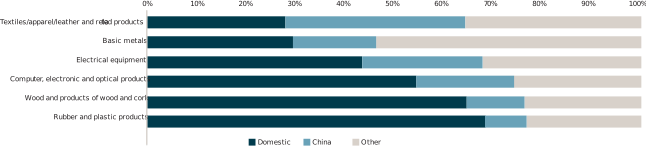
| Global Supply Chain Exposure: Whether directly or otherwise, industries and companies reliant on overseas supply chains are seeing materially higher costs and longer delays. Consumer goods companies especially, historically pursued global supply chains compared to other sectors. Pre-pandemic, this strategy drove enhanced margins while still enabling the rapid delivery of goods. Currently, both advantages have been blunted. However, as the wrinkles in the supply chain are solved, the globalization of the consumer goods economy will shift back to being an advantage. In response to the current upheaval, leading consumer businesses will seek to further diversify suppliers across multiple regions and perhaps even expand domestic sourcing. |
Figure 1. Many Consumer goods categories rely on numerous inputs sourced from overseas, illustrating how susceptible the retail economy is to shipping delays and cost increases.
Source: Bloomberg
| Elevated Demand: Through 2020 and 2021, consumer goods experienced increased demand, especially in the consumer electronics, home improvement and sporting goods categories. This is driven by high consumer household income as well as fewer opportunities for consumers to spend money in the entertainment and service sectors. Therefore, demand for consumer products has been rapidly increasing. While the elevated demand will relax broadly over time, winning companies and brands that have captured market share and are capitalizing on these gains will continue to benefit and further distance themselves from the competition. As the supply chain headwinds level off, these leading companies will emerge even better positioned than before. |
Figure 2. Consumers shifted spending away from services and towards consumer products during the pandemic
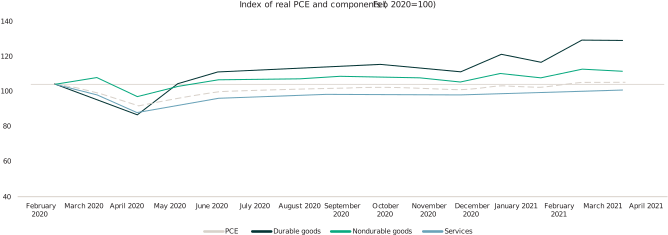
Note: The index is created from actual figures (seasonally adjusted annual rate) by rebasing February 2020 values to 100.
Sources: United States Department of Commerce (sourced through Haver Analytics); Deloitte Services LP economic analysis. Deloitte
While the consumer sector is broadly impacted by the supply chain disruptions, not all business models and products have been equally affected. In addition to variation within the globalization and demand drivers mentioned above, these key factors below also determine which companies are most vulnerable:
| Company Scale: On the procurement side, larger companies are better positioned to optimize shipping rates, while companies using fewer containers see less favorable rates. On the sales side, those businesses representing greater criticality to their customers (often related to scale, but not always) can pass through price increases more effectively. |
| Product Shipping Efficiency: Bulk products or those in non-standard dimensions are less efficiently shipped and, therefore experience a disproportionate impact from increased freight costs. This is especially true for lower priced, bulky items, whose shipping represents a larger portion of the total delivered cost of the product. |
| Complexity of Manufacturing: Items with longer production cycles or that involve many inputs have greater exposure to delays, a single delayed component can drastically extend production time. Furthermore, many companies accustomed to just-in-time inventory management are still catching up on demand needs and even once the elevated demand abates, the inventory will need time to catch up. |
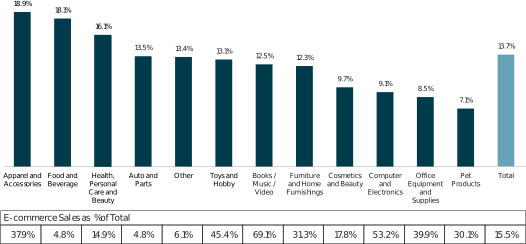
Spotlight: E-commerceCOVID-19 accelerated the volume shift from brick and mortar to e-commerce at levels not expected until after 2025, driving a digital boom for e-commerce platforms. Yet, the existing infrastructure supporting the e-commerce landscape was caught off guard and overburdened, resulting in short-term growing pains that are expected to dissipate as the underlying infrastructure catches up to the expected continued rapid growth of the channel. Despite the near-term disruption, the long-term shift to e-commerce will continue as consumers increasingly prefer to shop online. As the global supply chain returns to normal and the e-commerce infrastructure catches up to the growth of the channel, winners in the e-commerce space will benefit from the combination of 1) the permanent shift in consumer purchasing behavior favoring online shopping and 2) the catching up of technology, order fulfillment capabilities and logistics capacity requisite to match the demand. Contrary to fears of a “COVID-19 bump,” well-positioned players with differentiated e-commerce capabilities will continue to take market share from brick and mortar-focused companies. The below chart highlights the remarkable growth of e-commerce sales by product category in 2021 and e-commerce penetration rates for each. Those with high growth and low e-commerce penetration rates have significant opportunity for continued long-term category growth in e-commerce. |
Figure 3. COVID-19 rapidly accelerated e-commerce adoption across consumer product categories, especially in staple products
2021E U.S. retail e-commerce sales growth, by product category
Source: eMarketer
LINCOLN PERSPECTIVE
We believe the supply chain will stabilize in coming months. Following the high demand of the holiday season and the Chinese New Year, Lincoln will be watching for the supply chain to adjust and retool itself to support an environment of increased demand, which we anticipate will continue for many years. The impact of the Omicron variant is not yet known, but we remain optimistic with our view unchanged at this time.
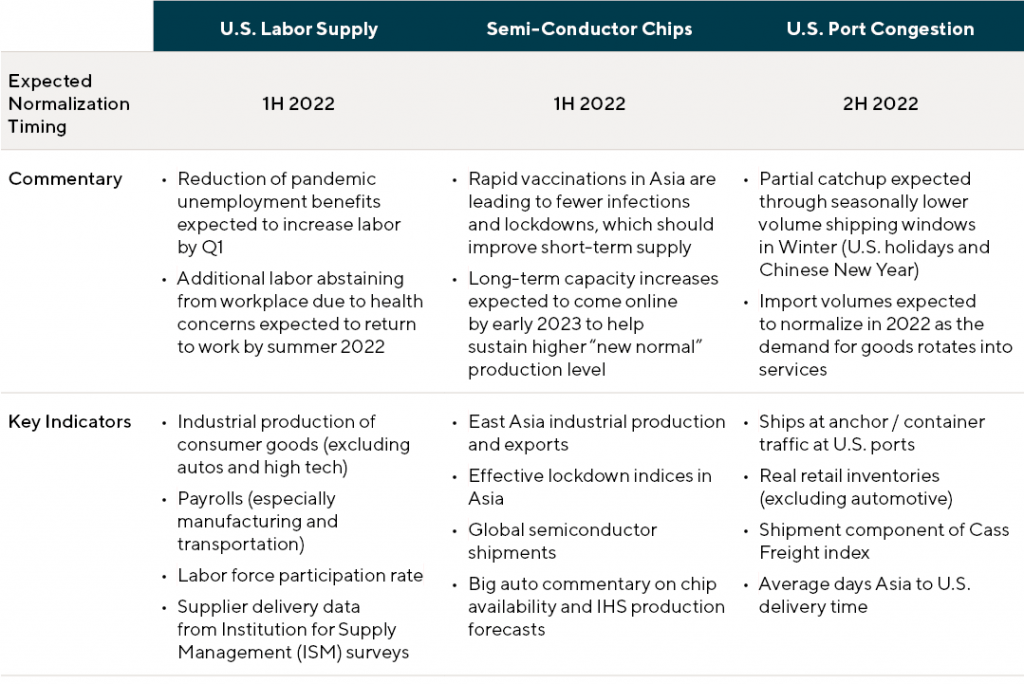
There remains significantly elevated demand in several consumer goods categories, but normalization is generally expected in 2022. Supply chains are expected to catchup to demand, as the elevated consumer demand for goods shifts back into services, with a nearly pre-COVID-19 balance of goods to services spend by late 2022, assuming the COVID-19 impact continues to normalize as anticipated. Additionally, given the accelerated consumer pivot to e-commerce due to the pandemic, supply chains will need to be built to support omnichannel models even more, given this growth leap in digital purchasing within the overall consumer spectrum.
While supply chain risk has impacted some sectors of the M&A markets in the very short term, the drivers for acquisition activity remain very strong. Sales synergies, vertical integration and allocation of private capital into the attractive consumer sector will continue for the long term and are expected to drive significant M&A activity in 2022.
Companies that favorably address the below points will be highly attractive in the 2022 M&A market:
Verify long-term consumer demand in the product category and the potential impact of pent-up, short-term demand. E-commerce-focused companies will be better able to establish this as there are many categories that remain underpenetrated in e-commerce. Growth driven by channel shift from B&M to e-commerce will likely compensate for any slowdown in overall product category sales.
Verify price increases have been implemented and are being accepted by the market. This will secure future margins and give future investors in a business confidence in a company’s ability to adapt to a changing supply chain environment. Identify and execute on near-term initiatives to mitigate or offset any expected long-term margin impact that cannot be passed through in price to customers.
Identify and execute on near-term initiatives to mitigate or offset any expected long-term margin impact that cannot be passed through in price to customers.
Clearly define the “moat” around any given business, such as brand, innovation, intellectual property, e-commerce expertise, superior supply chain or any combination of items. It is important for a buyer to have clarity around this so they know going into the investment the levers they can pull to thrive in the changing market.
Proactively address supply chain diligence as a top-of-mind priority with a focus on future risk management. Risk-based, “what-if” scenario analyses can be conducted to identify alternate suppliers, who could be called upon to provide any parts, materials, products or services that might be at risk.
Hire third-party advisors to thoroughly analyze and provide credibility to normalization of marketable EBITDA. Supply chain disruptions can impact performance and business plans, making a reliable purchase price calculation more difficult.
WHILE SUPPLY CHAIN RISK HAS IMPACTED SOME SECTORS OF THE M&A MARKETS IN THE SHORT TERM, THE DRIVERS FOR ACQUISITION ACTIVITY REMAIN VERY STRONG. SALES SYNERGIES, VERTICAL INTEGRATION AND ALLOCATION OF PRIVATE CAPITAL INTO THE ATTRACTIVE CONSUMER SECTOR WILL CONTINUE FOR THE LONG TERM AND ARE EXPECTED TO DRIVE SIGNIFICANT M&A |
Key Normalization Indicators to Watch8
1 Source: Bloomberg / RBC Capital Markets
2 Source: IHS Markit
3 Source: Goldman Sachs
4 Source: Adobe Digital Economy Index
5 Source: Goldman Sachs
6 Source: Hillebrand (How Covid created shipping’s container shortage – Investment Monitor)
7 Source: CBRE
8 Source: Goldman Sachs and Bloomberg
Contributors


Meet Professionals with Complementary Expertise








I design strategies and offer solutions that fit the unique ambitions of each client I serve.
Brian Little
Managing Director
Los Angeles


I empower my clients to achieve positive outcomes in the dynamic digital consumer landscape, leveraging deep sector expertise and a trusted, hands-on approach.
Monika Nickl
Managing Director & Co-Head of Consumer, Europe
Munich
Through honest advice, passionate client service and hands-on execution, I strive to deliver outlier results for my clients.
Christopher Petrossian
Managing Director & Co-Head of Consumer
Los AngelesRelated Perspectives
Recent Transactions









How the Asian Supply Chain is Impacting U.S. Businesses, and What That Means for M&A Activity
The COVID-19 crisis highlighted the fragility of supply chains in what has become a highly globalized and complex trade market. It exposed companies’ inability to adjust to demand and multi-faceted… Read More

Will Private Equity Activity in 2022 be as Robust as 2021?
Private equity (PE) has proven to be both stable and even resilient, despite economic uncertainty, as illustrated during the 2008 global financial crisis and the COVID-19 pandemic. During both events,… Read More

“Play On” – Investing in the Post-COVID-19 Pandemic Experience Economy
As we come to terms with the lasting impacts of the COVID-19 pandemic, it’s fair to say we have entered a new age in the consumer economy. While nearly all… Read More

Animal Health Players Pursue Vertical Integration as a Path to Growth
Animal health businesses that have established a strong presence within their area of expertise, may be considering where the next best path to growth lies. While cross-border expansion and consolidation… Read More

Investors Train Sights on Air Filtration Businesses
Emerging from the COVID-19 pandemic, people have a heightened level of focus on their health and wellness, specifically the air they breathe. While they were once concerned with air quality,… Read More

State of Dealmaking in India: Three Takeaways for Business Owners and Leaders
The Indian dealmaking landscape has made significant strides over the last 10 years. We have come far from 2011 when a total of $10 billion of private equity (PE) capital… Read More

From Corporate Social Responsibility to PE Impact Funds: Investor Interest in ESG and Sustainability Gains Pace
Institutional investors are increasingly accountable for how they deploy capital. More so than the widespread divestment from fossil fuels over the last decade, some capital allocators today are seeking to… Read More

Italy is Poised to Enter a Golden Era
Italy is Entering a Nuovo Rinascimento—a New Renaissance The first half of 2021 was defined by a morale-boosting Euro Cup win, record performance at the Olympic games and the start… Read More

Flavor and Fragrance Sector Continues to Blossom
Flavors and fragrances (F&F) underpin a wide variety of consumer and industrial purchasing decisions , despite the fact they frequently only contribute a small percentage of the overall cost of… Read More

Summer of Spending: Opportunity for Investors as UK Leisure Industry Rebounds
With the UK falling in and out of lockdown since March 2020, the Bank of England is anticipating the biggest surge in household spending since 1988 upon the planned reopening… Read More

E-commerce, Sustainability and Digital Capabilities Drive Consolidation
Following a rebound in the first half of 2021, the outlook for the economy remains positive for the second half of the year as vaccination rates continue to climb and… Read More

Ocean & Air Freight Prioritize Scale
The first half of 2021 has seen global economies re-emerge from the 2020 pandemic-induced slump. Whilst the U.S. recovery is ahead of Europe and parts of Asia, there is strong… Read More

Halftime Report: How Dealmakers Can Make the Most of H2 2021
As global economies reopen post-pandemic, the investing community is busier than ever. Looking ahead to the second half of 2021, this is a prime moment for deals to get done.… Read More

Race Toward Electrification: Automotive Players Define Investment Strategy for the Future
In 2020, global electric vehicle (EV) sales rose by 38%, despite a decline of 20% in total car sales around the world during the pandemic. In May 2021, IHS Markit… Read More

Our Economy Runs on Digital: Fueling Infrastructure Software Investment
As companies continue to move to the cloud and provide high-quality, global-scale cloud solutions, infrastructure software has seen a material increase in investment and consolidation, as evidenced by recent sponsor-led… Read More

Differentiated Pet Food Brands Fetch High Multiples: Guidance for Sector Entrepreneurs
For investors, the recession resilient nature of the pet sector and its strong performance through multiple economic cycles has long been notable. Most recently, the pandemic solidified the sector’s resilience… Read More

Cross-Border Deals: The Right Prescription for Animal Health
As the humanization of pets continues and pet lifespans grow longer, investment opportunities in animal health abound. While most animal health companies will first look for growth within their own… Read More

Pandemic Solidifies Investor Interest in Safety Products Businesses
From face masks to upgraded air filtration systems, employers implemented processes and protocols to keep employees safe throughout COVID-19. While demand for safety products skyrocketed during the peak of the… Read More

Dividend Recap Activity Reaches All-Time High
What drives this activity and what risks do boards face? As the initial economic fallout from COVID-19 dissipated towards the end of 2020, the drought of dividend recaps in 1H20… Read More

Fleet, Field and Asset Management Software: Convergence Creates Investment Opportunities
Maintaining equipment, vehicles and other assets while also optimizing performance of employees and the work they do is a daunting task for any organization. To address this challenge, both large… Read More
Whitepaper: 2021 Outlook for Value-Based Care and the Self-Insured Employer Marketplace
Numerous efforts to transition the U.S. healthcare system to a value-based care construct have been attempted during the past couple decades, including top-down initiatives such as accountable care organizations, with… Read More

Capital Requirements Drive Seismic Shifts in Auto Competitive Landscape
From the boardrooms of auto original equipment manufacturers (OEMs) and suppliers around the globe, the geographic landscape of the automotive industry is being continuously reshaped. Archnemeses are forming unlikely alliances.… Read More
Q&A with Lincoln TMT Managing Director Don More: Hacking Cybersecurity Investment
Lincoln International recently welcomed Don More as Managing Director focused on Cybersecurity on the Technology, Media & Telecom team. Don brings to Lincoln 20+ years of deal experience in cybersecurity,… Read More

Doing Well While Doing Good: Profiting from Non-Profit Tech
Non-profit organizations (NPOs) are increasingly adopting new technology solutions as they aim to provide efficient services, spawn innovation and attract the donations that are critical to their existence. The NPO… Read More

As the British Palate Diversifies, Investors Capitalize on South Asian Food Supplier Sector
While the UK’s grocery market has experienced little growth in recent years, the authentic South Asian cuisine market—offerings that incorporate ingredients, spices and food staples from India, Pakistan and Bangladesh—has… Read More