Q3 2025 Lincoln Senior Debt Index™
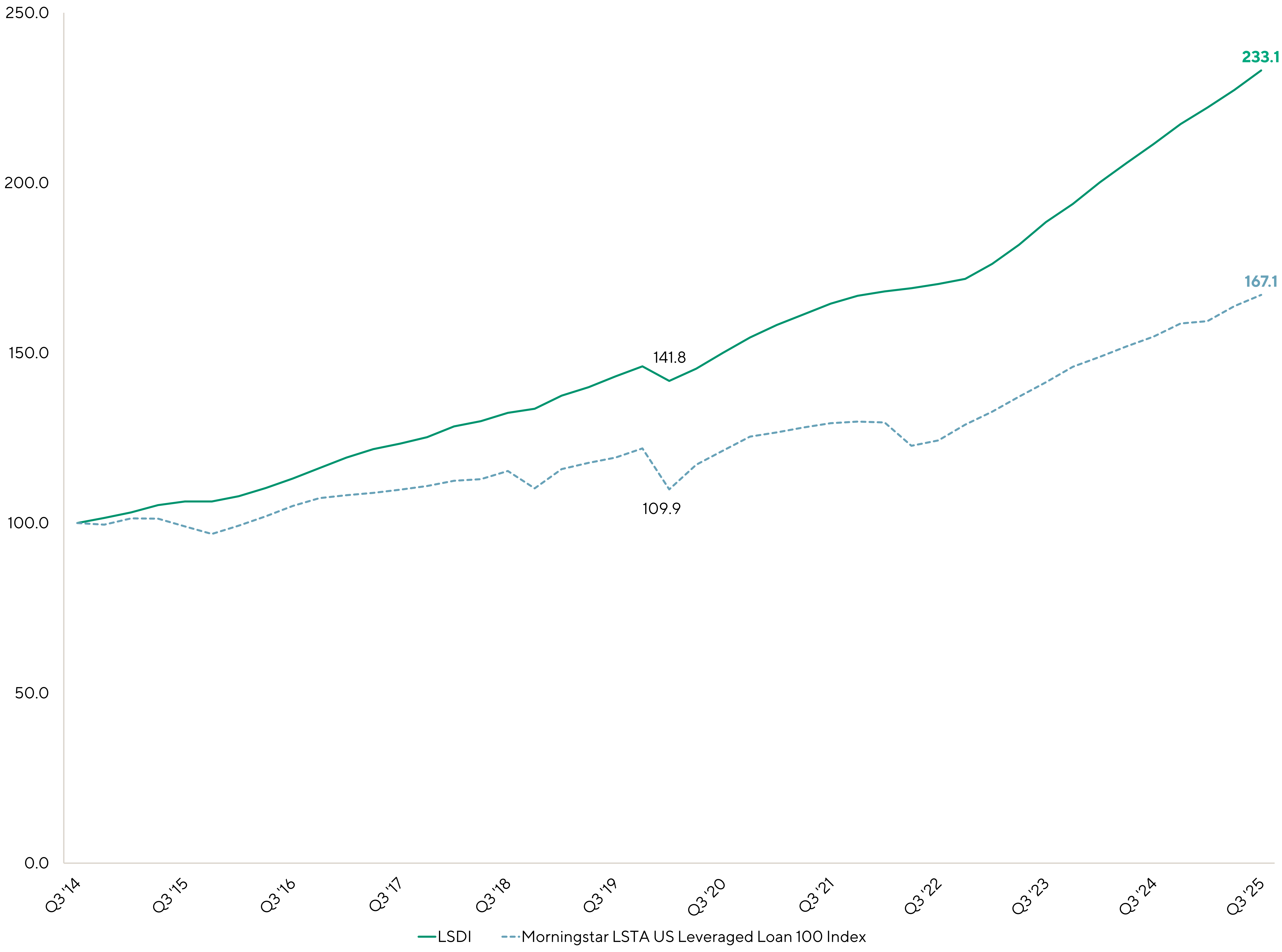
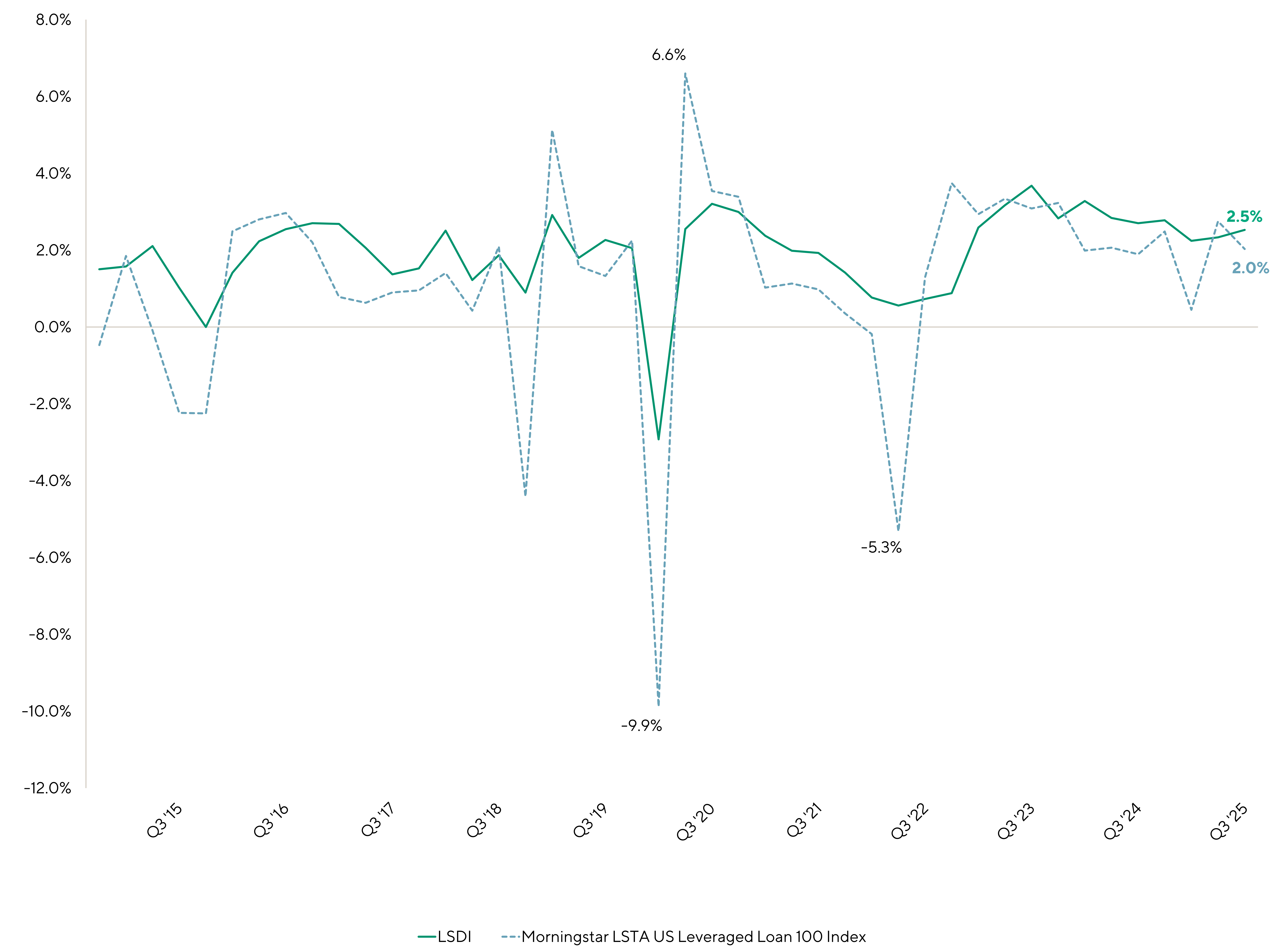
Lincoln International is pleased to release the Q3 2025 Lincoln U.S. Senior Debt Index (LSDI). The Lincoln U.S. Senior Debt Index represents years of research and analysis of data and was developed by professionals from Lincoln’s Valuations & Opinions Group in collaboration with Professor Pietro Veronesi of The University of Chicago Booth School of Business. In spite of several well-publicized bankruptcies, which we believe are due to idiosyncratic events combined with fraud and mismanagement, the LSDI continued to experience strong results. Post-Liberation Day volatility subsided, market conditions stabilized and both public and private debt markets rebounded. The LSDI reported its second highest price of fair value since inception in 2014, and quarterly return approximated 2.5%.
Enterprise value declines in the public markets that began in February and continued through April dramatically reversed and have since fully recovered. In mid-September, the Federal Reserve cut interest rates by 0.25%, providing relief to borrowers and contributing to SOFR rate declines. The yield on the LSDI ended the quarter at 9.56%, reflecting a 0.59% decrease compared to the prior quarter as spreads tightened and SOFR rates declined. Spreads were 6.17% over SOFR, or the lowest spread since inception of the LSDI, reflecting competitive market conditions. Heightened competition for transactions, combined with resilient portfolio company performance, resulted in an increase in the average fair value of loans in the LSDI from 98.90% to 99.13%, marking the second-highest fair value in LSDI history and highest since the first quarter of 2018, with quarterly returns equaling 2.5%. Covenant defaults declined quarter-over-quarter, going from 3.4% to 3.2%, but have increased by 1.0% year-over-year.
While results for the quarter were positive overall, the macroeconomic impact of higher tariffs has caused heightened global market volatility, and therefore the outlook going forward remains uncertain. Lincoln’s Valuations and Opinions Group has been monitoring recent events and their impact on the private markets in real time. We encourage readers to contact any Lincoln valuation professional for continued updates on the current state of the private markets.
Monthly Update – Months Ending October 30 and November 30, 2025
For the month ending October 30, 2025, the U.S. Lincoln Senior Debt Index declined 0.10% to 99.0 from a fair value of 99.1 as of September 30, 2025. The index declined an additional 0.10% to 98.9 for the month ending November 30, 2025. As a result, for the two months ending November 30, 2025, the U.S. Lincoln Senior Debt Index decreased from its September 30, 2025 value, but remained at its third highest fair value in history.
The LSDI provides insight into the direct lending market as it is a fair value index consisting of four components:
|
Each of the four components are then categorized into three types of senior loans:
|
-
Quarterly Overview
- IMPORTANT DISCLOSURE
- The LSDI provides insight into the direct lending market as it is a fair value index consisting of four components: 1. Total return (income return plus capital gain return); 2. Price (i.e., fair value); 3. Spread; and, 4. Yield to maturity.
- Each of the four components are then categorized into three types of senior loans: 1. All senior loans – consisting of first lien, Unitranche, and second lien loans; 2. Senior loans consisting of first lien and 3. Second lien loans.
- Click here to download a printable version of this report.
-
Q3 2025 Lincoln European Senior Debt Index
Comparison of U.S. and European Senior Debt Indices



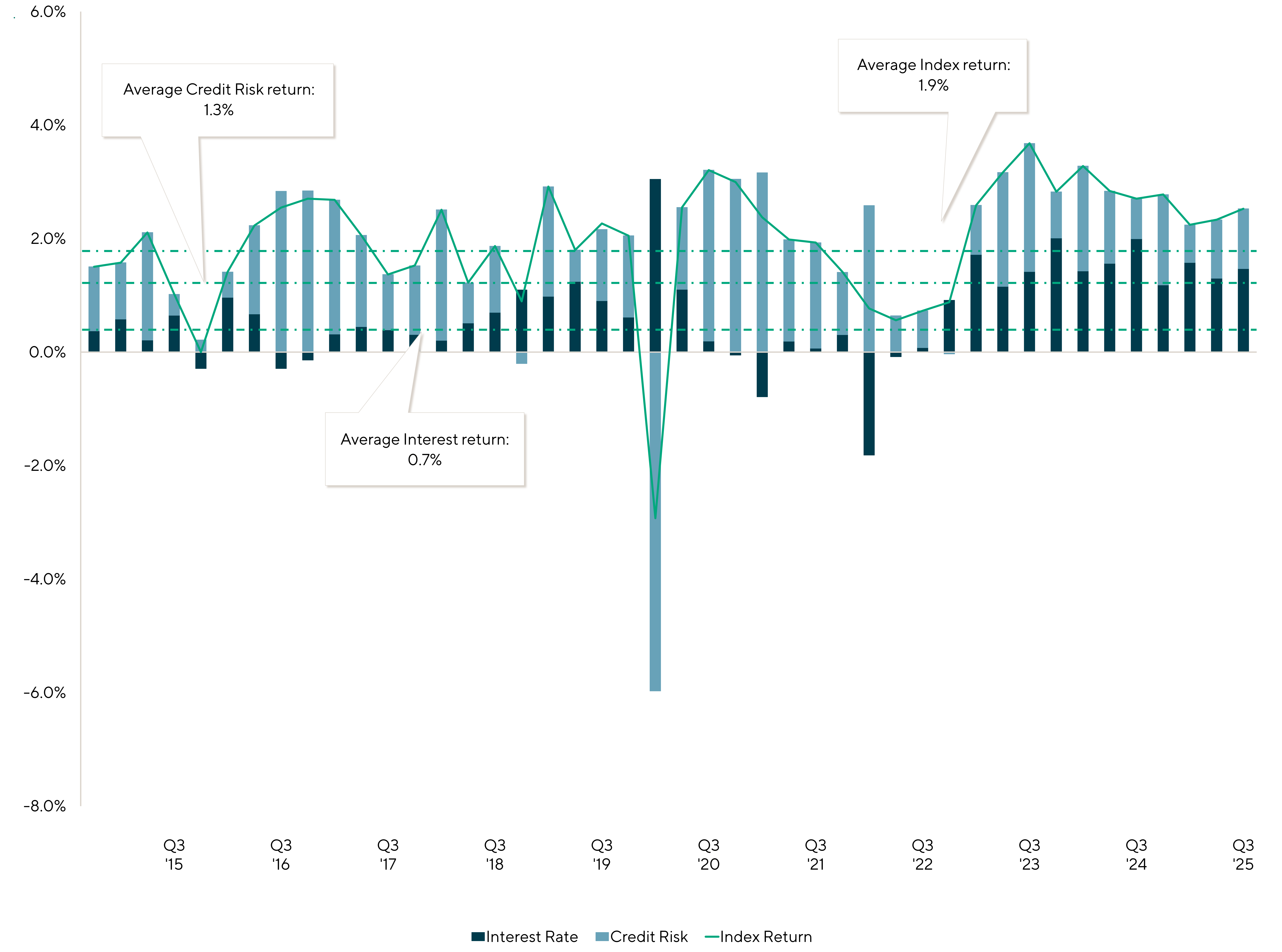
In addition, we provide additional descriptive statistics including: (a) loan-to-value; (b) the impact of interest rate (SOFR) and credit changes (spread) on total return; (c) default rates; and (d) historical yields by EBITDA size and by industry.
The U.S. non-investment grade corporate loan market has two segments: the broadly syndicated loan (BSL) market, which attracts investors investing in broadly syndicated deals, and the direct lending market, for investors investing in club deals. While correlated, there are subtle but significant differences between the two markets. Both markets primarily provide floating rate loans; however, divergences exist in terms of market liquidity, company size and credit facility size. Given the greater liquidity in the BSL market, pricing and terms are a function of the technical market and competitive factors, whereas the more illiquid direct lending market has a stronger orientation to assessing company fundamentals.
In contrast to the Morningstar LSTA U.S. Leveraged Loan 100 Index, which is comprised of companies borrowing in the BSL market, the constituents in the LSDI are virtually all companies borrowing in the direct lending market. The direct lending market is a significant source of capital to private equity-backed middle market companies. The Lincoln U.S. Senior Debt Index benefits market participants by providing information to facilitate a greater understanding of the attributes of this important source of capital to the private sector.
How We Obtain the Information
On a quarterly basis, Lincoln values more than 6,250 private companies primarily owned by 200+ alternative investment funds and lenders to funds. Most of these companies are levered via borrowings from the direct lending market. A significant percentage of the LSDI constituents are based upon valuations of loans provided for non-public business development companies and other private investment vehicles and, therefore, not disclosed in public filings.
For many of the private companies valued quarterly, Lincoln advises on the fair value of at least one senior debt security in the capital structure. All valuations conform with generally acceptable accounting principles and fair value principles and have been reviewed by fund management, fund boards, limited partners and auditors.
Additional information can be found in our methodology discussion and on our website.
| 99.1 |
| Average Fair Value of SDI for the Quarter Ending September 30, 2025 |
| 99.0 |
| Estimated Average Fair Value of SDI for the Month Ending October 30, 2025 |
| 98.9 |
| Estimated Average Fair Value of SDI for the Month Ending November 30, 2025 |
Results
Total Return
Comparison of Total Return – LSDI (All Loans) to Morningstar LSTA U.S. Leveraged Loan 100 Index
Correlation and Comparison of Quarterly Returns – LSDI (All Loans) to BSL Market
Yields
Comparison of Yields – LSDI (All Loans) to BSL Market
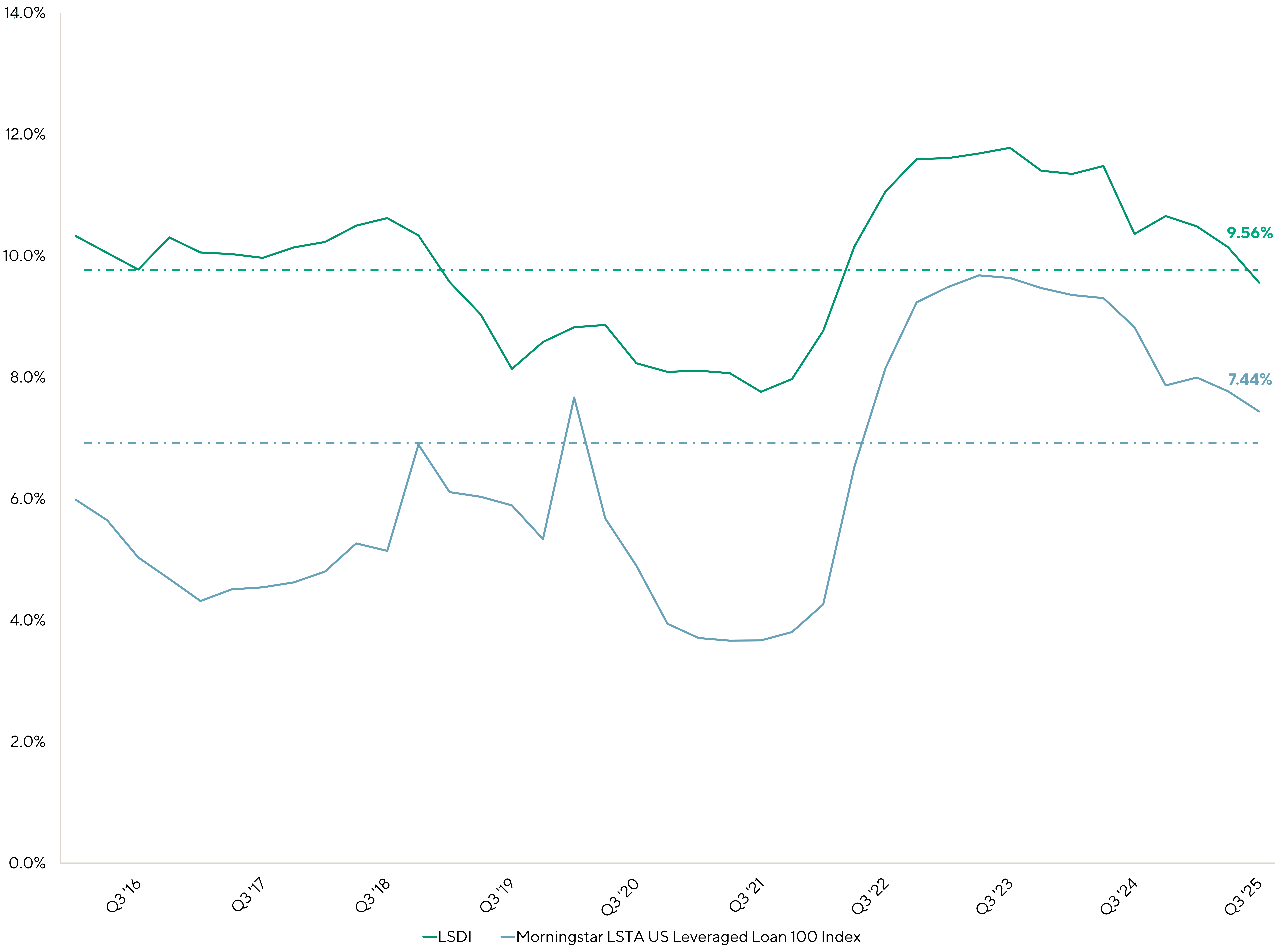
1. LIBOR/SOFR in the current analysis reflects the 4-year end of quarter swap rate.
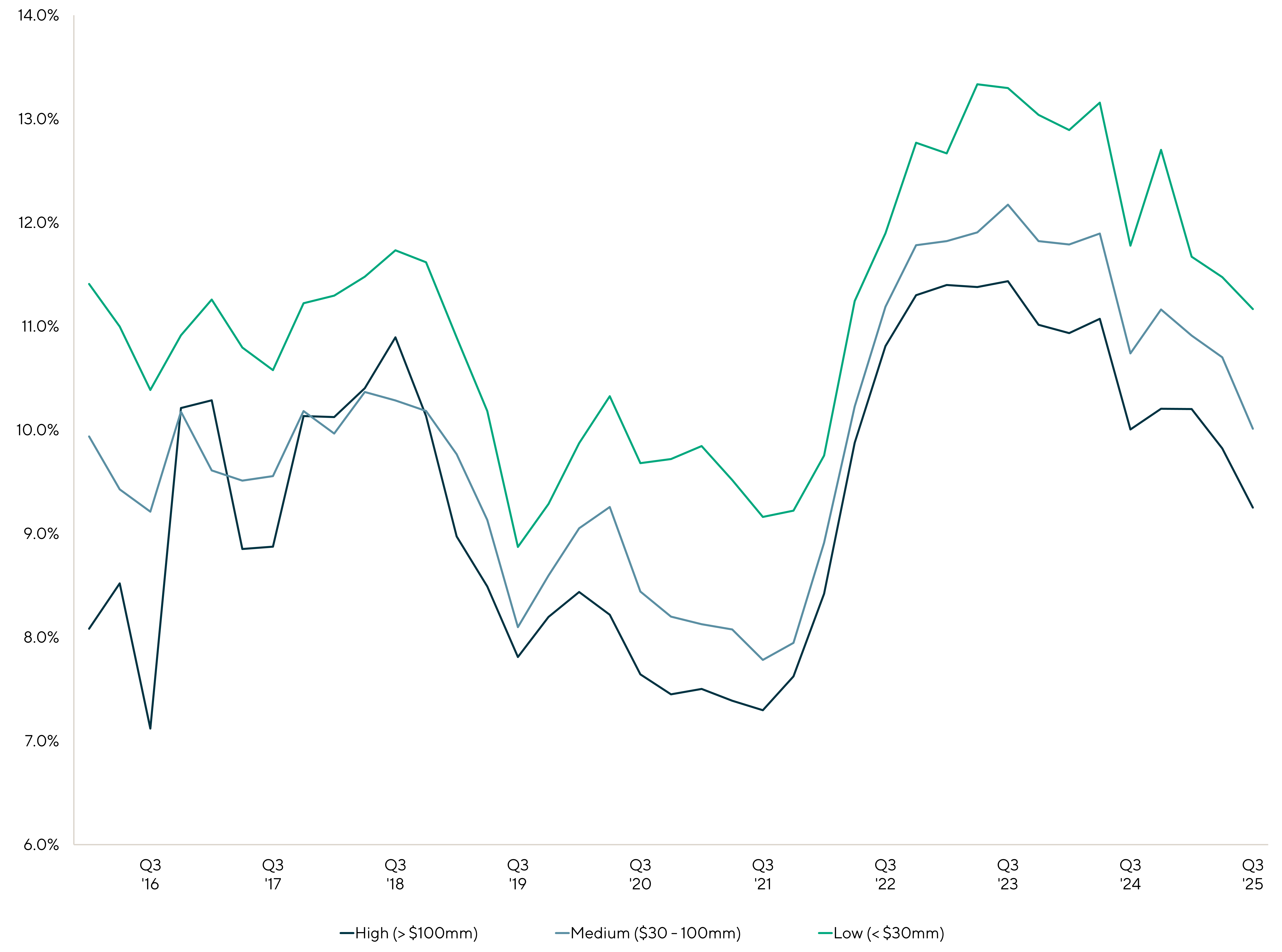
Comparison of Yields – LSDI (All Loans) by Size
Default Rates
Direct Lending Default Experience
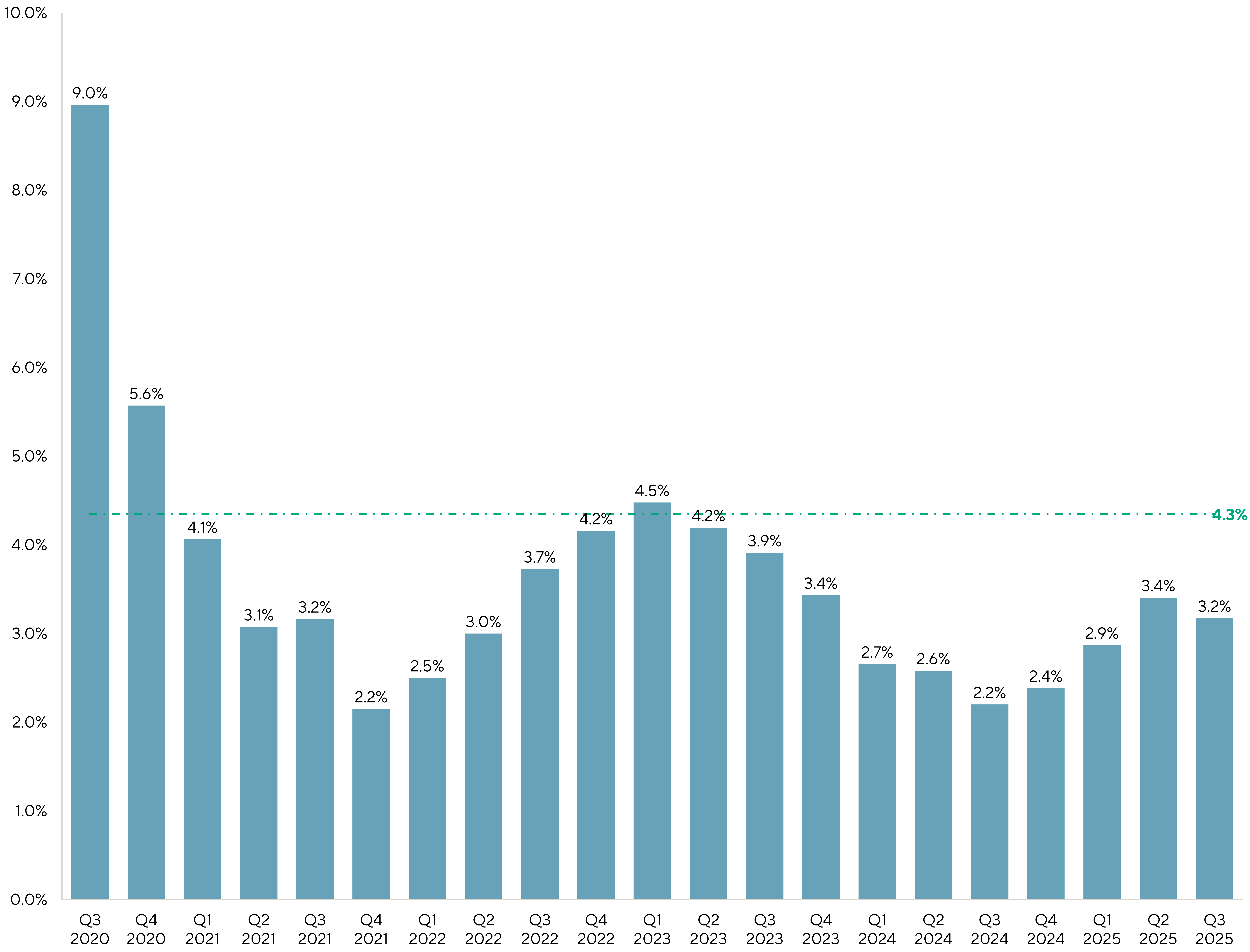
Note: Defaults defined as loan covenant defaults (not monetary defaults)
Decomposing Yields in the Direct Lending Market – LIBOR/ SOFR Floors and Spreads
Decomposing Yield – LIBOR, LIBOR / SOFR Floors and Spreads – All Loans
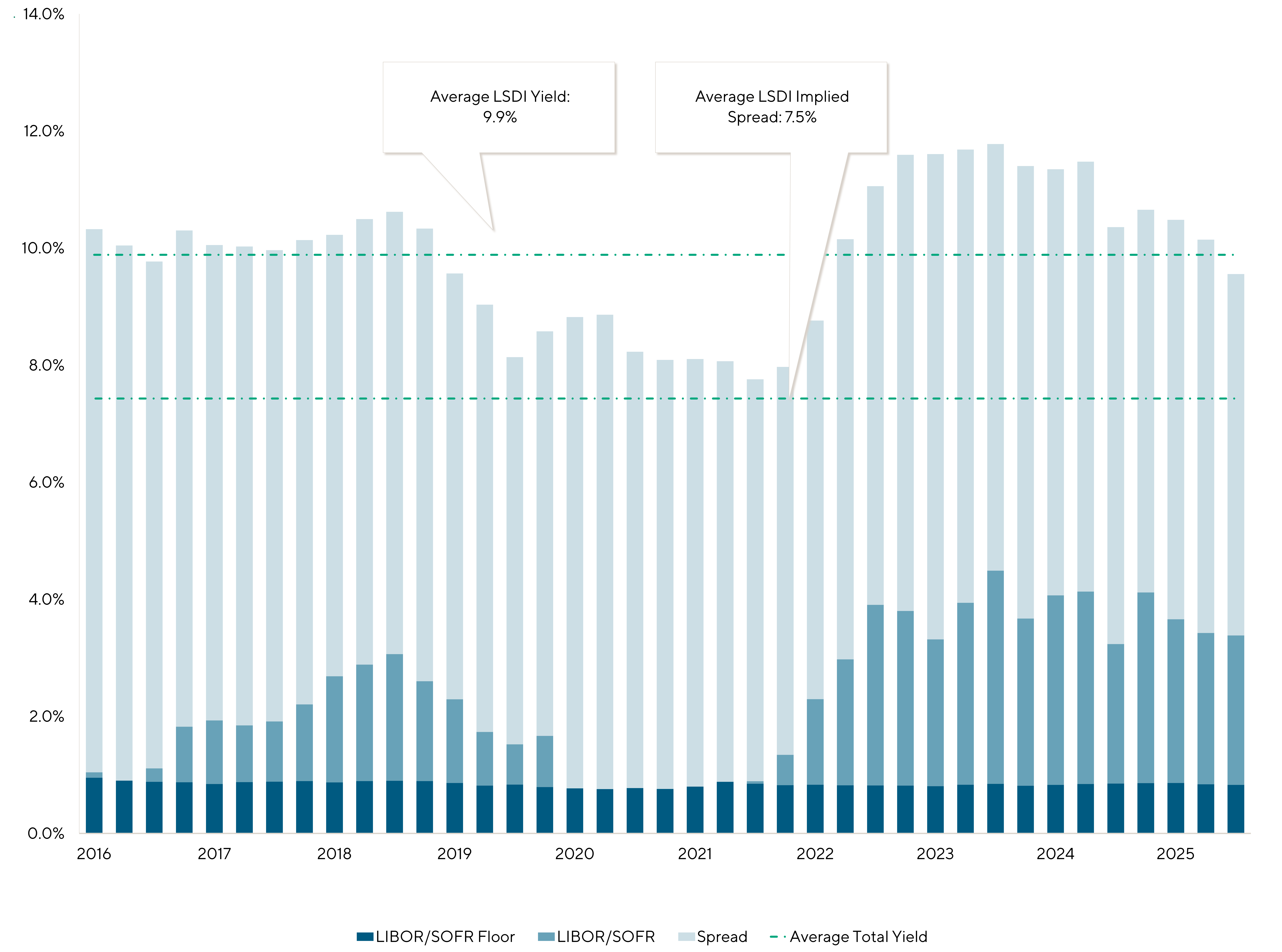
Note: LIBOR / SOFR Floor reflects fair value weighted average for each period while LIBOR / SOFR above reflects the extent to which LIBOR / SOFR is above the floor. LIBOR / SOFR in the current analysis reflects the 4-year end of quarter swap rate.
Fair Value – Price – Trends
Fair Value – Lincoln Senior Debt Index (All Loans) Compared to the S&P / LSTA U.S. Leveraged Loan Index
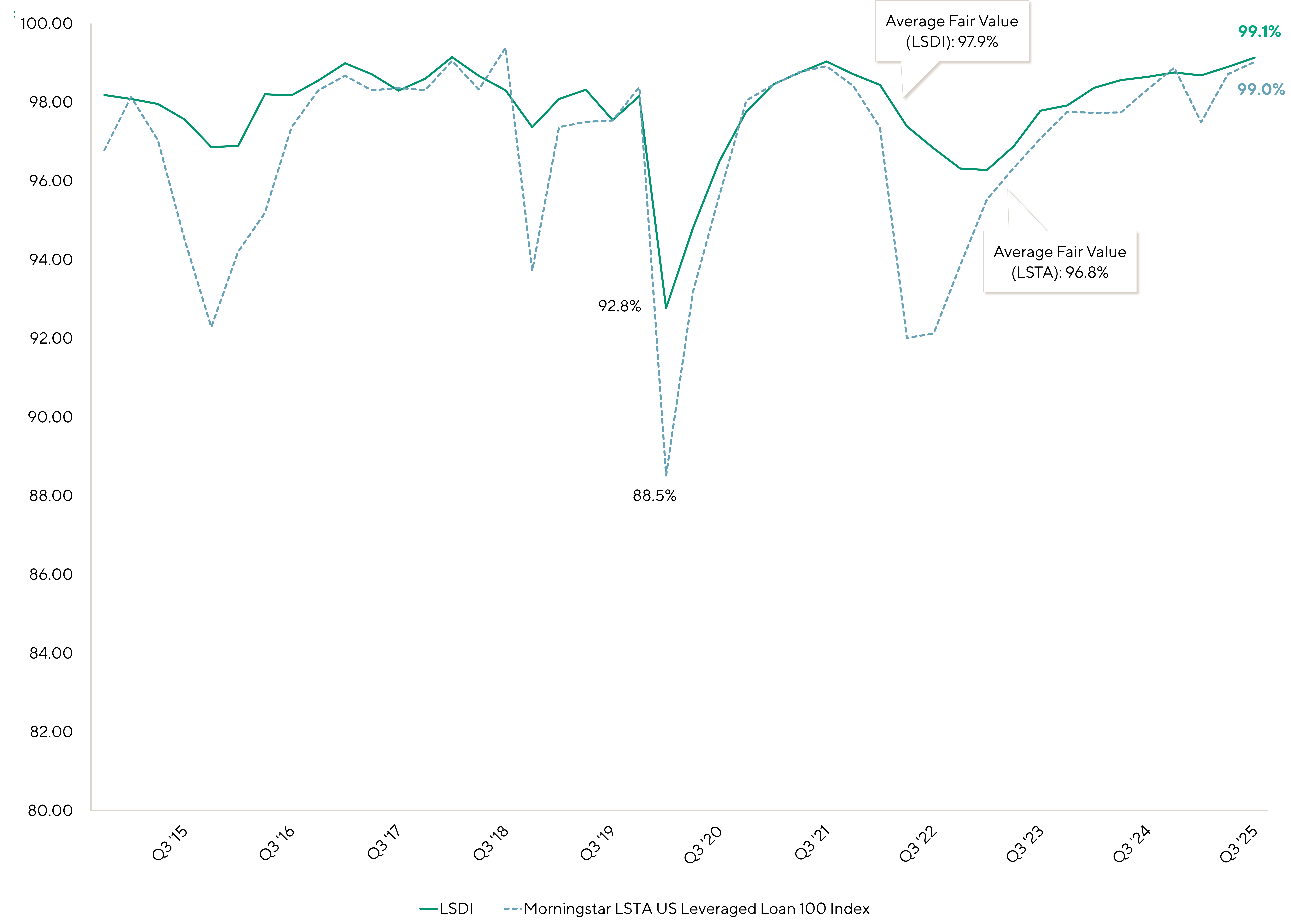
Note: Price based on fair value of the LSDI and average bid of the Morningstar LSTA U.S. Leveraged Loan Index
Bifurcation of the Impact on Total Return Due to Credit Risk and Interest Rate Risk
Decomposition of Index Returns: Interest Rate versus Credit Risk
Methodology
Source of Data and Sample Size
On a quarterly basis, Lincoln determines the enterprise fair value of over 6,250 portfolio companies for more than 225 private equity sponsors and lenders. These portfolio companies report quarterly financial results to the sponsor (i.e., private equity group) or lender. Lincoln obtains company and loan level information to create the Lincoln Senior Debt Index.
All information is prepared in accordance with the fair value measurement principles of generally accepted accounting principles. Finally, each valuation is then vetted by auditors, company management, boards of directors and regulators.
Additional information about the methodology of the LSDI can be found at: www.lincolninternational.com/perspectives/an-overview-of-the-lincoln-senior-debt-index.
Academic Advisor
Professor Pietro Veronesi is the Chicago Board of Trade Professor of Finance at the University of Chicago, Booth School of Business. He is also a research associate of the National Bureau of Economic Research and a research fellow of the Center for Economic and Policy Research.
Professor Veronesi’s research has appeared in numerous publications, including the Journal of Political Economy, American Economic Review, Quarterly Journal of Economics, Journal of Finance, Journal of Financial Economics and Review of Financial Studies. He is the recipient of several awards, including the 2015 AQR Insight award, the 2012 and 2003 Smith Breeden prizes from the Journal of Finance; the 2008 WFA award; the 2006 Barclays Global Investors Prize from the EFA; the 2006 Fama / DFA prizes from the Journal of Financial Economics and the 1999 Barclays Global Investors / Michael Brennan First Prize from the Review of Financial Studies. Professor Veronesi teaches both masters- and Ph.D.-level courses. He is the recipient of the 2009 McKinsey Award for Excellence in Teaching.
His undergraduate work was in economics at Bocconi University where he received a laurea magna cum laude with honor in 1992. He earned a master’s degree with distinction in 1993 from the London School of Economics. He joined the Chicago Booth faculty upon obtaining his Ph.D. in economics from Harvard University in 1997.
SummaryQ3 2025 Lincoln Senior Debt IndexFrom 2014 through September 30, 2025, a portfolio of direct lending loans has yielded higher returns and lower volatility relative to broadly syndicated loans. The Lincoln U.S. Senior Debt Index provides market participants many unique valuation insights into the fair value of direct lending loans and represents a significant enhancement to the information available within an opaque market. |
IMPORTANT DISCLOSURE: The Lincoln Senior Debt Index is an informational indicator only, and does not constitute investment advice or an offer to sell or a solicitation to buy any security. It is not possible to directly invest in the Lincoln Senior Debt Index. Some of the statements above contain opinions based upon certain assumptions regarding the data used to create the Lincoln Senior Debt Index, and these opinions and assumptions may prove incorrect. Actual results could vary materially from those implied or expressed in such statements for any reason. The Lincoln Senior Debt Index has been created on the basis of information provided by third-party sources that are believed to be reliable, but Lincoln International has not conducted an independent verification of such information. Lincoln International makes no warranty or representation as to the accuracy or completeness of such third-party information.
The LSDI should not be construed as an offer to sell or buy, or a solicitation to sell or buy, any products linked to the performance of the LSDI. The use of the LSDI in any manner, including for benchmarking purposes, is not endorsed or recommended by Lincoln International and Lincoln International is not responsible for any use made of the LSDI. Lincoln International does not guarantee the accuracy and/or completeness of the LSDI and Lincoln International shall not have any liability for any errors or omissions therein. None of Lincoln International, any of its affiliates or subsidiaries, nor any of its directors, officers, employees, representatives, delegates or agents shall have any responsibility to any person (whether as a result of negligence or otherwise) for any determination made or anything done (or omitted to be determined or done) in respect of the LSDI and any use to which any person may put the LSDI. Lincoln International has no obligation to update the LSDI and has no obligation to investors with respect to any product based on the performance of the LSDI. Any investment in such a product will not acquire an interest in the LSDI. Lincoln International is not an investment adviser and will not provide any financial advice relating to a product linked to the performance of the LSDI. Investors should read any such product offering documentation and consult with their own legal, financial and tax advisors before investing in any such product.
© 2024 Lincoln Partners Advisors LLC. All rights reserved. LINCOLN SENIOR DEBT INDEX and LINCOLN INTERNATIONAL are service marks owned by Lincoln Partners Advisors LLC and its affiliated entities. Any use of these service marks and these materials, including the reproduction, modification, distribution or republication of these materials, without the prior written consent of Lincoln International, is strictly prohibited.
Contributors




I find immense fulfillment in enabling clients to achieve their objectives and navigate the complexities of today's ever-changing landscape.
Chris Croft
Managing Director & Co-Head of Transaction Opinions
New York

I enjoy sharing private capital market insights and valuation trends with my clients, while also leading a differentiated and high-touch process.
Brian Garfield
Managing Director & Global Head of Portfolio Valuations
New York

I enhance my clients’ decision making and governance processes by providing independent and objective financial advice in a highly responsive manner.
Chris Gregory
Managing Director & Co-Head of Transaction Opinions
New York



I enjoy the opportunity to provide clients with insightful and unbiased advice that will help them make the most informed decisions possible.
Ron Kahn
Managing Director & Global Co-Head of Valuations & Opinions
Chicago