
Publications
Private market growth outpaced the public markets due to steadier performance amidst challenging macro-conditions
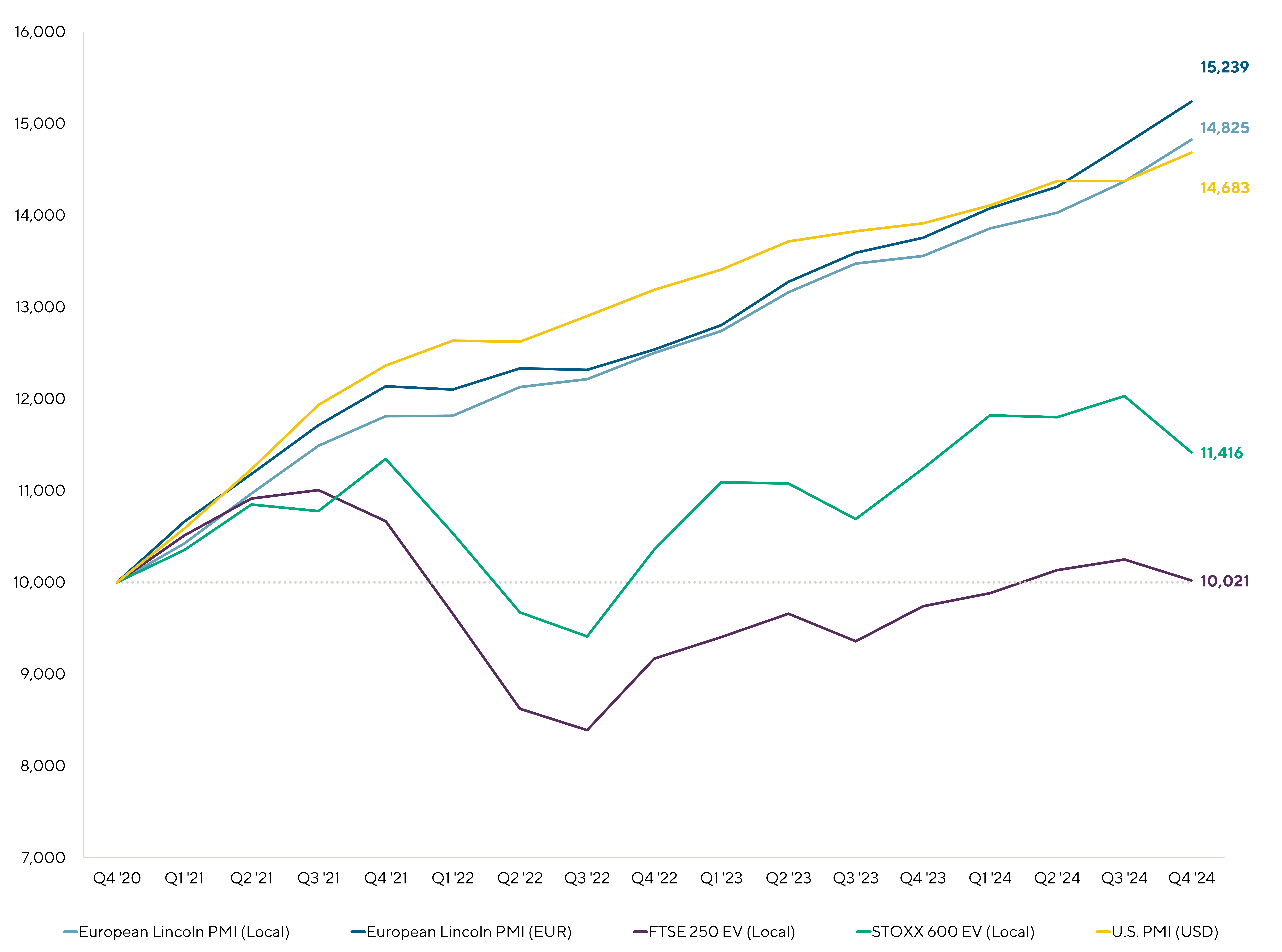
(NOTE: The Lincoln PMI, STOXX 600, and FTSE 250 EV returns above reflect enterprise values)
(Index EVs exclude financial institutions and real estate for which enterprise value is generally not meaningful; however, including such companies produces similar results)
| Index | Q4 ’24 | 2024 | CAGR since Inception |
| European Lincoln PMI (Local) | 3.2% | 9.4% | 10.3% |
| European Lincoln PMI (EUR) | 3.2% | 10.8% | 11.1% |
| FTSE 250 EV (Local) | (2.2%) | 2.9% | 0.1% |
| STOXX 600 EV (Local) | (5.1%) | 1.6% | 3.4% |
| US Lincoln PMI | 2.2% | 5.5% | 10.1% |
European Lincoln PMI by sector
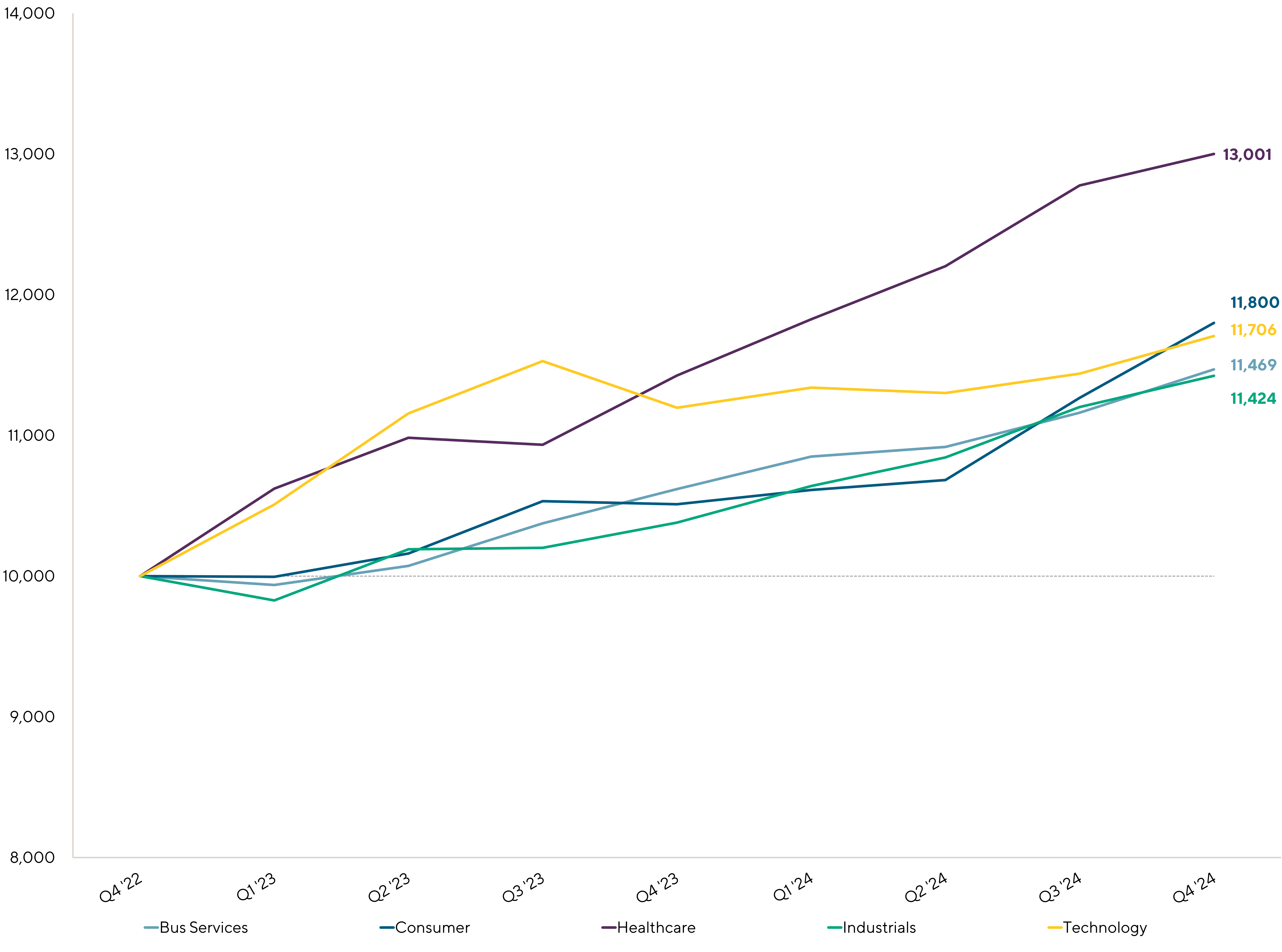
| Industry | Q4’24 | 2024 | Since Q4 2022 |
| Business Services | 2.8% | 8.0% | 14.7% |
| Consumer | 4.7% | 12.3% | 18.0% |
| Healthcare | 1.8% | 13.8% | 30.0% |
| Industrials | 2.0% | 10.0% | 14.2% |
| Technology | 2.3% | 4.5% | 17.1% |
| European Lincoln PMI (Local) | 3.2% | 9.4% | 18.6% |
Examining the Lincoln PMI
EBITDA Multiples versus Earnings
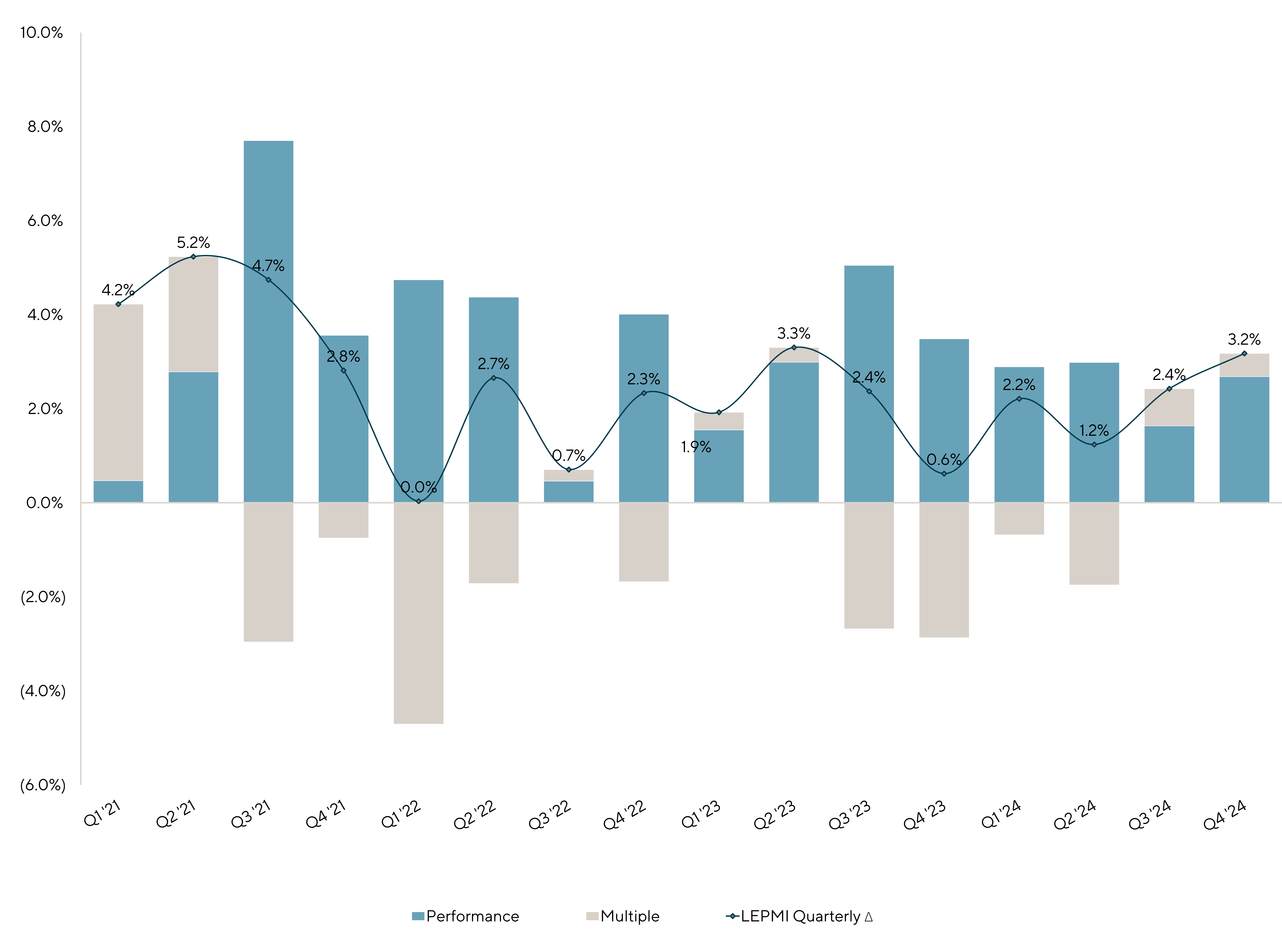
The gray line in Graph 3 indicates the quarterly change in PMI EVs; this change is based on changes in performance (i.e., EBITDA) combined with the change in EBITDA multiples. Private market EV growth has been driven by financial performance in almost every quarter since inception, demonstrating how private market EV performance is closely tied to fundamentals rather than multiples expansion. Richard commented, “The strong underlying fundamental performance observed in our index in 2024 and before indicates a solid foundation for the continued growth of European sponsor-backed companies in 2025, especially as deal volumes and exits begin to pick up.”
Ron Kahn, co-head of Lincoln’s global Valuations and Opinions Group, said, “Over the last seven years, our various private market indices have increased in value to our clients, asset managers, investment research firms and the media who cover the private markets. We are thrilled to now be able to bring further proprietary insights on private company performance with the launch of our European Lincoln Private Market Index.”


(Ron Kahn and Steve Kaplan)
Steve Kaplan, Neubauer Distinguished Service Professor of Entrepreneurship and Finance at the University of Chicago Booth School of Business added, “Private companies in Europe have demonstrated robust financial performance for many quarters, and Lincoln’s new European index provides the data to illustrate the point. It will be a useful tool for the market in understanding private market performance relative to the public markets and for stakeholders to assess the performance of their own portfolio companies.”
Summary
In Summary, we believe the Lincoln PMI
|
Academic Advisors
Professor Steven Kaplan
Professor Steven Kaplan is a Senior Advisor to Lincoln’s Valuations and Opinions Group. He is the Neubauer Family Distinguished Service Professor of Entrepreneurship and Finance and Kessenich E.P. Faculty Director at the Polsky Center for Entrepreneurship and Innovation at the University of Chicago Booth School of Business. Among other courses, Professor Kaplan teaches advanced Master of Business Administration and executive courses in entrepreneurial finance and private equity, corporate finance, corporate governance and wealth management. Professor Kaplan conducts research on a wide array of issues in private equity, venture capital, corporate governance, boards of directors, mergers and acquisitions and corporate finance. He has been a member of the Chicago Booth faculty since 1988.
Professor Kaplan serves on the board of Morningstar and several fund and company advisory boards. He is also a Research Associate at the National Bureau of Economic Research.
Professor Kaplan received a Bachelor of Arts, summa cum laude, in applied mathematics and economics from Harvard College and earned a Doctor of Philosophy in business economics from Harvard University.
Professor Michael Minnis
Professor Michael Minnis is a Senior Advisor to Lincoln’s Valuations and Opinions Group. He is the Deputy Dean for Faculty and Fuji Bank and Heller Professor of Accounting at the University of Chicago Booth School of Business, where he researches the role of accounting information in allocating investment efficiently by both managers and capital providers. His recent research focuses on understanding the role of privately held companies in the U.S. economy and how these firms use financial reporting to access, deploy and manage capital. He particularly enjoys identifying unique data and methods to empirically examine issues in a novel way.
In January 2018, Professor Minnis became a member of the Private Company Council, the primary advisory council to the Financial Accounting Standards Board (FASB) on private company issues. Professor Minnis received his Ph.D. from the University of Michigan and his B.S. from the University of Illinois, where he graduated with Highest Honors.
Methodology
The index is calculated using anonymized data on an aggregated basis by Lincoln’s Valuations & Opinions Group, which has unique insights into the financial performance of thousands of portfolio investments across a variety of investment vehicles, including private equity and private debt funds. All figures are quoted in and based on calculations in local currencies; however, Lincoln also prepares the index on a single-currency basis to account for FX impacts. Lincoln applied the same methodology to public indices to allow a like-for-like EV comparison between the index, the FTSE 250, and the STOXX 600.
Meet Our Senior Team












Related Perspectives
IMPORTANT DISCLOSURE: The Lincoln Private Market Index is an informational indicator only, and does not constitute investment advice or an offer to sell or a solicitation to buy any security. It is not possible to directly invest in the Lincoln Private Market Index. Some of the statements above contain opinions based upon certain assumptions regarding the data used to create the Lincoln Private Market Index, and these opinions and assumptions may prove incorrect. Actual results could vary materially from those implied or expressed in such statements for any reason. The Lincoln Private Market Index has been created on the basis of information provided by third-party sources that are believed to be reliable, but Lincoln International has not conducted an independent verification of such information. Lincoln International makes no warranty or representation as to the accuracy or completeness of such third-party information.
The LPMI should not be construed as an offer to sell or buy, or a solicitation to sell or buy, any products linked to the performance of the LPMI. The use of the LPMI in any manner, including for benchmarking purposes, is not endorsed or recommended by Lincoln International and Lincoln International is not responsible for any use made of the LPMI. Lincoln International does not guarantee the accuracy and/or completeness of the LPMI and Lincoln International shall not have any liability for any errors or omissions therein. None of Lincoln International, any of its affiliates or subsidiaries, nor any of its directors, officers, employees, representatives, delegates or agents shall have any responsibility to any person (whether as a result of negligence or otherwise) for any determination made or anything done (or omitted to be determined or done) in respect of the LPMI and any use to which any person may put the LPMI. Lincoln International has no obligation to update the LPMI and has no obligation to investors with respect to any product based on the performance of the LPMI. Any investment in such a product will not acquire an interest in the LPMI. Lincoln International is not an investment adviser and will not provide any financial advice relating to a product linked to the performance of the LPMI. Investors should read any such product offering documentation and consult with their own legal, financial and tax advisors before investing in any such product.
© 2024 Lincoln Partners Advisors LLC. All rights reserved. LINCOLN PRIVATE MARKET INDEX and LINCOLN INTERNATIONAL are service marks owned by Lincoln Partners Advisors LLC and its affiliated entities. Any use of these service marks and these materials, including the reproduction, modification, distribution or republication of these materials, without the prior written consent of Lincoln International, is strictly prohibited.
Q4 2024 European Lincoln Private Market Index
Europe’s Private Companies Significantly Outperformed Public Ones over Last Four Years, According to New Index from Lincoln International The European Lincoln Private Market Index (PMI) is the only index which… Read More about Q4 2024 European Lincoln Private Market Index

EMS Quarterly Review Q4 2024
In Q4 2024, the EMS industry concluded the year with steady momentum, underscoring its adaptability in navigating persistent global challenges. Normalized inventories, improved supply chain reliability and targeted investments in… Read More about EMS Quarterly Review Q4 2024
Q4 2024 Lincoln Private Market Index
Modest Growth Appears In Lincoln’s Private Market Index – Yet Cracks Are Emerging The Lincoln Private Market Index (LPMI), the only index that tracks changes in the enterprise value of… Read More about Q4 2024 Lincoln Private Market Index

Packaging Quarterly Review Q4 2024
2024 was another somber year in packaging M&A activity, shaped by the lingering effects of 2023 destocking trends, economic uncertainty and evolving industry dynamics. This mirrored the broader M&A market,… Read More about Packaging Quarterly Review Q4 2024

Facilities Services Market Update Q4 2024
The M&A market ended 2024 with increasing activity, continuing the growing momentum we have seen since a series of declining quarters in 2022 and 2023. According to S&P Global, there… Read More about Facilities Services Market Update Q4 2024

Human Capital Services Market Update Q3 2024
In Q-3 2024, M&A buyers were anticipating the coming inflection point in rates as M&A volume in the Human Capital Services spaces covered by Lincoln actually increased by nearly 7%… Read More about Human Capital Services Market Update Q3 2024

Automotive Aftermarket Intelligence Report Q4 2024
With significant declines in used car prices impacting the actual cash value (ACV) of the vehicle, insurers have increased the amount of total losses.

Chemicals Quarterly Review Q3 2024
The need for continued innovation and macro tailwinds make the agrochemicals segment an attractive one for private capital. Continued shifts from the majors creates opportunities in terms of dislocation and… Read More about Chemicals Quarterly Review Q3 2024

Fashion & Apparel Market Update Q3 2024
This comprehensive report highlights key trends such as the rise of the resale market, increased competition in active lifestyle apparel, and the growing importance of shoppable content. Additionally, it provides… Read More about Fashion & Apparel Market Update Q3 2024
Industrial Software: Spotlight on Engineering, Design & Manufacturing Software – Fall 2024 Report
Industrial Software continues to be an incredibly compelling area for investment and M&A among key investors and strategics. Learn more about our views in the space in our Fall 2024… Read More about Industrial Software: Spotlight on Engineering, Design & Manufacturing Software – Fall 2024 Report
Q3 2024 Lincoln Private Market Index
Lincoln Private Market Index Clocks In Another Quarter Of Growth In Q3 On The Back Of Steady Earnings Performance The Lincoln Private Market Index (LPMI), the only index that tracks… Read More about Q3 2024 Lincoln Private Market Index

Food & Beverage Market Update Q3 2024
Looking back at the third quarter, middle market deal flow remained mixed, with a slight uptick in September activity. However, there was no large wave of post Labor Day deal… Read More about Food & Beverage Market Update Q3 2024

EMS Quarterly Review Q3 2024
In Q3 2024, the EMS industry exhibited normalization of inventories, consistent improvement in technology and an uptick in market demand, all of which underscore emerging market optimism. In all, Q3… Read More about EMS Quarterly Review Q3 2024

Cybersecurity Report: Q3 2024
Q3 2024 continued to see the strengthening of the cybersecurity M&A market observed in the first half of the year, led by the highest quarterly number of M&A transactions in… Read More about Cybersecurity Report: Q3 2024

Facilities Services Market Update Q3 2024
After a series of declining quarters since 2021, Q3 2024 marks the fourth consecutive quarter of M&A activity growth, with ~7,700 deals closed, according to S&P Global. This represents an… Read More about Facilities Services Market Update Q3 2024

Packaging Quarterly Review Q3 2024
Foodservice packaging has evolved in recent years to align with consumer preferences while maintaining sustainability throughout the manufacturing process. Consumer preferences have gravitated toward food packaging that reduces the risk… Read More about Packaging Quarterly Review Q3 2024

Information Technology Services Mid-Year 2024 Report
For the first half of 2024, the number of M&A transactions in the global IT Services sector totaled 581, compared to 594 in H2 2023, representing a slight decline of… Read More about Information Technology Services Mid-Year 2024 Report

Chemicals Quarterly Review Q2 2024
The level of fragmentation in the Building & Infrastructure chemicals market and diverse sub-sub-sectors provides ample opportunity for value creation. By certain estimates, the top 30 players in the construction… Read More about Chemicals Quarterly Review Q2 2024

Food & Beverage Market Update Q2 2024
Lincoln International is pleased to release its Q2 2024 Food and Beverage Quarterly Review. Looking back at the second quarter, middle market deal flow saw a steady uptick in April… Read More about Food & Beverage Market Update Q2 2024
Q2 2024 Lincoln Private Market Index
While the Lincoln Private Market Index Increased in the Second Quarter, Private Company Earnings Growth Slowed The Lincoln Private Market Index (LPMI), the only index that tracks changes in the… Read More about Q2 2024 Lincoln Private Market Index

EMS Quarterly Review Q2 2024
In Q2 2024, the EMS industry continued to build sector momentum by maintaining a margins-focused strategy. The normalization of inventories, consistent improvement in technology and uptick in market demand underscores… Read More about EMS Quarterly Review Q2 2024

Cybersecurity Report: Q2 2024
Beset by escalating geopolitical tensions and high interest rates, 2023 saw significant declines in cybersecurity sector deal volume. However, the first half of 2024 has shown a significant turnaround, with… Read More about Cybersecurity Report: Q2 2024

Packaging Quarterly Review Q2 2024
Over the last several years, the packaging industry has undergone significant transformations driven by rapid advancements in technology. From the introduction of innovative materials and sustainable practices to automation and… Read More about Packaging Quarterly Review Q2 2024

Facilities Services Market Update Q2 2024
After a series of declining quarters since 2021, Q2 2024 marks the third consecutive quarter of mergers and acquisitions (M&A) activity growth, with ~7,300 deals closed, according to S&P Global.… Read More about Facilities Services Market Update Q2 2024

Distribution Quarterly Review Q1 2024
Public equities in Q1 2024 continued the positive momentum of Q4 2023, accelerated by impressive earnings releases particularly from the technology and energy sectors that benefited from strong artificial intelligence… Read More about Distribution Quarterly Review Q1 2024