
Q1 2026 European Lincoln Private Market Index™
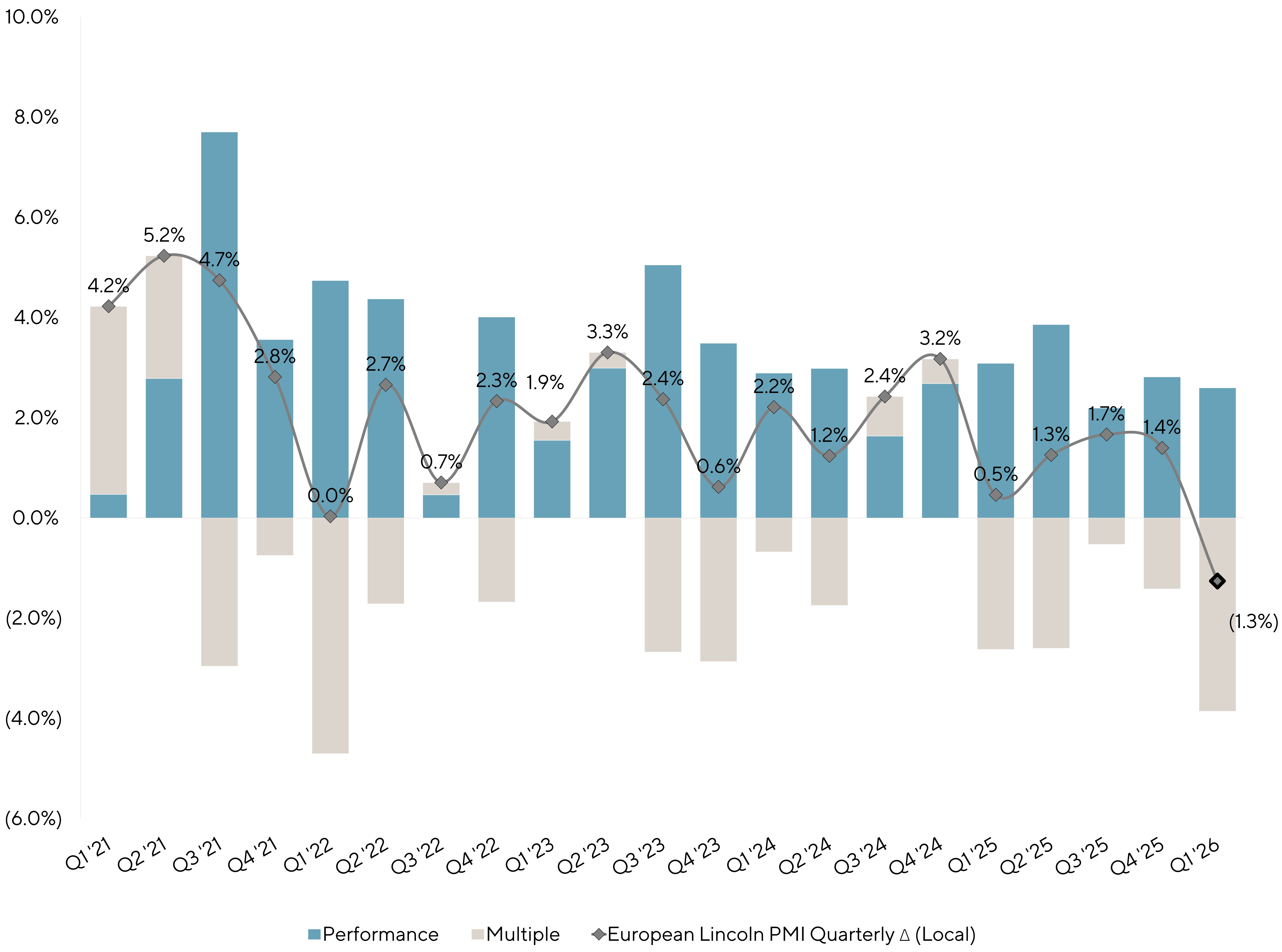
European Lincoln PMI Declines in Q1 But Outperforms Public Markets Amid The Software-Driven Sell-OffThe European Lincoln Private Market Index (PMI) is the index that tracks changes in the enterprise value (EV) of Europe’s privately held companies. Starting at a value of 10,000 as of December 31, 2020, the PMI grew to 15,350, though declined 1.3% in Q1 2026. This marked the first quarterly decline since inception, as multiple contraction more than offset earnings growth following the recent public market software sell-off. About the European Lincoln PMIThe European Lincoln PMI is a index measuring changes in the EVs of European private companies over time and a barometer of private company performance. The PMI enables private equity firms and other investors to benchmark how private company investments are performing against peers and how this performance compares to the STOXX 600 and FTSE 250 public indices. To review the results of an independent study on the quality and breadth of Lincoln’s private market database, click here. |
Summary
-
Quarterly Overview
- IMPORTANT DISCLOSURE
- 6th Edition: Covers Q1 2026
- Measures quarterly changes in the enterprise values of more than 300 European private companies with a median EBITDA of ~€38 million.
- Analyzes the impact of earnings and multiples on the index’s performance.
- Assesses the change in value for five broad industries.
- Click here to download a printable version of this report.


Results
European Lincoln PMI Decreased for the First Time since Inception, Declining -1.3% Despite Continued Positive Earnings Growth
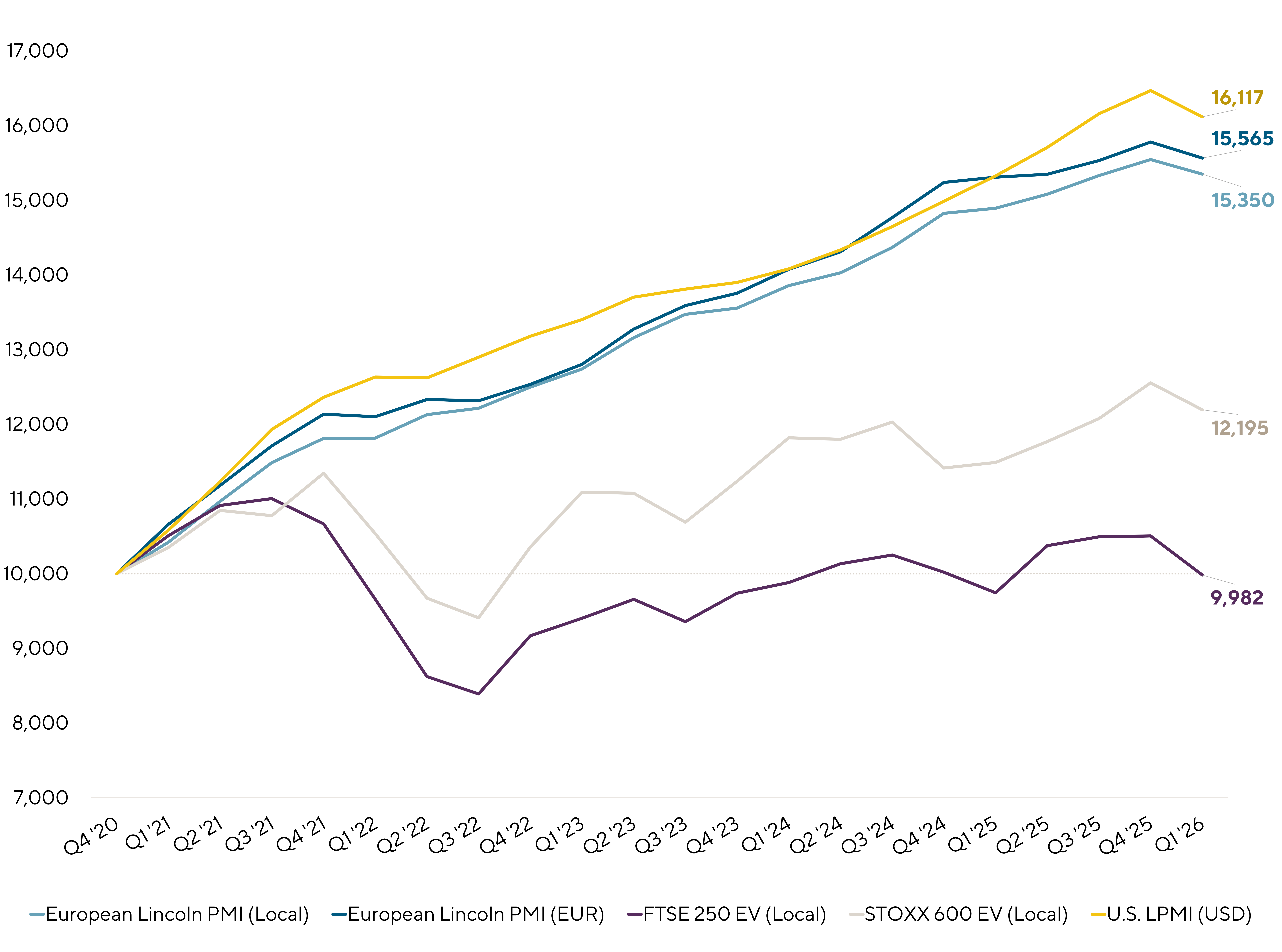
(NOTE:The Lincoln PMI, STOXX 600 and FTSE 250 EV returns above reflect enterprise values)
(Index EVs exclude financial institutions and real estate for which enterprise value is generally not meaningful; however, including such companies produces similar results)
| Index | Q1’26 | LTM | CAGR Since Inception |
| European Lincoln PMI (Local) | (1.3%) | 3.1% | 8.5% |
| European Lincoln PMI (EUR) | (1.4%) | 1.7% | 8.8% |
| FTSE 250 EV (Local) | (5.0%) | 2.4% | (0.0%) |
| STOXX 600 EV (Local) | (2.9%) | 6.1% | 3.9% |
| U.S. Lincoln PMI | (2.1%) | 5.2% | 9.5% |
Examining the LPMI
European Lincoln PMI QoQ Delta Drivers: EBITDA Multiples Versus Earnings
Considering the Impacts of Small and Large Businesses1
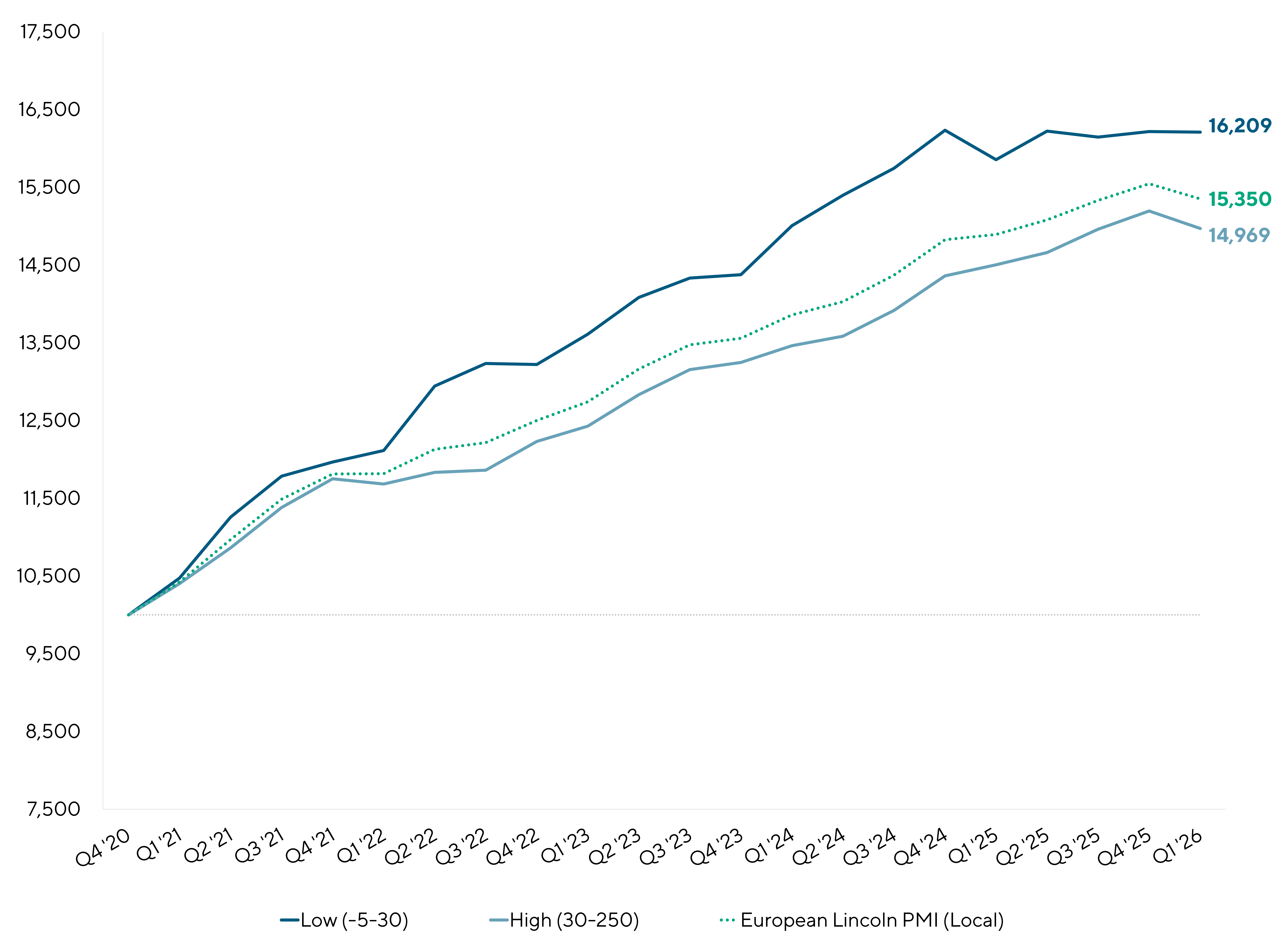
1. Small and large businesses were defined as having an EBITDA of -€5.0 to €30.0 million and greater than €30.0, respectively
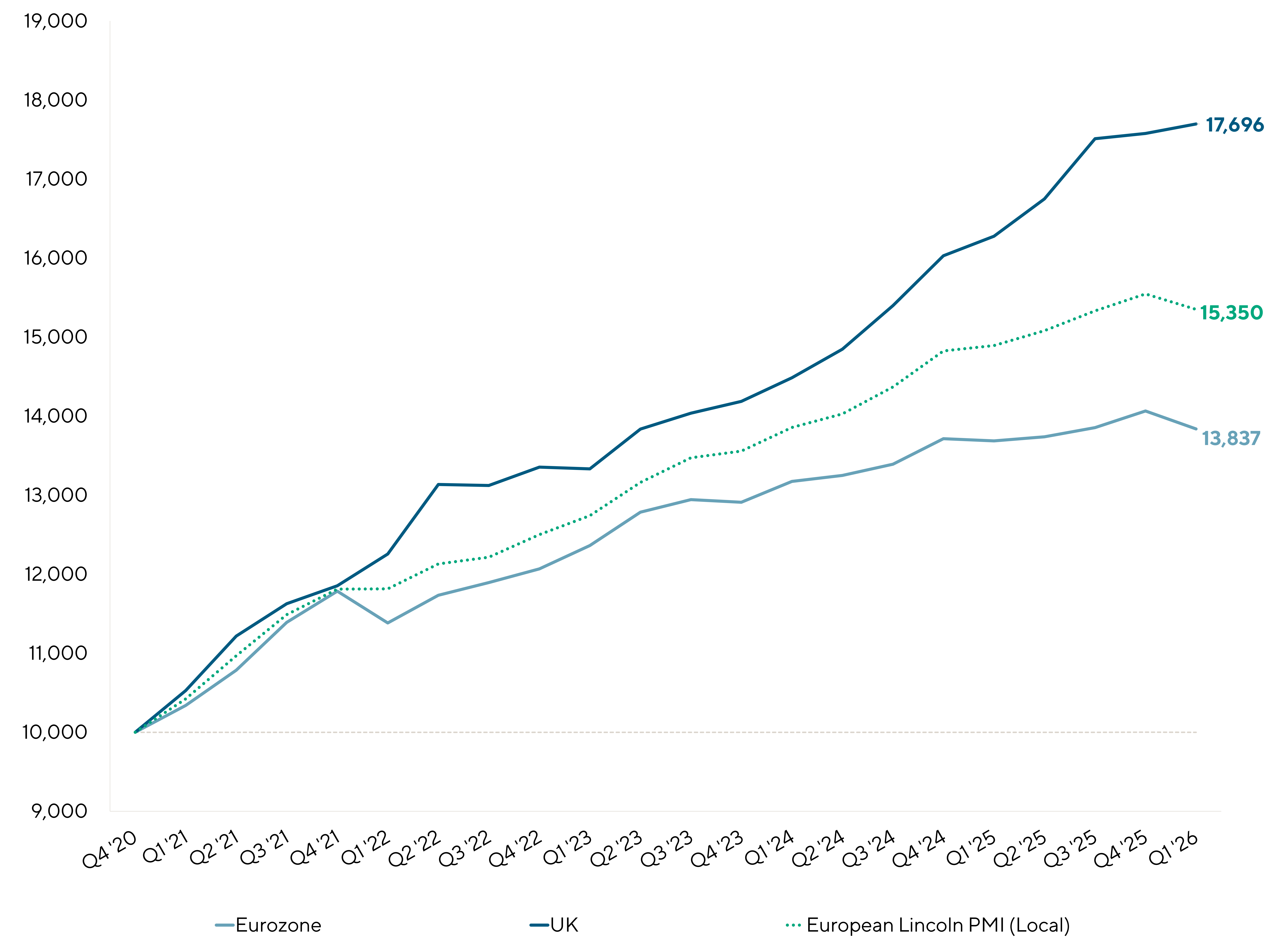
Comparing the UK and the Eurozone
European LPMI by Sector 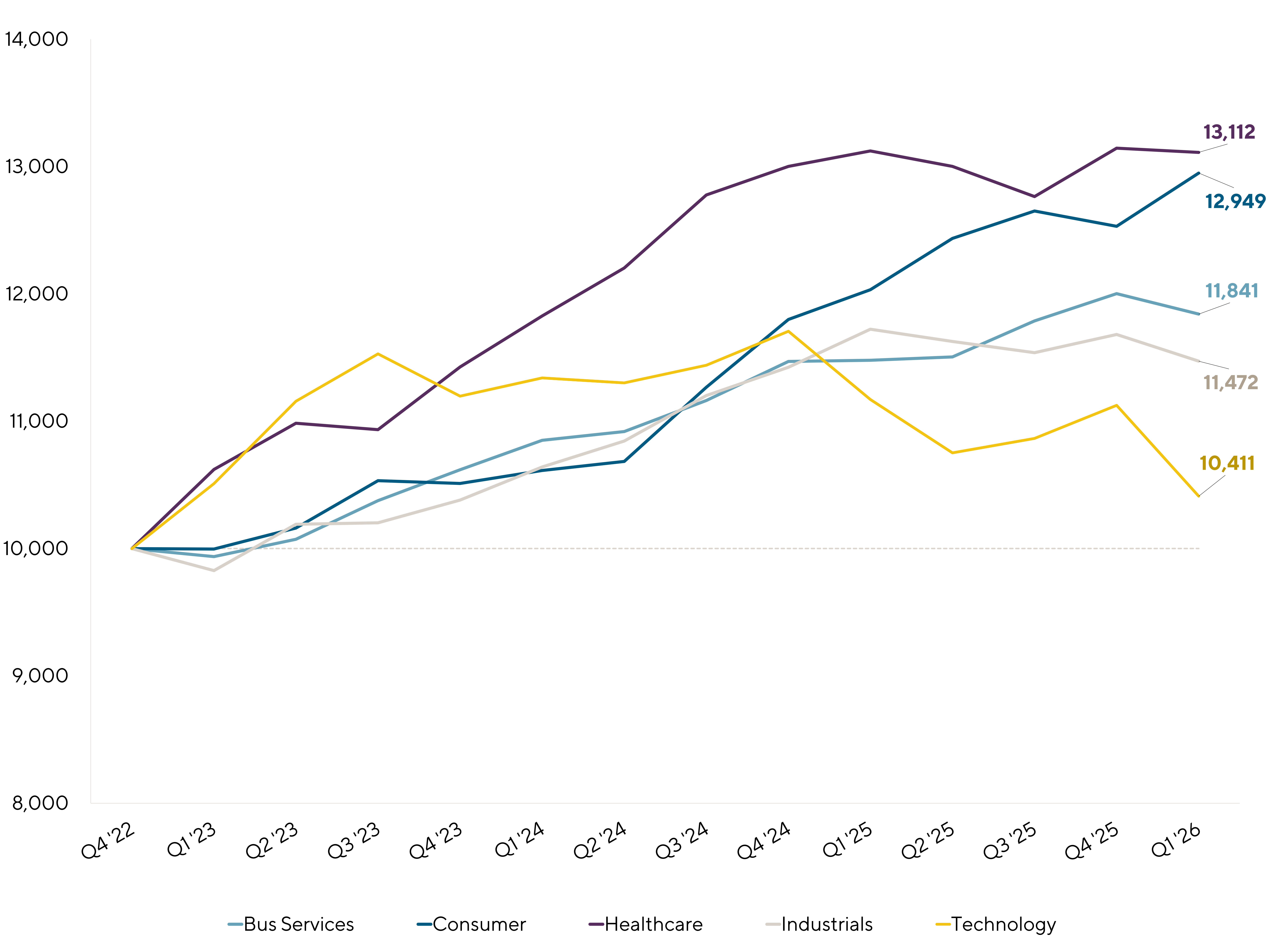
Consistent with public market headlines, the decline in EVs this quarter was primarily driven by weakness in the technology sector, which represented 15% of the European Lincoln PMI and contributed to over 50% of the overall decline. The pressure in the sector was driven by software companies, reflecting the recent global sell-off of public software equities and credits and concerns around AI disruption to software and Software as a Service (SaaS) businesses. AI’s capabilities, investment and adoption have grown significantly and far more quickly than many market participants expected. However, the decline in the software subsector was driven by multiple contraction rather than earnings, which remained positive within the European Lincoln PMI in Q1. While macroeconomic factors such as AI disruption may take time to be reflected in financial results, private companies’ earnings growth overall remained positive in Q1, albeit with the rate of growth continuing to slow slightly.
Business services declined by 1.3%, marking its first decline since early 2023, as AI-related disruption spread into subsectors such as insurance, which is particularly exposed to AI-related risks. Other subsectors experiencing average earnings decline were marketing and information services, whilst the majority of subsectors experienced average multiple decline.
Industrial EVs declined in Q1, reflecting concerns around the Iran conflict’s impact on energy costs and supply chains. While underlying performance remained resilient, any sustained disruption could translate into more pronounced operational pressure in coming quarters.
Meanwhile, consumer was the only sector to grow in Q1, rebounding from the decline in Q4. The sector saw strong average earnings growth across all subsectors but most notably in lifestyle and leisure.
Credit Conditions: Some Signs of Weakness Remain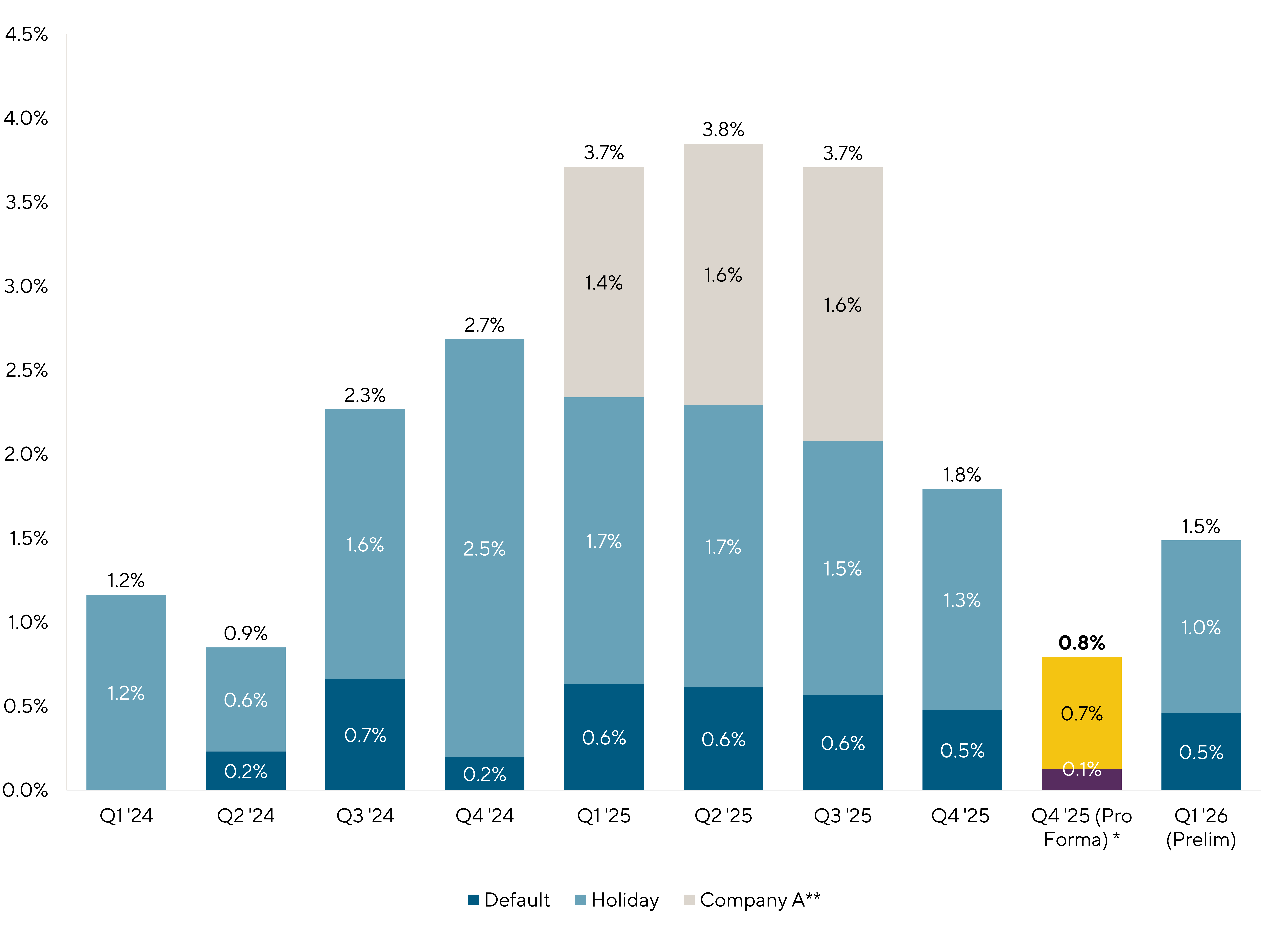
* Q4 ‘25 (Pro Forma) excludes borrowers that were classified as Fail/Holiday in Q4 ‘25 but whose status was subsequently remediated through covenant
amendments or restructured in Q1 ‘26.
** As per the prior quarter, 1 large issuer made up a significant portion of defaults between Q1 ‘25 and Q3 ‘25.
While headline metrics appeared positive, some signs of weakness remain. Covenant default rates declined from 1.8% to 1.5%; however, this was influenced by the amending or restructuring of several breaches in the prior quarter rather than a fundamental improvement in borrower health, with nine new companies that breached covenants in the quarter. The overall proportion of companies utilizing PIK interest declined from 17.1% to 16.2%. However, the percentage of companies that paid cash interest at close before implementing PIK interest (i.e., bad PIK) increased from 7.3% to 7.8%, indicating rising stress among more challenged private companies. For those companies with “bad PIK,” LTV increased 28.5% since transaction close.
While private markets have remained resilient, Q1 reflected a shift toward multiple-driven valuation declines offsetting earnings growth, albeit slowing growth, in addition to some persistent credit stress. Together, these trends point to a more cautious market backdrop.
Nick Baldwin, Managing Director in Lincoln International’s European Valuations & Opinions Group, commented, “Q1 marked a notable shift, with the decline in the European Lincoln PMI largely driven by the software-led sell-off and changing market expectations around AI. That said, underlying fundamentals remain robust, with the European Lincoln PMI still supported by positive earnings growth. What we are seeing is a growing divergence, where strong businesses continue to perform, but valuations are adjusting to reflect longer-term uncertainty. As a result, investors are becoming more selective, particularly in sectors most exposed to disruption.”
In Summary, we believe the LPMI
|
Methodology
The Index is calculated using anonymized data on an aggregated basis by Lincoln’s Valuations & Opinions Group, which has unique insights into the financial performance of thousands of portfolio investments across a variety of investment vehicles, including private equity and private debt funds. All figures are quoted in and based on calculations in local currencies, however Lincoln also prepares the index on a single-currency basis to account for FX impacts. Lincoln applied the same methodology to public indices to allow a like-for-like enterprise value comparison between the Index, the FTSE 250 and the STOXX 600.
Academic Advisors
Professor Steven Kaplan
Professor Steven Kaplan is a Senior Advisor to Lincoln’s Valuations & Opinions Group. He is the Neubauer Family Distinguished Service Professor of Entrepreneurship and Finance and Kessenich E.P. Faculty Director at the Polsky Center for Entrepreneurship and Innovation at the University of Chicago Booth School of Business. Among other courses, Professor Kaplan teaches advanced Master of Business Administration and executive courses in entrepreneurial finance and private equity, corporate finance, corporate governance and wealth management. Professor Kaplan conducts research on a wide array of issues in private equity, venture capital, corporate governance, boards of directors, mergers and acquisitions and corporate finance. He has been a member of the Chicago Booth faculty since 1988.
Professor Kaplan serves on the board of Morningstar and several fund and company advisory boards. He is also a Research Associate at the National Bureau of Economic Research.
Professor Kaplan received a Bachelor of Arts, summa cum laude, in applied mathematics and economics from Harvard College and earned a Doctor of Philosophy in business economics from Harvard University.
Professor Michael Minnis
Professor Michael Minnis is a Senior Advisor to Lincoln’s Valuations and Opinions Group. He is the Deputy Dean for Faculty and Fuji Bank and Heller Professor of Accounting at the University of Chicago Booth School of Business, where he researches the role of accounting information in allocating investment efficiently by both managers and capital providers. His recent research focuses on understanding the role of privately held companies in the U.S. economy and how these firms use financial reporting to access, deploy and manage capital. He particularly enjoys identifying unique data and methods to empirically examine issues in a novel way.
In January 2018, Professor Minnis became a member of the Private Company Council, the primary advisory council to the Financial Accounting Standards Board (FASB) on private company issues. Professor Minnis received his Ph.D. from the University of Michigan and his B.S. from the University of Illinois, where he graduated with Highest Honors.
Meet Our Senior Team












Related Perspectives
The Lincoln Private Market IndexTM (Lincoln PMI) is an informational indicator only, and does not constitute investment advice or an offer to sell or a solicitation to buy any security. It is not possible to directly invest in the Lincoln Private Market Index. Some of the statements above contain opinions based upon certain assumptions regarding the data used to create the Lincoln Private Market Index, and these opinions and assumptions may prove incorrect. Actual results could vary materially from those implied or expressed in such statements for any reason. The Lincoln Private Market Index has been created on the basis of information provided by third-party sources that are believed to be reliable, but Lincoln International has not conducted an independent verification of such information. Lincoln International makes no warranty or representation as to the accuracy or completeness of such third-party information.
The LPMI should not be construed as an offer to sell or buy, or a solicitation to sell or buy, any products linked to the performance of the LPMI. The use of the LPMI in any manner, including for benchmarking purposes, is not endorsed or recommended by Lincoln International and Lincoln International is not responsible for any use made of the LPMI. Lincoln International does not guarantee the accuracy and/or completeness of the LPMI and Lincoln International shall not have any liability for any errors or omissions therein. None of Lincoln International, any of its affiliates or subsidiaries, nor any of its directors, officers, employees, representatives, delegates or agents shall have any responsibility to any person (whether as a result of negligence or otherwise) for any determination made or anything done (or omitted to be determined or done) in respect of the LPMI and any use to which any person may put the LPMI. Lincoln International has no obligation to update the LPMI and has no obligation to investors with respect to any product based on the performance of the LPMI. Any investment in such a product will not acquire an interest in the LPMI. Lincoln International is not an investment adviser and will not provide any financial advice relating to a product linked to the performance of the LPMI. Investors should read any such product offering documentation and consult with their own legal, financial and tax advisors before investing in any such product.
© 2026 Lincoln Partners Advisors LLC. All rights reserved. LINCOLN PRIVATE MARKET INDEX and LINCOLN INTERNATIONAL are service marks owned by Lincoln Partners Advisors LLC and its affiliated entities. Any use of these service marks and these materials, including the reproduction, modification, distribution or republication of these materials, without the prior written consent of Lincoln International, is strictly prohibited.