Spotlight on Government Services
| Lincoln International’s observations of the government services market highlight the increasing opportunities and risks for government contractors under the new White House regulatory shifts and DOGE actions. The White House’s “shock and awe” campaign of rapid change has left mergers and acquisitions (M&A) market participants off-balance, leading some to forestall the launch of sale processes or even delay the closing of new investments. At the same time, investors are searching for opportunities to back the businesses poised to benefit from a shifting landscape.
In this series, Lincoln International delves into the government services market in 2025, exploring its innovative solutions, trends, opportunities and positive impact on public sector operations. Lincoln International is uniquely positioned to guide clients through the changing federal landscape, with deep sector expertise and decades of experience advising on both buy-side and sell-side M&A transactions in the government services sector. |
Summary
-

Government Services
- Lincoln International launches a government services series, where our experts will explore the shifting dynamics and opportunities in 2025 and beyond.
- Sign up to receive Lincoln's perspectives



Volume 3: Two Worlds Collided: How the Government Contracting Market Has Embraced the Tech Pivot
A quiet revolution has been underway in the government contracting (GovCon) sector. What began as an incremental shift nearly a decade ago has, over the past several years, accelerated into a full-scale transformation: Contractors once known for labor-based services are now positioning themselves as technology-first solutions firms. The forces driving this change are powerful, structural and reshaping the market from top to bottom.
DoD Demand Signals
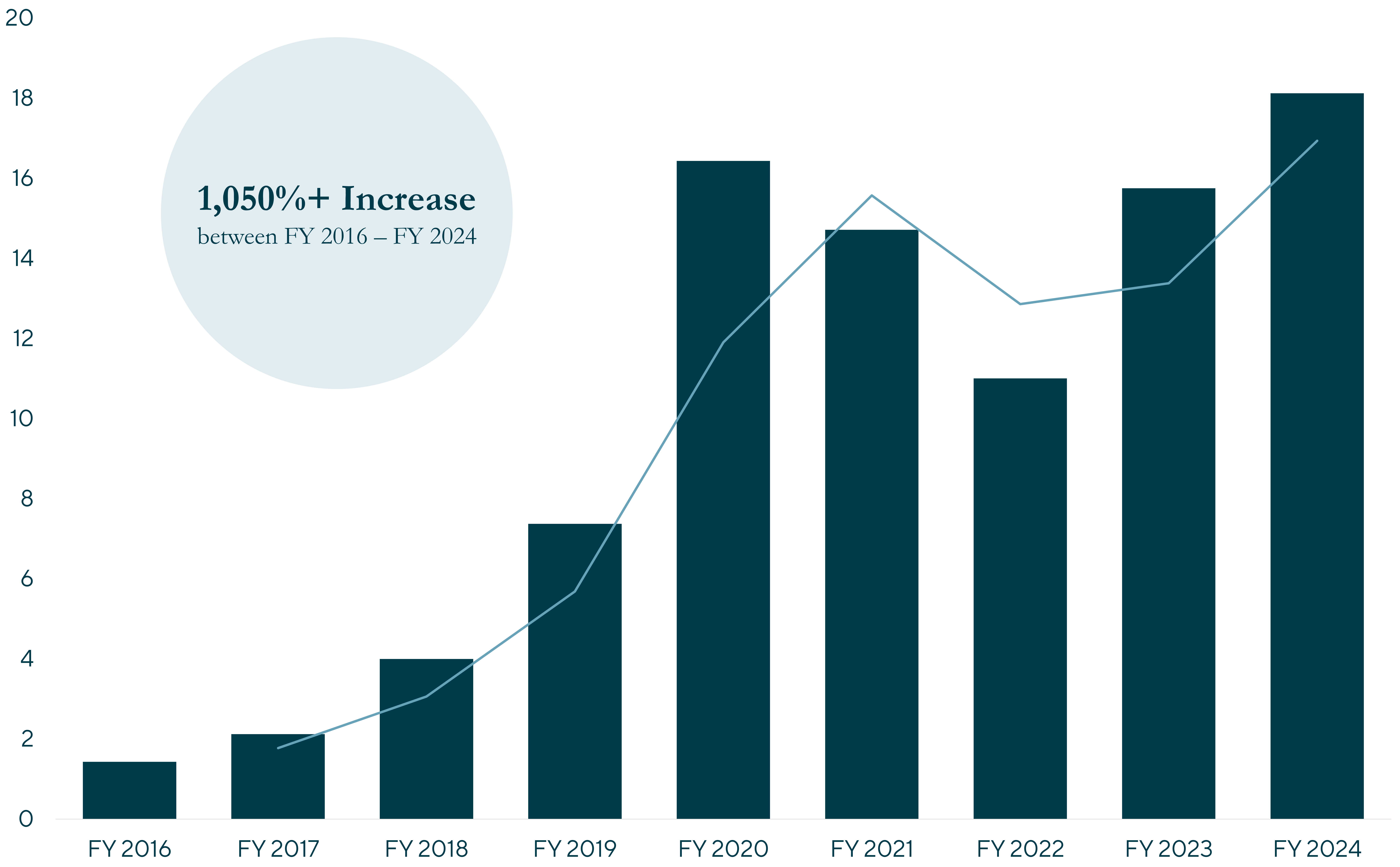
At the heart of this pivot is the Department of Defense’s (DoD) evolving appetite for speed and innovation. Other Transaction Authorities (OTAs) and Commercial Solutions Openings (CSOs), once considered niche procurement methods, have become mainstream procurement tools. Between FY2021 and FY2024, the DoD obligated nearly $63 billion through OTAs, up from just $760 million a decade ago. OTAs were designed to move faster than traditional contracts and bypass the lumbering requirements of the Federal Acquisition Regulation (FAR). The growth at which OTAs are being leveraged underscores how serious the government is about buying new technology quickly and efficiently.
Defense OTA Allocations (in billions)
At the same time, streamlined procurement has attracted Silicon Valley to the defense sector. Historically, venture capitalists eschewed defense because a single procurement process often ran longer than their entire expected hold period. The advent of rapid procurement, coupled with a greater willingness from the federal government to adopt Commercial Off-the-Shelf (COTS) software, cracked open the door to early-stage venture investors. Encouraged by the stratospheric success of darlings like Palantir, Andruil and Saronic, venture dollars have rushed in at record-breaking levels. In Q2 2025 alone, investors deployed $19.1 billion across 165 deals—more than double the $9.3 billion raised in Q1 and up more than 200% from Q2 2024. Year-to-date, defense tech startups have raised $28.4 billion across 361 deals, putting the sector on pace to surpass 2024’s $37.9 billion total.
Government is stepping up to support this trend. The Defense Innovation Unit (DIU), originally launched in 2015 to connect Silicon Valley with the Pentagon, received nearly $1 billion in appropriations for FY2024, a step-change that underscores the DoD’s intent to pull dual-use technologies into programs of record. The Replicator Initiative announced in 2023 furthered the DUI’s mission to accelerate capability delivery to the warfighter. By committing to field thousands of attritable autonomous systems within a 24-month span, the DoD signaled that autonomy, swarming software and rapid prototyping were no longer future ambitions but instead near-term requirements. Layered on top of this, federal agencies have dramatically accelerated AI adoption, with generative AI use across 11 surveyed agencies increasing nearly ninefold in just the past year.
Industry’s Supply-Side Response
With demand squarely focused on leveraging technology rather than purely staffing open billets, contractors are responding in kind, and not just by chasing new contracts, investing in technology development or partnering with technology firms. Contractors are instead reshaping their own business models and portfolios via mergers and acquisitions (M&A).
Lincoln examined M&A activity of the top publicly traded government contracting firms since 2021. These firms, including Amentum, Booz Allen Hamilton, CACI, GDIT, KBR, Leidos, ManTech [1], Parsons and SAIC, have historically been viewed across the government industry as pure-play service providers, offering the federal government a pool of highly talented, educated and cleared contractor personnel to augment its government workforce. Interestingly, however, nearly 60% of M&A volume over the last five years by these firms has been for technology solutions-focused companies.
Government Contracting M&A Volume Since 2021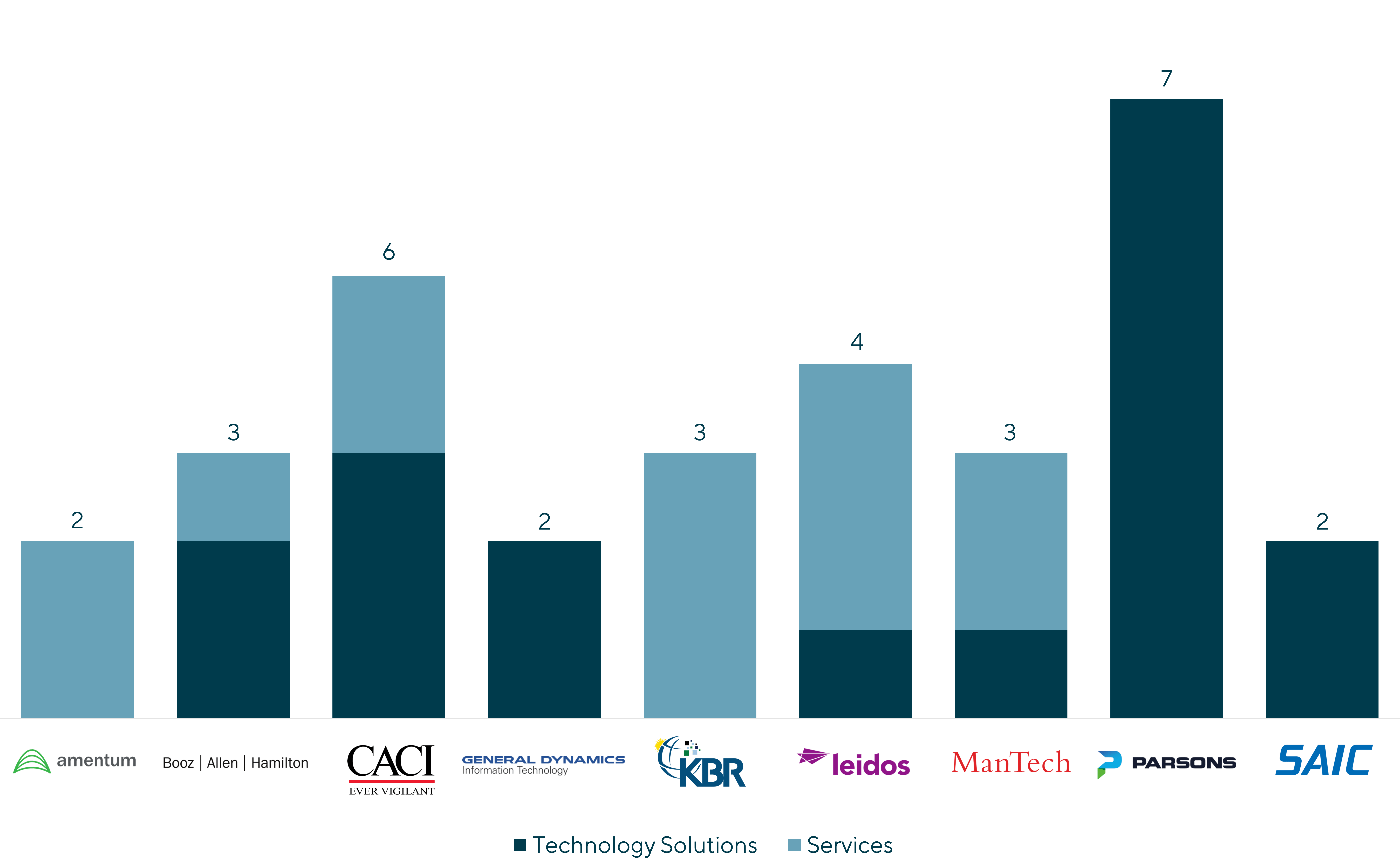
Parsons has led the market with seven tech deals completed, building a portfolio around cyber, electronic warfare and C4ISR [2] by acquiring firms such as BlackHorse Solutions, BlackSignal Technologies and Sealing Technologies. Elsewhere, CACI added SA Photonics to deepen its communications and space optics capabilities. More recently, GDIT purchased Iron EagleX for its AI / machine learning, cyber and quantum computing technologies.
Even the largest advisory firms are repositioning. Booz Allen Hamilton has branded itself as the government’s leading provider of AI, showcasing mission-grade generative AI deployments—including in space applications—and openly targeting some of the government’s largest AI contracts. Across the market, deal activity has tilted toward assets with intellectual property, product margins and adjacency to emerging programs of record.
There is some tension here as the defense tech market, characterized by high growth even at the cost of short-term profit and deals priced off revenue multiples, crashes into traditional government services, which prioritizes EBITDA and is content with low double-digit revenue growth. The result has left traditional government services executives and their conservative private equity investors grappling with how to reconcile the two worlds into a single unified model for value creation, all while competing and partnering with the new industry titans like Palantir and Anduril.
The Arc of Change
The shift has been gradual but consistent. Between 2015 and 2018, OTAs began to gain popularity across the DoD, the DIU found its footing and contractors began distancing themselves from lowest-price, technically acceptable (LPTA) work. From 2019 to 2021, the first wave of tech-focused acquisitions reshaped portfolios, and in 2022, the Russian invasion of Ukraine highlighted the importance of autonomy and electronic warfare. Today, the acceleration is unmistakable: larger budgets for the DIU, skyrocketing AI adoption and an M&A market that rewards differentiated technology.
What It Means Going Forward
For contractors, this pivot reshapes everything from revenue mix to go-to-market strategy. Labor-based models are giving way to repeatable, IP-driven solutions. The dominant path to new business increasingly runs through OTAs, pilots and prototype-to-production transitions rather than long-term staff augmentation contracts. Talent strategies have shifted as well, with firms hiring machine learning engineers, autonomy specialists and data scientists to build tools that can scale. Valuations reflect the change: Differentiated tech platforms with productized solutions command higher multiples and greater buyer interest than traditional services businesses.
The implications are clear. GovCon is no longer a story of labor rates and headcount, but one of capabilities, intellectual property, software and fieldable solutions. The importance of national security as global tensions rise and the promise of AI both point in the same direction: Technology is the new currency of competition. Contractors that fail to pivot risk being left behind, while those that lead with software, autonomy, space and electronic warfare solutions are poised to capture the next decade of growth.
[1] ManTech International was publicly traded prior to its take-private buyout by The Carlyle Group in 2022
[2] “C4ISR” (Command, Control, Communications, Computers, Intelligence, Surveillance, and Reconnaissance)
Volume 2: Procurement Overhaul: Implications for Defense Technology
Although DOGE’s initial “shock and awe” campaign continues to drive headlines, attention is increasingly shifting to the U.S. Department of Defense (DoD).
On April 10, Defense Secretary Pete Hegseth issued a memo terminating four IT services contracts worth $5.1 billion, about 0.61% of the current defense budget. The move comes as the department aims to shrink its civilian workforce by roughly 60,000 jobs. Less than a week later, the White House issued two executive orders (EOs) designed to “create the most agile, effective, and efficient procurement system possible” simplifying the annual government procurement of nearly $1 trillion of goods and services. Most recently, in late April, Secretary Hegseth directed the U.S. Army to implement a comprehensive transformation strategy that seeks to, in part, eliminate redundancies and waste, reform the acquisition process and modernize inefficient defense contracts.
These sweeping procurement reforms represent a turning point for the defense and government services sectors, opening doors for innovation and challenging businesses to adapt quickly. The EOs, memos and regulatory shifts have broad implications for the mergers and acquisitions (M&A) market at all levels of government services. Companies and investors must act decisively to seize opportunities or risk falling behind. Lincoln International is uniquely positioned to guide clients through this evolving landscape, offering tailored M&A advisory services and deep market expertise.
April 2025 Executive Orders on Federal Procurement
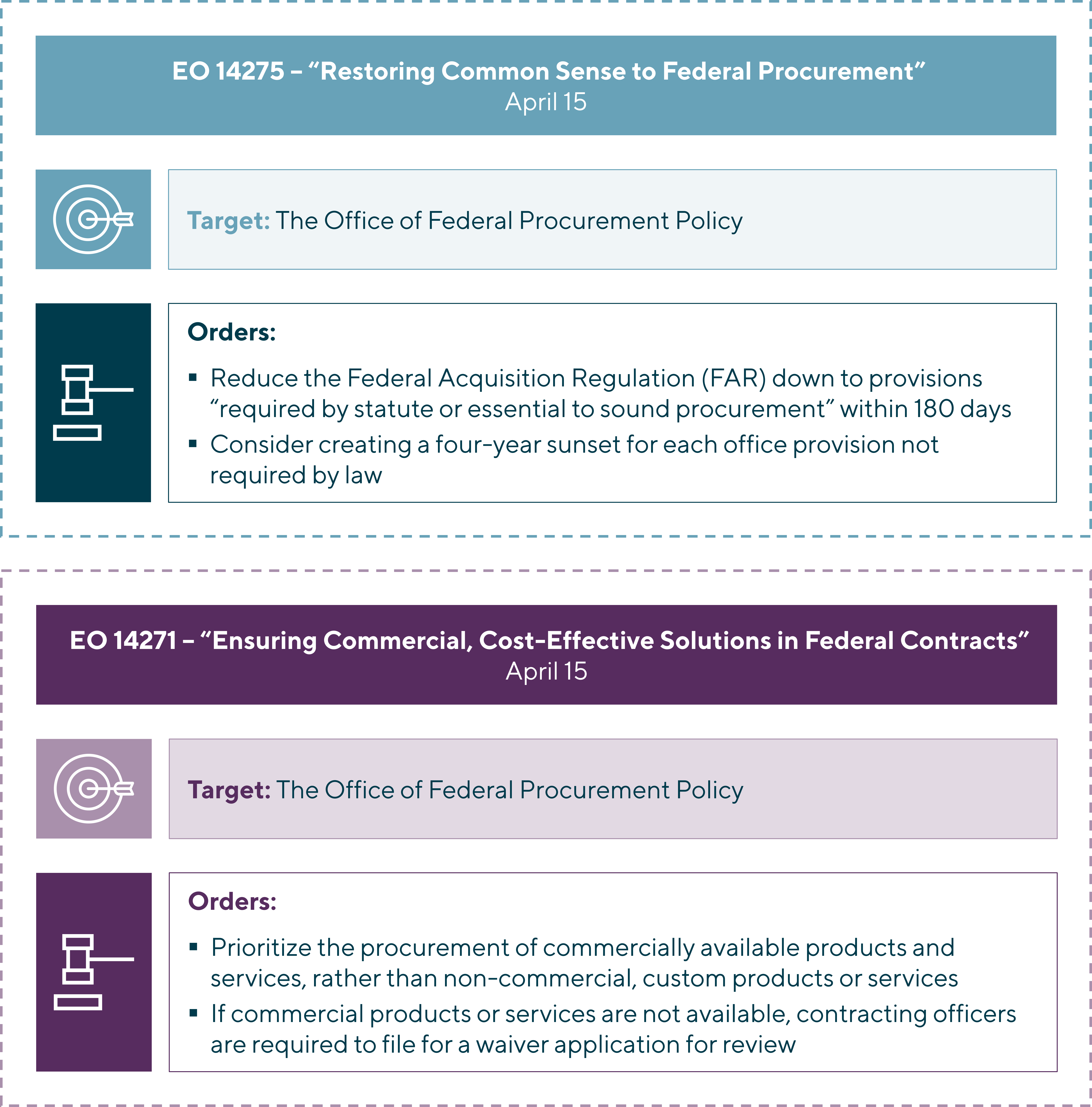
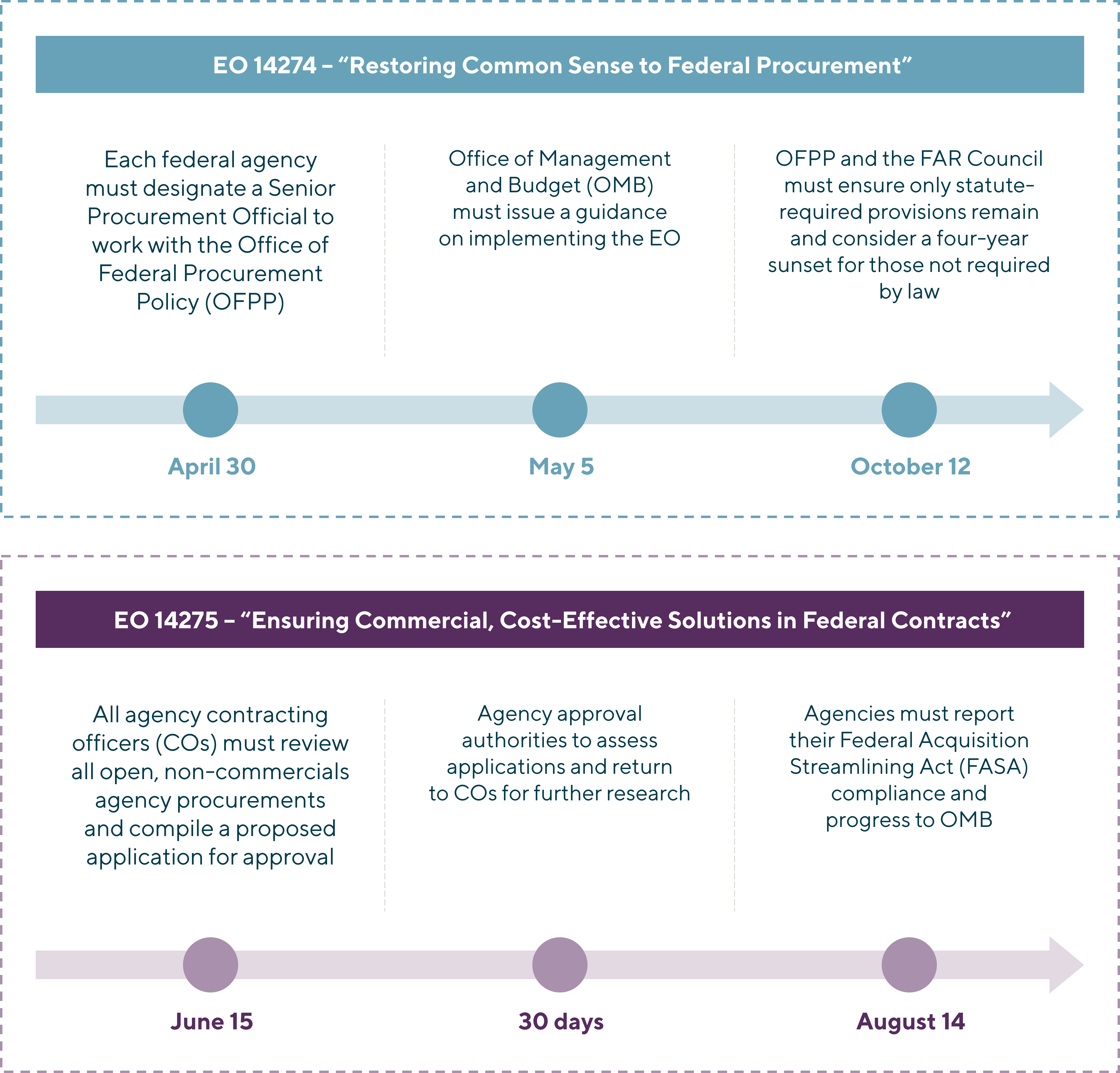
The first order, “Restoring Common Sense to Federal Procurement,” aims to reduce the number of provisions within the Federal Acquisition Regulation (FAR). Issued jointly by the Department of Defense, U.S. General Services Administration and National Aeronautics and Space Administration, FAR currently comprises 53 parts and over 1,900 clauses. In a global context, procurement regulations vary greatly in scope and enforcement. By contrast, India’s General Financial Rules 2017 contain 324 rules and eight appendices outlining government procurement procedures, while Australia’s Commonwealth Procurement Rules contain fewer than 120 rules.
The second order, “Ensuring Commercial, Cost-Effective Solutions in Federal Contracts,” requires agencies to prioritize the procurement of commercially available products and services over non-commercial, custom products or services. It expands on a memo issued by Secretary Hegseth in March, “Directing Modern Software Acquisition to Maximize Lethality,” which directed the use of streamlined procurement tools such as “Commercial Solutions Openings” (CSOs) and “Other Transaction Agreements” (OTAs) as the default approaches for acquiring software. The DoD’s business transactions with nontraditional defense contractors are expected to increase as a result of both the EO and earlier memo.
Both EOs seek to reform the procurement process after years of complaints from both sides of the aisle. The private sector has long decried red tape as a hindrance to innovation, a complaint validated by successful procurement reforms abroad. For example, after legal reforms in 2009, Germany’s business sector saw a robust and significant effect of innovation-directed public procurement policy changes.
Short-term challenges in implementing these regulations include pausing existing contracts, such as the DoD’s pausing of consulting contracts, and confusion regarding new requirements. However, in the coming years, government services firms will benefit from increased transparency and a reduced bureaucratic burden.
Implications for Defense Technology and Government Services M&A
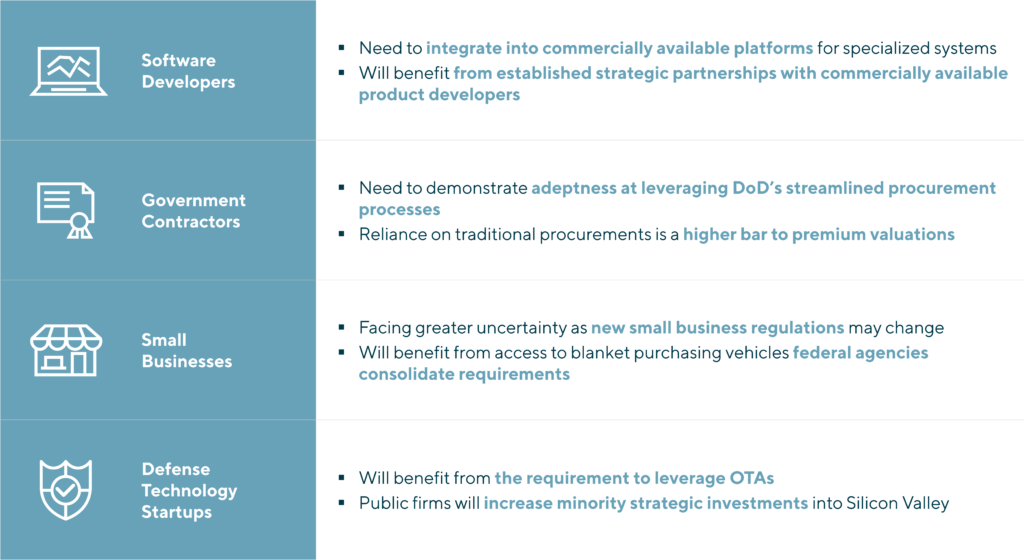
The EOs and memos have broad implications for the M&A market at all levels of government services. Private innovators, financial sponsors, and service platforms will each see increased demand, although potential risks may arise amidst the administration’s rapid shifts.
| Software developers specializing in custom systems for DoD will need to integrate their products into commercially available platforms like Palantir. We expect there will still be a demand for custom tools and applications that interface with these systems. Developers with established strategic partnerships with commercially available product developers will become more favored compared to those who try to go it alone. |
| Government contractors who can demonstrate their adeptness at leveraging DoD’s streamlined procurement processes by winning CSOs, BAAs, and OTAs can expect to garner premium valuations. In contrast, firms relying on traditional procurements will face a higher bar. |
| Small businesses face greater uncertainty due to new small business regulations enacted in 2024, governing change of control. Changes to the FAR may result in another round of changes to small business rules, impacting how 13 CFR (the main body of small business regulations) is interpreted. This may drive more federal agencies to consolidate requirements on GSA vehicles and other blanket purchasing vehicles. Firms with access to the right contracts can expect to benefit, while those lacking vehicles may find themselves limited in their ability to access customers. |
| Defense technology startups will benefit from the requirement to leverage OTAs, providing an additional tailwind as startups and founders scramble to take advantage of the shift from the Beltway to Silicon Valley. The disconnect in valuations between venture capital markets and public markets makes it difficult for government services firms to acquire into the defense tech market. As a result, we expect to see an increase in minority strategic investments by public companies into Silicon Valley, evidenced by Booz Allen Hamilton’s April investment in Scout AI. |
Looking Ahead with LincolnOverall, we remain optimistic that procurement reforms will benefit the Pentagon’s procurement of software and related services in the long term. The orders promise to reduce costs, improve efficiency and deliver cutting-edge solutions to defense leaders—addressing sector complaints that have spanned multiple federal administrations. As with any regulatory change, the eventual implementation of the EOs will create winners and losers. Disruption in the procurement process offers unique opportunities for financial sponsors to enter the sector. However, firms adversely affected by regulatory shifts risk losing market share and revenue without immediate action. Corporate and private equity acquirers can leverage M&A as a powerful tool to align their businesses with the public policy priorities of the current administration. Lincoln International’s team of dedicated bankers is uniquely positioned to guide clients through the changing federal landscape. By leveraging deep sector expertise and decades of experience advising on both buy-side and sell-side sector transactions, clients can capitalize on the opportunities created by DOGE’s transformative initiatives. |
Volume 1: DOGE and Policy Shifts: M&A Impacts
Sector Drilldown: Government Services
Government services and defense technology businesses are on the front lines of dramatic policy shifts. President Donald Trump officially established the Department of Government Efficiency (DOGE) on January 20, 2025, as the newest piece of the Executive Office of the President. Reporting directly to Susie Wiles, the White House Chief of Staff, DOGE is no longer a campaign-trail concept designed to capture voter attention but a formalized advisory body with a clear objective: cut federal spending.
With DOGE driving efficiency across federal agencies, the government services sector is experiencing disruption. Companies able to quickly adapt to changing procurement priorities and efficiency mandates can expect heightened interest from both strategic and financial buyers, particularly those seeking to capitalize on technology-driven digital transformation.
Additionally, some government services providers are capitalizing on the opportunity to strengthen customer relationships by rehiring laid-off employees and redeploying them under existing contracts to maintain mission capacity. The increased labor supply also may serve to relieve upward pressure on wages, making it easier for firms to grow.
DOGE: From Concept to Execution
Since its conception in November 2024, DOGE has faced legal challenges and public scrutiny. Officially, it replaces the Obama-era U.S. Digital Service (USDS), initially created in 2014 to address HealthCare.gov’s technical issues. The agency has been repurposed as the United States DOGE Service (retaining the USDS acronym), and Trump’s executive order officially tasked it with “modernizing federal technology and software to maximize efficiency and productivity.”
Each of the 438 federal agencies will establish a dedicated “DOGE Team,” designating at least one engineer, HR specialist, legal advisor and team lead to reimagine government operations. An early focus was cutting over $500 billion in annual unauthorized expenditures, which senior advisor Elon Musk describes as funds “used in ways Congress never intended.”
The establishment of DOGE sparked market uncertainty for the government contracting sector—evidenced by an immediate post-election decline of over 25% in many defense and government-focused public sector stocks. In recent weeks, government contracting firms have begun to report DOGE’s impact.
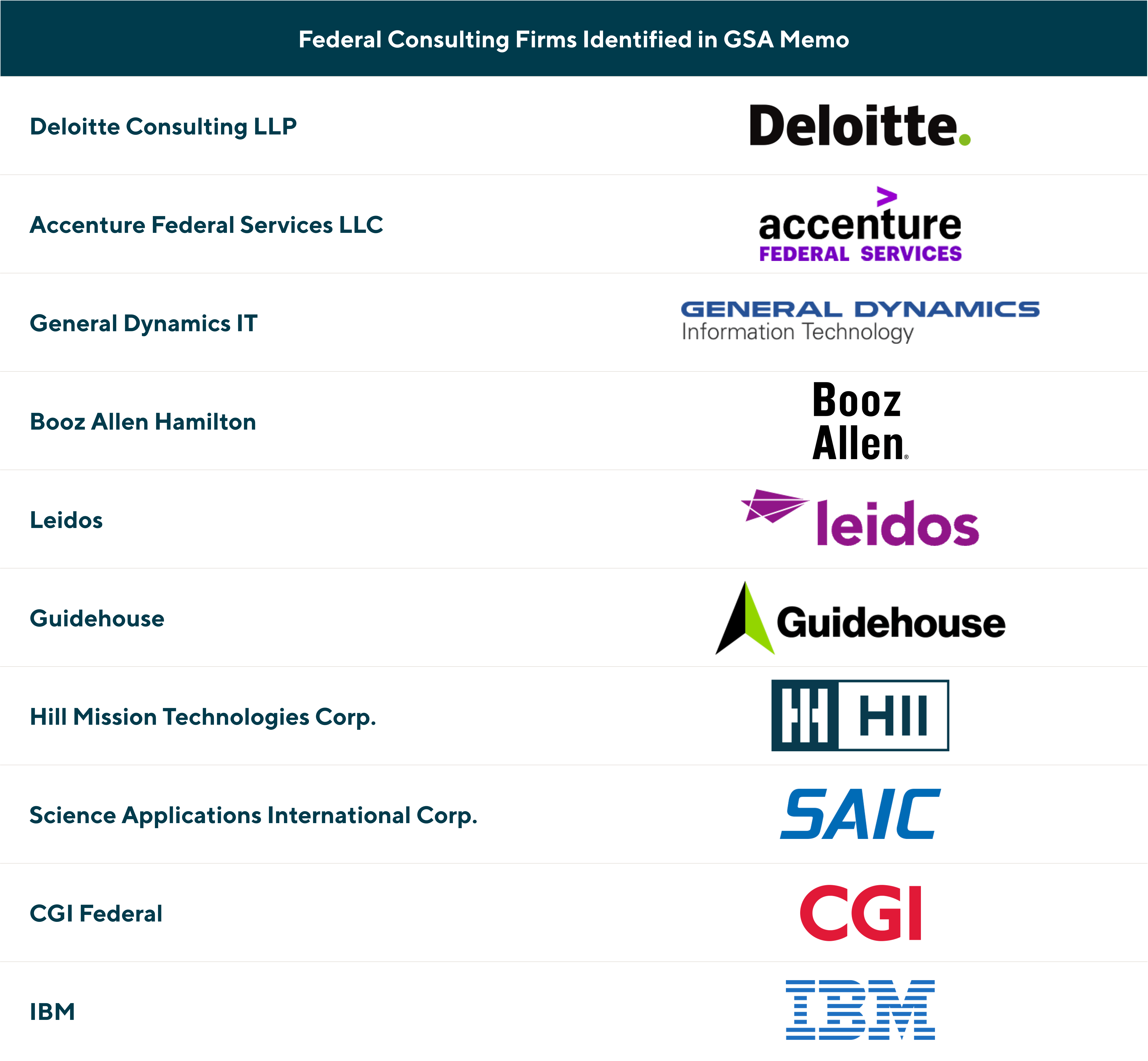
On February 26th, Stephen Ehikian, Acting and Deputy Administrator of the General Services Administration, sent a memo taking aim at the top 10 federal consulting firms. He directed agencies to aggressively review over $65 billion in contractual commitments and terminate any deemed “non-essential” or not providing “substantive technical support.”
ICF International’s stock price fell by nearly 25% between the inauguration on January 20 and February 26. Following its February 27 earnings call, the stock declined an additional 20% after the company reported stop-work orders on $90 million in annual revenue, representing approximately 4.5% of its total revenue and over 9.0% of its federal business.
What began as a seemingly limited initiative has evolved into a broader campaign, leaving industry participants to speculate about DOGE’s next target and where the cuts will end.
Opportunities Amid Challenges
Despite challenges, key opportunities are surfacing for the government services sector.
While the government services sector has traded down from pre-election highs, EBITDA multiples have proven resilient by historical standards. The average market EBITDA multiple for the peer set is 11.1x, 16.6% below its 10-year average of 13.4x. This is in stark contrast to the impact of the Obama-era Budget Control Act of 2011, when an across-the-board 7-8% reduction in federal spending caused many stocks to trade down to 6x EBITDA.
EV / LTM EBITDA
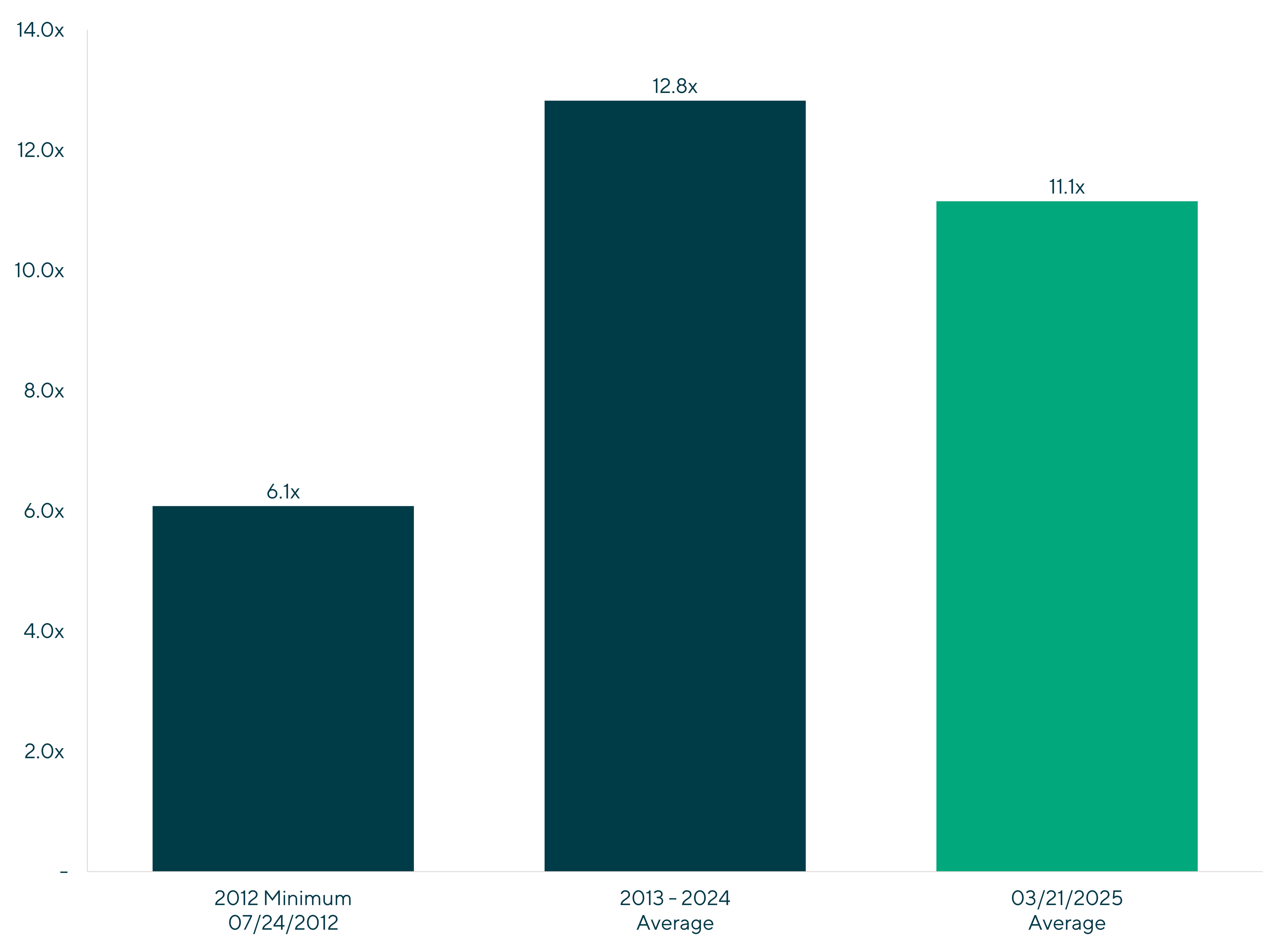
Notes: $ in millions. Financial metrics include: AMTM, BAH, CACI, ICFI, LDOS, SAIC, VVX; historical financial metrics between 2012 and 2024 also include Mantech, Dynamics Research Corporation, Perspecta, PAE, Engility Holdings, and KeyW.
DOGE’s approach is markedly different. Rather than indiscriminate cuts, the department emphasizes targeted efficiency improvements and modernization. Its mandate is to eliminate waste, fraud and abuse, decrease unnecessary regulations and improve efficiency of government. If leaders stay true to the mission of streamlining federal operations, DOGE has the potential to deliver long-term benefits to the government services sector, fostering innovation and value creation rather than the stagnation and disruption associated with sequestration.
Early “cuts” now show promising signs of being repositioned as “reallocations.” Defense Secretary Pete Hegseth has ordered senior defense officials to draft a proposal reallocating $50 billion of the 2025 budget (a projected 8%) to align spending with the president’s national security priorities. Concurrently, Republican lawmakers seek to add more than $100 billion to the Pentagon’s proposed 2025 budget, bringing total annual military spending close to $1 trillion – a robust bankroll by any practical measure.
The center of gravity in government innovation appears to be shifting from Washington, D.C. to Silicon Valley, as Palantir – a key player in the new administration’s tech strategy – anticipates nearly doubling its government sector revenue in 2025, from approximately $1 billion to an expected $2 billion. Many Beltway defense contractors have seen the writing on the wall and have joined Palantir’s partnership ecosystem, strengthening ties between DC and Silicon Valley.
Sector Implications
Who Is at Risk?
DOGE’s initial focus on unauthorized expenditures has placed numerous federal programs and agencies under scrutiny, with many now facing significant legal and operational challenges. As these agencies navigate mounting uncertainty, the broader implications for federal operations and resource allocation remain a pressing concern. Companies associated with disrupted agencies or programs will need to diversify revenue streams to mitigate risk. Similarly, non-technology-enabled firms supporting non-critical missions may face reduced demand as federal priorities shift.
Who Will Benefit?
Conversely, high-performing, technology-enabled firms aligned with critical missions stand to gain in the long term. Defense technology-related companies are particularly well-positioned to benefit from increased efficiency, streamlined procurement processes and private sector demand for innovation. We also anticipate continued pressure to shift away from in-house developed Government Off-the-Shelf (GOTS) software towards existing Commercial Off-the-Shelf (COTS) tools that can be inexpensively modified to suit government needs. This shift will benefit GovTech software firms that have invested in developing software to support government agency missions.
The Role of Private Sector Innovation
Incentivizing innovation and high performance is crucial for the future of the government services sector.
During the Cold War, then-undersecretary of defense William Perry orchestrated a “revolution in military affairs” by dedicating funding to DOD research efforts. His work between 1977-81 was instrumental in developing America’s stealth aircraft technology. Years later, the DOD has shifted from a producer to a consumer of innovation.
The U.S. government’s reliance on private sector innovation has grown significantly over the past six decades. From 1960 to 2020, the federal government’s share of global R&D funding fell from 45% to 6%, with nearly three-quarters of global R&D investments now outsourced to the private sector.
Despite current turmoil and uncertainty, this decades-long shift underscores the importance of private sector contributions to the Defense Industrial Base (DIB). As DOGE initially challenges the government operations sector, private companies will continue to play a critical role in driving innovation and ensuring mission success.
Implications for M&A Activity
Many government services companies are sitting on the sidelines for Q1 in 2025, reading the headlines and responding to changes in their business rather than initiating transactions. However, well-positioned firms can take advantage of the market lull to attract private equity investors and strategic buyers alike. Premium businesses tend to trade for premium multiples in any market, and the current cycle is no different.
At the same time, delaying a sale process until H2 2025 may be the wisest strategy for businesses directly impacted by DOGE or those needing to return to the market. A delay offers disrupted or unstable businesses the opportunity to realign operations, positioning themselves more effectively once the opening salvos of “Shock and Awe” have passed and DOGE’s strategy becomes more cohesive.
Connect With LincolnAs DOGE reshapes the federal landscape, Lincoln International remains at the forefront of advising clients in the government services sector. With over 100 successful transactions, our team of dedicated government services bankers average over 20 years of experience representing government contractors in M&A transactions and have a strong track record representing sellers serving federal departments and agencies. We anticipate continued deal activity as DOGE’s initiatives create new opportunities for high-performing companies. With Lincoln’s guidance, clients can navigate the uncertainty of this unique market shift and capitalize on the opportunities created by DOGE’s transformative initiatives. |