
Post-Close Purchase Price Adjustment Process in M&A: Tips for Buyers and Sellers to Mitigate the Risk of Net Working Capital Disputes
This article walks through each stage of the post-close net working capital purchase price adjustment process in M&A transactions and highlights practical considerations to help buyers and sellers mitigate dispute risk at every phase.
Summary
-
Lincoln’s experts share insights into minimizing the risk of post-close net working capital purchase price adjustment processes in M&A transactions.
- Sign up to receive Lincoln's perspectives



Introduction
Post-close purchase price adjustments are a standard feature of most private mergers and acquisitions (M&A) transactions. In concept, they are intended to be a straightforward alignment of the purchase price paid and the value delivered at closing. In practice, however, post-closing adjustments can frequently lead to purchase price disputes between buyers and sellers and are among the most common drivers of post-close disputes in M&A transactions.
There are two main types of M&A purchase price adjustments: post-close “true-ups” and earnouts.1 The post-close “true-up” compares a “target” level of net working capital with the actual level of net working capital at closing. These adjustments typically are based on the target company’s financial statements at closing and focus on balance sheet metrics, such as net working capital, cash and debt, which are defined in the purchase agreement and tailored to each deal. Net working capital is among the most common drivers of post-close purchase price adjustment disputes in M&A transactions.
This article walks through the post-close process for the net working capital “true-up,” focusing on four phases commonly encountered in M&A transactions, whether involving a strategic buyer or a financial buyer, such as a private equity sponsor, highlighting where disputes most often arise and providing tips to mitigate the risk of a dispute.
Example Post-Closing Purchase Price Adjustment Process

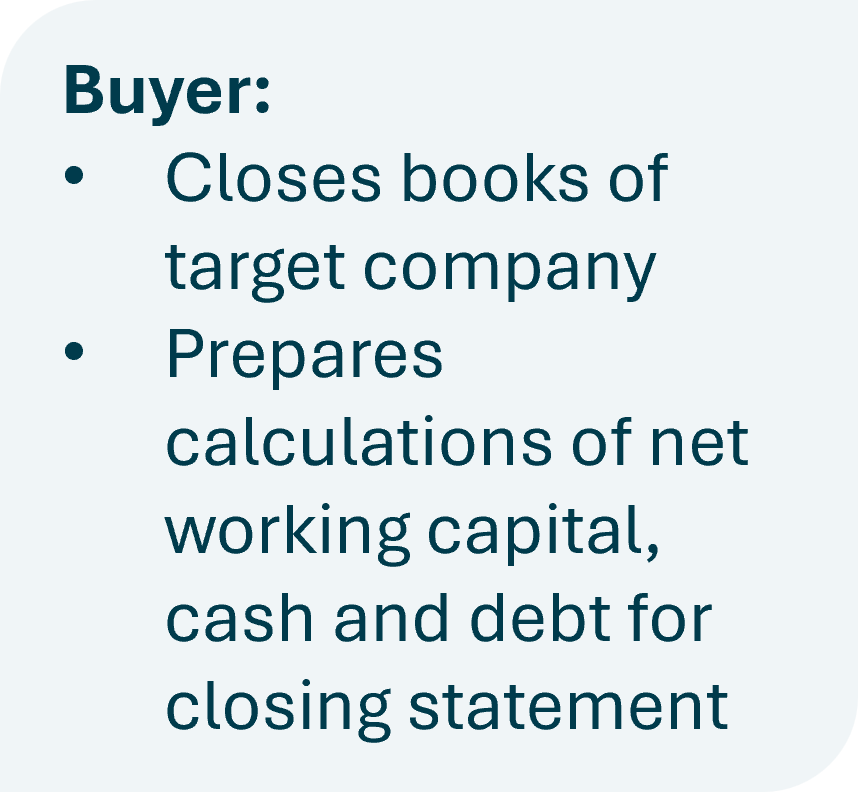
Phase 1: Closing Statement Preparation
Following closing, the buyer is typically required to prepare and deliver a closing statement to the seller within a defined period, often 90 to 120 days. This document typically sets the baseline for the post-close net working capital adjustment and often reflects the buyer’s most favorable position on the purchase price adjustment. From that point forward, any changes to the closing statement (whether made during the good faith negotiation period or accounting arbitration, which are each described below) generally move in the seller’s favor. For example, if the buyer’s closing statement reflects a $10 million downward adjustment to the purchase price, subsequent negotiations typically focus on reducing that amount (e.g., to $8 million), and it generally will not be increased (e.g., to $12 million).
The purchase price adjustment reported in the closing statement is generally driven by:
- The purchase agreement’s definitions of net working capital, cash, debt and other components of the purchase price adjustment.
- Accounting definitions and other provisions of the purchase agreement that dictate how components of the closing statement should be calculated. These provisions often require consideration of specific accounting policies (bespoke to the specific transaction), the target company’s accounting practices applied in its historical financial statements and Generally Accepted Accounting Principles (GAAP).
Items of net working capital at closing that most frequently draw scrutiny from sellers are those that either are subject to judgments and estimates or relate to transactions recorded near reporting period cut-offs. Those accounts may include:
- Inventory and obsolescence reserves
- Allowances for doubtful accounts
- Accrued expenses
We have found that closing statements that tend to best hold up against scrutiny from sellers are those that:
- Clearly map trial balance accounts to the purchase price adjustment calculation
- Strictly apply the purchase agreement’s accounting definitions and other provisions relevant to the closing statement
- Document judgment-based assumptions
- Are supported by organized, transparent workpapers
For sellers, preparation often begins before the closing statement is delivered. Sellers that have documented historical accounting practices, particularly in estimate-driven areas, are typically better-positioned to evaluate whether post-closing adjustments are contractually supported. This increased focus on early preparation reflects a broader shift in the market, where sellers are more actively scrutinizing closing statements and narrowing outcome gaps that historically favored buyers. (see How Sellers are Narrowing the Gap with Buyers in M&A Post-Close Working Capital Adjustments)
Phase 2: Reviewing the Closing Statement and Raising Objections
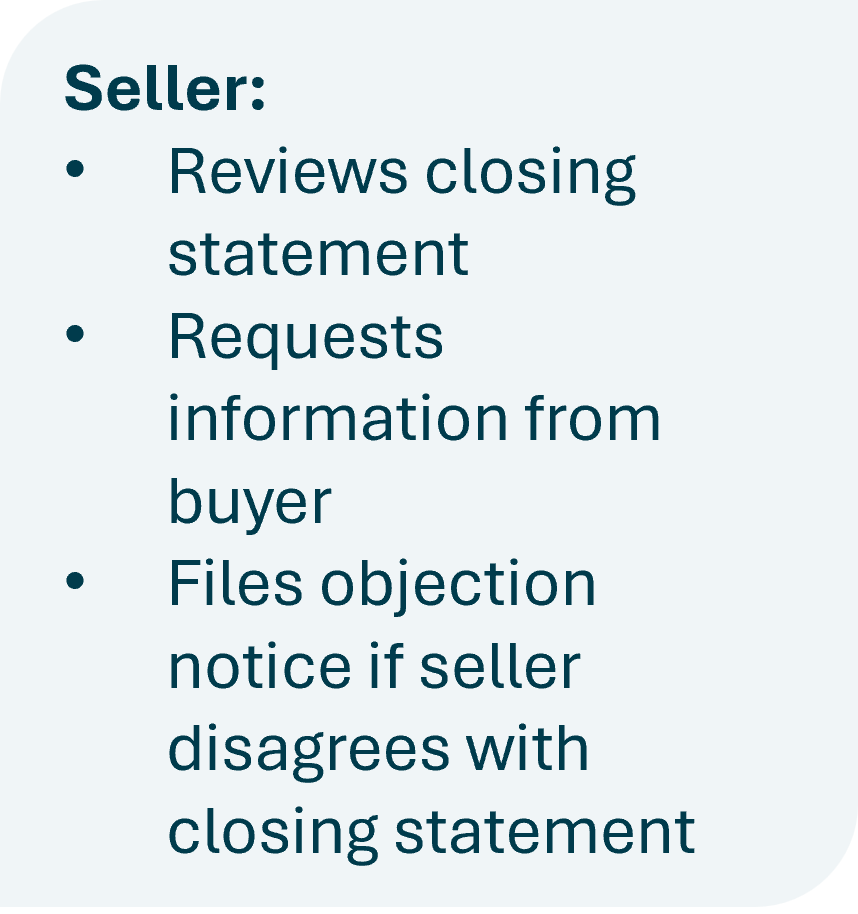
Once the closing statement is delivered, the seller generally has a limited review period, commonly 30 to 60 days, to submit an objection notice (sometimes called a “dispute notice”).
Most purchase agreements require an objection notice to be specific as to the line item and amount disputed and to explain how those components of the buyer’s closing statement were not consistent with the purchase agreement’s definitions and accounting principles.
Common challenges at this stage include:
- Objections that lack sufficient supporting detail
- Disputes over access to underlying data and workpapers
- Procedurally deficient or late objections
From a process perspective:
- Buyers can facilitate seller’s review by providing seller with organized support and responding promptly to reasonable information requests.
- Sellers can be most effective when they prioritize the accounts with the largest dollar impact or greatest degree of judgment, rather than disputing every difference. This comparison can be more informative than focusing solely on deviations from the negotiated target net working capital, which may have been set using assumptions that differ from closing-period realities. (see Bridging the Gap Between Target and Closing Net Working Capital in M&A Deals)
In practice, the objection notice often establishes the seller’s calculation of net working capital at closing that increases the purchase price as compared to the buyer’s calculation of net working capital at closing. While negotiations may reduce the magnitude of seller’s proposed increases to buyer’s calculation, they generally will not move beyond the specific objections and amounts timely raised by the seller in the objection notice.
Taken together, the closing statement and the objection notice typically establish the outer bounds, or “goal posts,” of the post-closing net working capital adjustment dispute. Issues or amounts not properly raised at these stages could be barred from later negotiation or neutral accountant proceedings, making these documents critical in constraining the scope of any net working capital dispute.
Phase 3: Good-Faith Negotiation
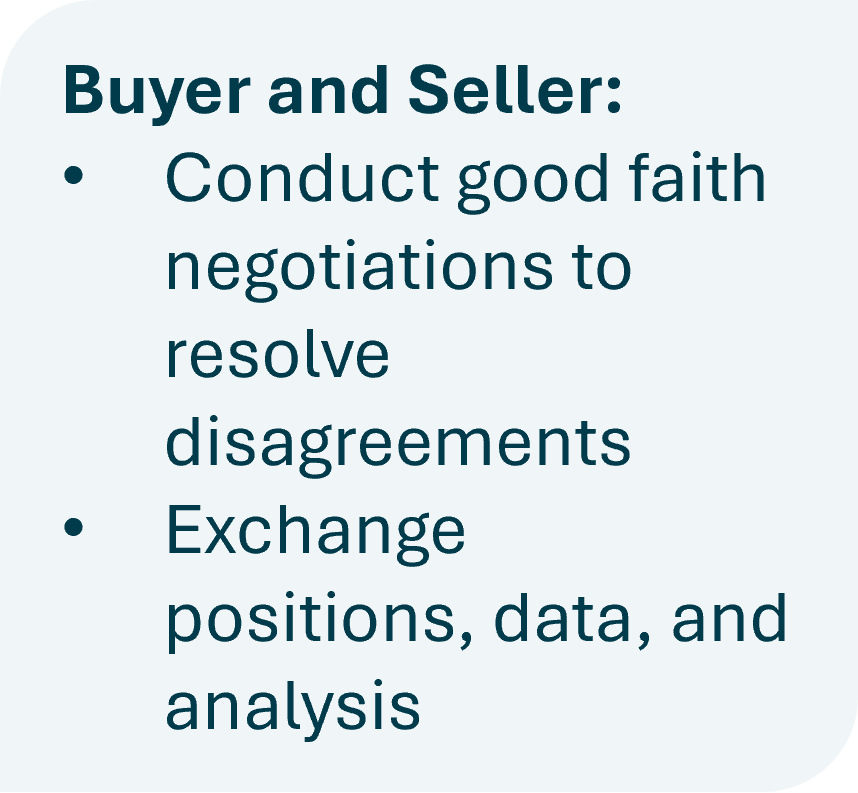
After a seller delivers its objection notice, the buyer and seller typically enter a good-faith negotiation period to resolve the items described in the objection notice, with all undisputed items from the closing statement deemed final. The good-faith negotiation period is typically defined in the purchase agreement as 30 days, but buyers and sellers may agree to extend this period if negotiations have been productive.
In practice, negotiations are more productive when parties:
- Anchor positions in the purchase agreement
- Support those positions with clear analyses
Phase 4: Neutral Accountant Determination
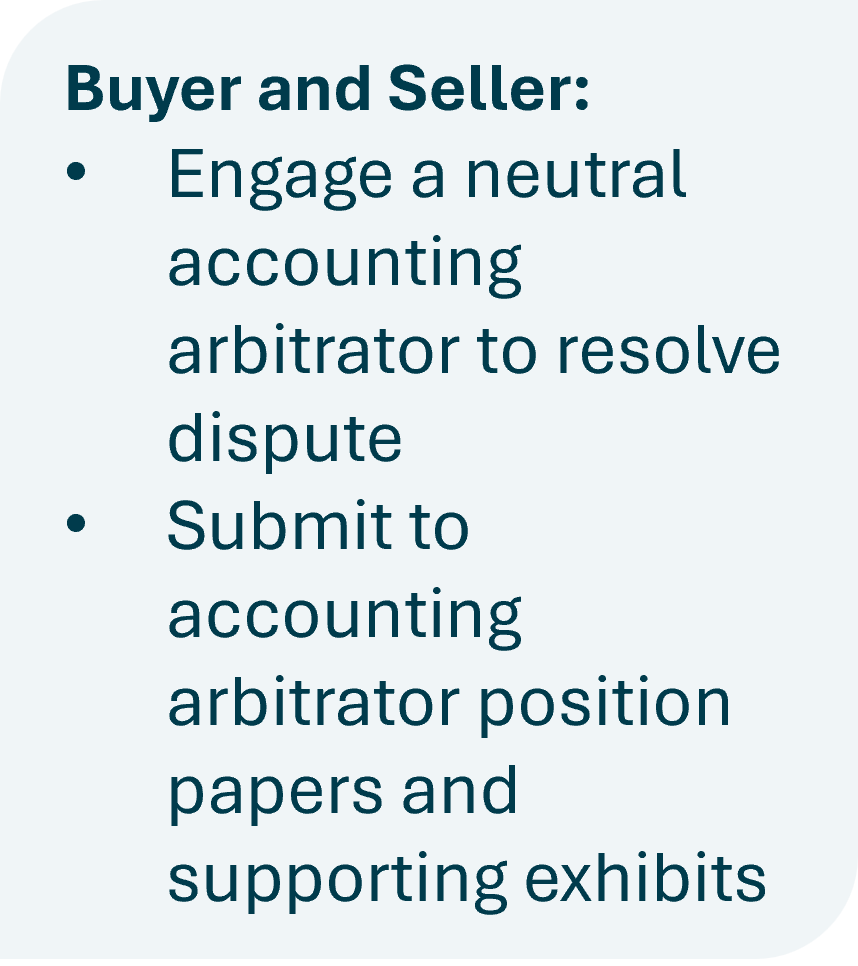
If net working capital disputes identified in the objection notice remain unresolved after the expiration of the good-faith negotiation period, the purchase agreement typically requires these unresolved items to be submitted to a neutral accountant for determination of the final purchase price adjustment, a process often referred to as an “accounting arbitration.” The neutral accountant’s authority is usually limited to accounting matters and does not extend to legal interpretation.
Many purchase agreements require the neutral accountant to select a value for each disputed item that is equal to or between the buyer’s and seller’s respective positions.
In these proceedings, neutral accountants generally focus on:
- Whether the positions of each of buyer and seller comply with the purchase agreement’s definitions and closing statement provisions
- The quality of the supporting documentation
Positions that extend beyond the scope of the purchase agreement or rely primarily on deal economics are often less persuasive.
Pre-Signing ConsiderationsAlthough this article focuses on post-closing mechanics, many disputes can be mitigated before signing through thoughtful drafting and alignment of expectations. Common risk-reduction steps include:
Pre-close involvement of accounting advisors can help translate commercial intent into language in the purchase agreement that is more likely to function as intended post-close. |
Conclusion
Post-close net working capital calculations are often intended by the parties to be straightforward, but they frequently become contentious when accounting judgment, documentation and contractual interpretation intersect.
A clear understanding of the purchase price adjustment process, combined with disciplined preparation at each stage, can materially reduce friction and help preserve deal value. For parties navigating post-closing adjustments, the most effective approach remains a consistent focus on the purchase agreement, supported by clear analysis and well-documented accounting positions.
Lincoln International’s Disputes team has extensive experience representing both buyers and sellers in post-close net working capital and purchase price adjustment disputes. Our team combines technical accounting expertise under both GAAP and IFRS with extensive experience in accounting arbitration proceedings to help clients navigate the purchase price adjustment at every stage of the process.
- This article will not address earnouts, which we will cover in a future article.