European Private Markets M&A: From Scale to Strategic Capabilities
Consolidation in asset management is not new, but mergers and acquisitions (M&A) activity has accelerated. Across the broader asset management industry, 2026 year-to-date deal value has reportedly surpassed all prior years on record at ~$55 billion,1 and three of the five highest years by aggregate announced deal value have occurred since 2021. This provides a backdrop to a more varied set of transactions among European private markets managers.
While headlines often focus on the large mega-deals—such as Nuveen / Schroders, Victory Capital / First Eagle and EQT / Coller Capital—an equally important development is taking place among smaller and mid-sized private markets managers. Increasingly, the objective is not simply to combine assets under management (AUM) but to secure complementary investment capabilities, distribution reach, growth capital and institutional infrastructure. The route chosen depends on what each manager needs and what its shareholders wish to retain.
Summary
- Lincoln International’s financial services experts unpack trends driving consolidation in the European asset management market.
- Sign up to receive Lincoln's perspectives


What is driving increased consolidation?
1
Capital is becoming more concentrated. Private capital fundraising remains substantial but unevenly spread across managers. According to Preqin, the 100 largest private capital funds by aggregate capital raised at final close accounted for ~50% of global private capital commitments in 2024, compared with ~34% in 2021.2 Although this measures concentration at the fund rather than manager level, it highlights the challenges facing smaller managers as LPs become more selective. Slower distributions and portfolio constraints also limit new commitments, increasing competition for LP attention and the importance of a strong fundraising proposition.
2
Capital requirements can also constrain growth. As managers grow, so too do the demands on their balance sheets. Larger successor funds require larger GP commitments, while seeding adjacent strategies, warehousing investments and supporting new teams can require meaningful additional capital. For smaller managers, these demands can be particularly meaningful when growth capital is funded primarily from partner economics and the firm’s own balance sheet.
3
Distribution is evolving. Institutional investors are increasingly looking to build deeper relationships with a narrower group of managers, while private wealth and insurance are becoming increasingly important channels for fundraising. According to Bain & Company,3 individual investors represent ~50% of global assets but only ~16% of assets under management in alternative investment funds. Accessing this opportunity requires product development, regulatory capabilities and dedicated distribution resources—areas where a broader, more established platform can bring clear advantages.
4
Infrastructure costs are increasing. Technology, data, reporting, compliance and fund operations have become a larger part of the institutional asset management proposition. BCG4 found that total costs grew at a 6% compound annual growth rate between 2022 and 2024 in its proprietary asset management benchmarking sample. Many of these costs are relatively fixed, creating greater operating leverage as a manager grows and strengthening the economic rationale for sharing infrastructure across a broader asset base.
Together, these pressures are changing not just the volume of M&A but its purpose. Managers are increasingly seeking capabilities, capital and distribution that may be difficult or slow to build independently.
Three Routes to Building a Stronger Platform
Combine to create scale
A merger of equals can create a broader proposition without one firm being absorbed into a much larger organization. The rationale is strongest where the partners contribute distinct investment capabilities, distribution relationships or capital resources rather than simply combining assets under management.
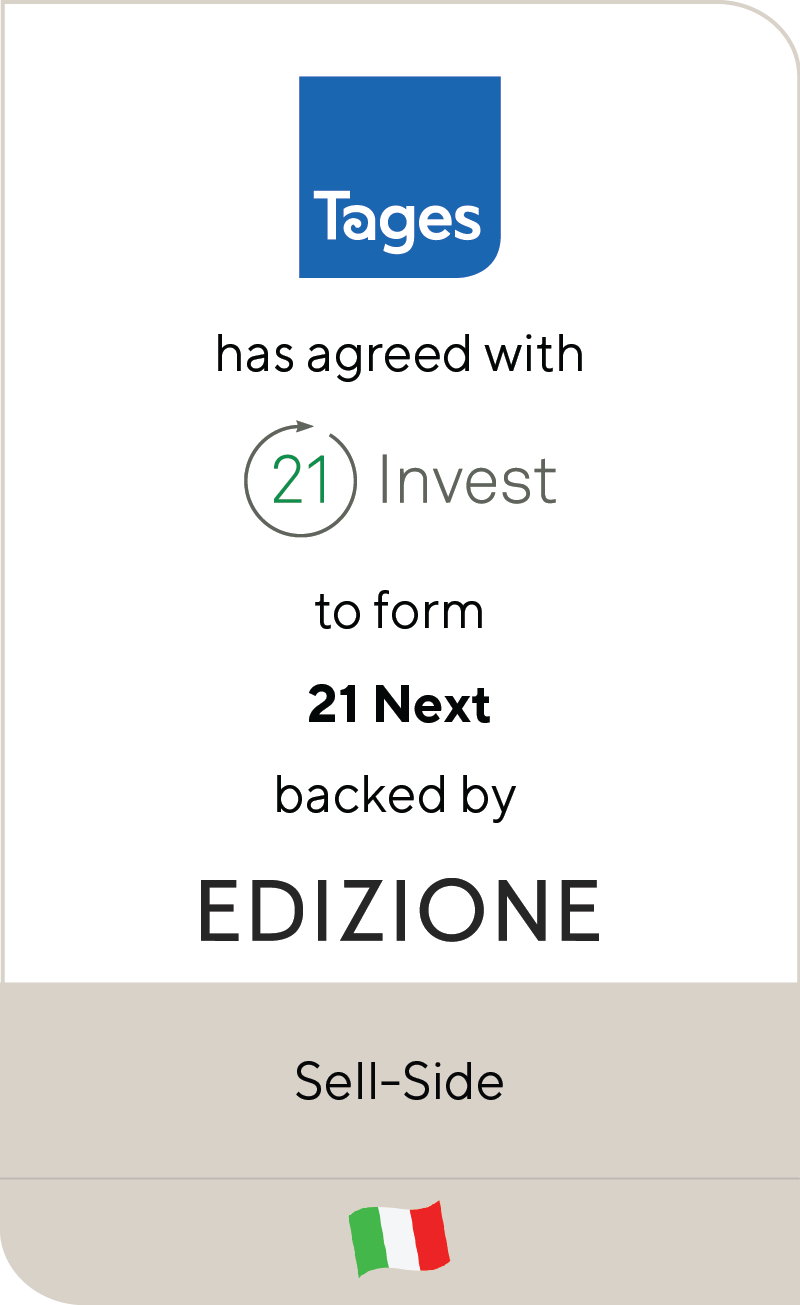
The creation of 21 Next illustrates this approach. Tages Capital and 21 Invest bring complementary infrastructure and private equity capabilities into a broader platform, backed by Edizione. Alongside the combination, Edizione’s €500 million commitment provides capital to seed strategies, support GP commitments and pursue selective acquisitions. The strategic proposition is therefore as much about funding future growth as combining existing AUM.
Other recent combinations include Cerea Partners and Demeter Investment Managers, which merged to form Demea Invest; Praetura Ventures and Par Equity, which came together to form PXN Group; Icona Capital and Stoneweg, which combined to form SWI Group; and GHO Capital and CBC Group, which announced in May 2026 that they are joining forces to create what they describe as the largest dedicated healthcare investment manager globally. Together, these transactions demonstrate that complementary specialisms can underpin combinations across manager sizes and strategies.
Partner to access scale
A second route is to partner with a more established platform. For a specialist manager, this can provide access to distribution, capital and infrastructure while allowing the investment franchise to retain its identity. This route can also include full acquisitions where the strategic rationale is access to a larger platform, not necessarily retained ownership or autonomy. For the acquirer, the attraction is often a capability or geographic presence that would take time to develop organically. The commercial case depends on making those advantages tangible without undermining the specialist team’s investment proposition.
RoundShield Partners’ partnership with Harrison Street illustrates this model. Harrison Street acquired 60% of the European credit manager in 2025, with RoundShield’s senior management retaining 40% and continuing to lead the business. The strategic logic was access to wider distribution, capital formation capabilities, business infrastructure and potential seed or bridge capital while preserving the specialist European credit expertise on which RoundShield was built. The business has since rebranded as Harrison Street Asset Management Europe.
DWS’s October 2026 agreement to acquire 100% of Peakside Capital Advisors (pending completion) illustrates a similar approach in European real estate, while transactions involving Apera, Committed Advisors and Rantum demonstrate the breadth of this model across other private markets strategies.
Acquire to extend scale
A third route is for smaller managers to become acquirers themselves.
Selective bolt-ons can extend a manager’s capabilities or geographic reach without requiring a transformational merger. Jolt Capital’s acquisition of Mirova’s private equity business adds a complementary, earlier-stage capability, while CapMan’s majority acquisition of CAERUS established real asset debt as a new investment area. In both cases, the rationale goes beyond the AUM acquired: The new capability can broaden the proposition to existing and prospective investors.
Selected European Private Markets Consolidation Transactions
Combine to create scale


May 2026
>$21bn combined AUM

Dec 2025
~€3.0bn combined AUM


Jun 2025
~£700m combined AUM
Mar 2025
>€10bn combined AUM

Jan 2025
~€2.8bn combined AUM
Partner to access scale


Oct 2026
100% acquired*
>€1.7bn AUM


Jun 2026
100% acquired
€1.2bn AUM
Apr 2026
56% acquired
€7.7bn AUM


Jul 2025
60% acquired
$5.4bn AUM


Jun 2025
Majority stake
>€5bn AUM
Acquire to extend scale
Private equity business
Oct 2026
100% acquired
~€220m AUM

Jun 2026
100% acquired
~£400m AUM

Sep 2025
100% acquired
~£2bn AUM


Aug 2025
100% acquired
~€3bn AUM

Jun 2025
51% acquired
~€700m AUM
Notes: AUM as at announcement date
*Pending completion
Sources: company announcements, Lincoln research
These routes show that consolidation is not exclusively a process of the largest managers acquiring smaller firms; middle market specialists can also use M&A to shape their own growth.
However, while consolidation can bring multiple benefits to managers, these benefits are not automatic. Combinations can introduce integration costs, governance conflicts, investment-team departures and disruption to client relationships. Broader distribution does not necessarily translate into additional commitments, and shared infrastructure may take time and investment to deliver efficiencies. Outcomes depend on transaction structure, execution and the ability to preserve the specialist capabilities that motivated the combination.
A broader consolidation market
Across these transactions, the defining consideration is scope as well as scale: Complementary investment capability, distribution, growth capital or infrastructure can matter more than headline AUM.
Several recent structures preserve management ownership and autonomy, recognizing the importance of investment talent and the specialist franchise.
Peer combinations, strategic partnerships and bolt-on acquisitions serve different needs: complementary capabilities, access to capital and distribution or targeted expansion.
The next phase of European private market M&A is unlikely to be defined by scale alone. The more consequential question is whether combinations can translate complementary investment capabilities, distribution and capital into sustainable fundraising growth, while preserving the investment performance and entrepreneurial culture on which specialist managers have built their franchises.
Sources
- Dealogic data reported by the Financial Times, August 2026.
- Preqin, “Fundraising 2024 and 2025 Themes and Trends: LP Appetite for ‘Creative Liquidity Solutions’ Could Help Recycle Capital,” March 2025.
- Bain & Company, “Global Private Equity Report 2025,” March 2025.
- BCG, “Global Asset Management Report 2025: Becoming Radically Leaner to Boost Resilience,” April 2025.