
Electricity generation from renewable (%) & Global renewable energy investments ex. China (US$ bn)
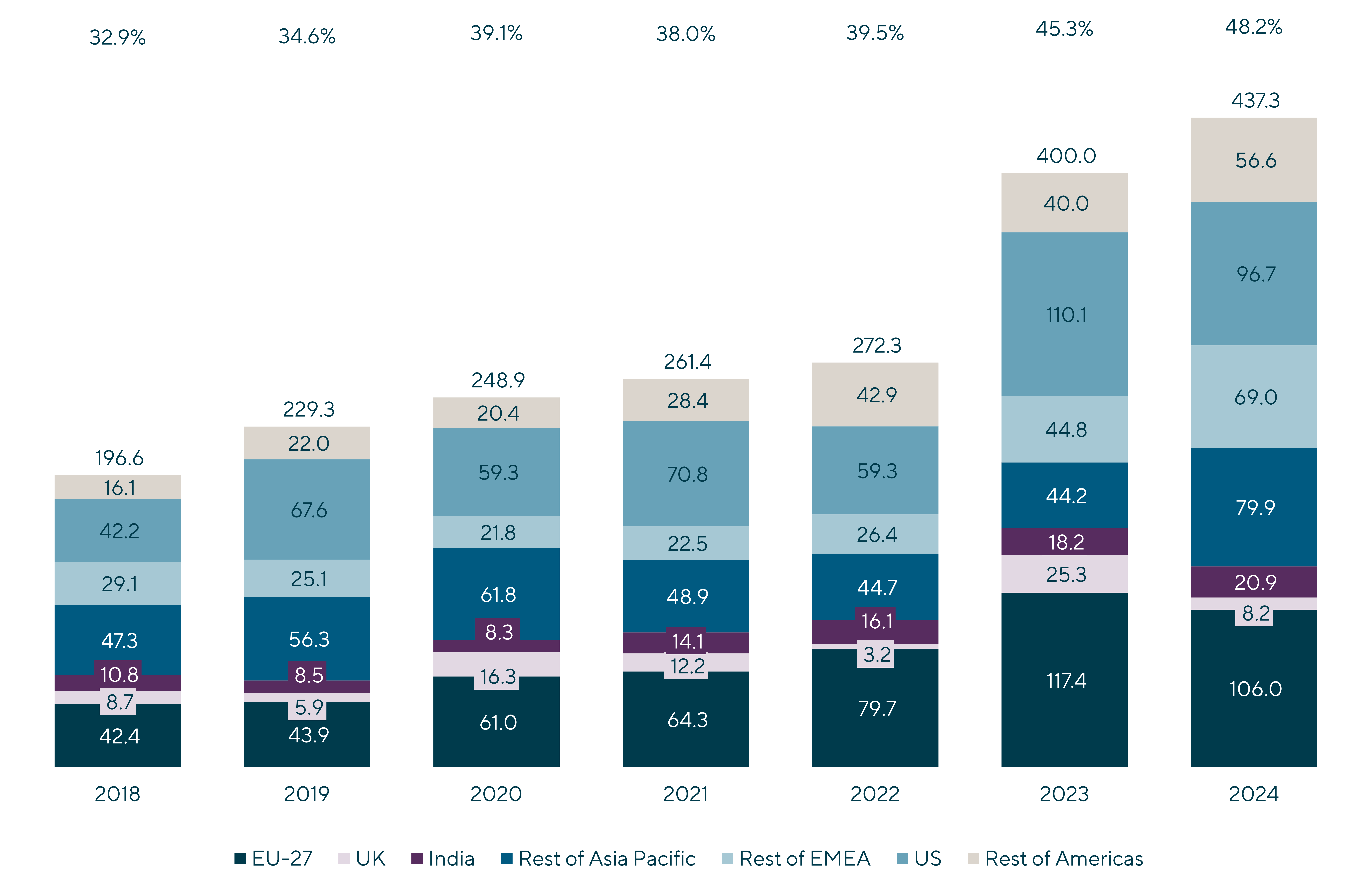
Source: Eureletric, BNEF
Yet, within this challenge lies opportunity. Asset investors have identified new ways to extract value by bypassing traditional grid constraints. Solutions that present actionable investment themes with measurable returns include repowering aging wind farms, hybridizing renewable assets with storage and deploying behind-the-meter generation for data centers.
Lincoln International’s dedicated team of bankers is uniquely positioned to navigate the global Energy Transition, Power and Infrastructure sector. Our bespoke advisory processes, informed by proprietary index data and research, help position our clients for growth and assess strategic options amid shifting market trends. This paper explores the evolving strategies turning infrastructure bottlenecks into scalable, bankable opportunities. It also considers the policy shifts, financing mechanisms and trends in mergers and acquisitions (M&A) that make these strategies particularly attractive in today’s macro environment.
1. Grid Constraints and their Impacts
|
1.1 |
Connection delays and idle assets
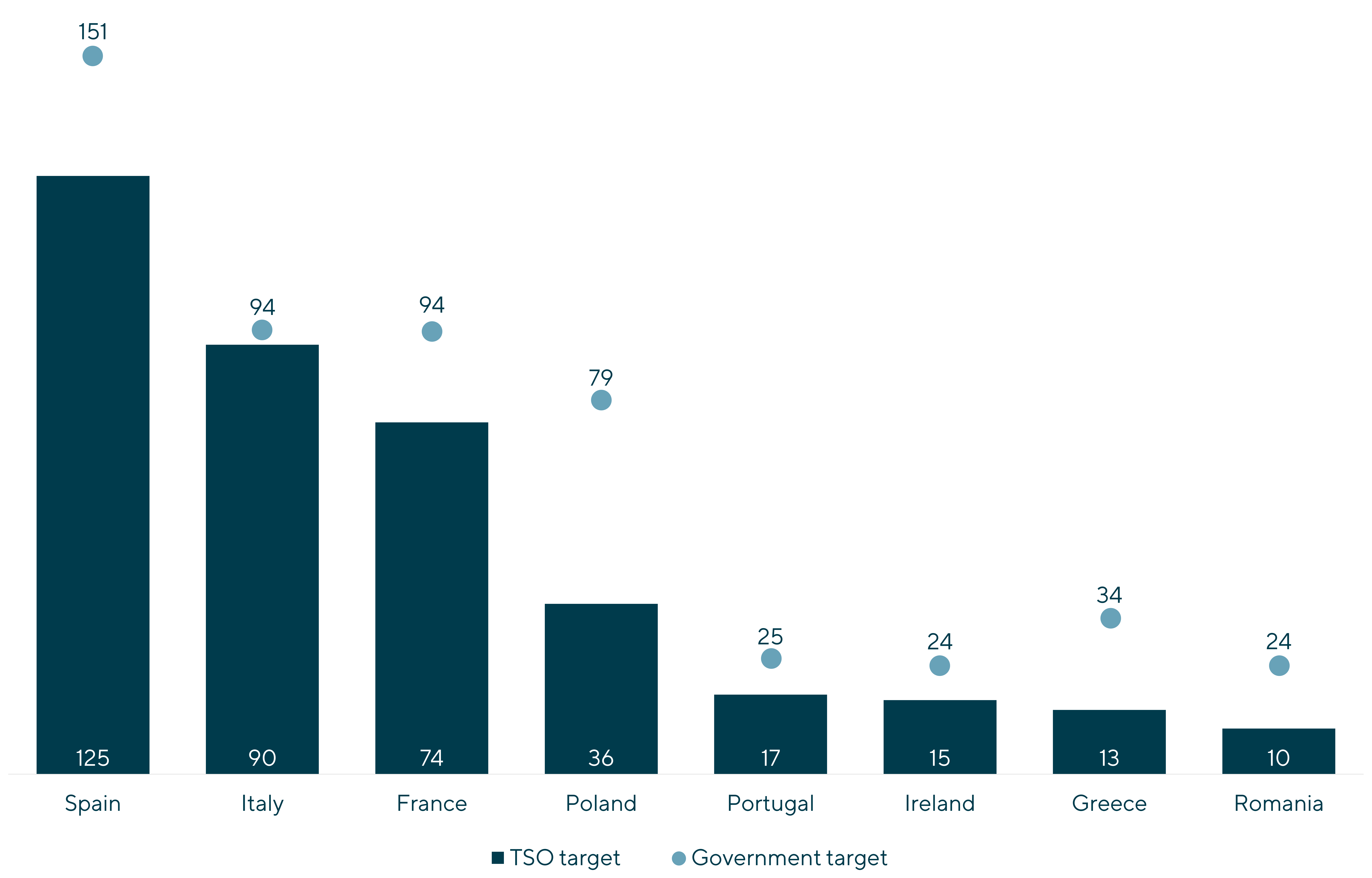
Europe’s transmission and distribution infrastructure is aging and ill-equipped for the required scale of renewable integration1, and most Transmission System Operators (TSOs) are falling short of building sufficient grid capacity to meet national energy targets. For example, Poland is projected to reach only half of its solar and wind goals by 2030 under its current grid expansion plan. These limitations are increasingly material to investors who rely on accurate commissioning timelines to project returns. TSO grid plans for solar/wind capacity vs 2030 energy policy targets (gigawatts)
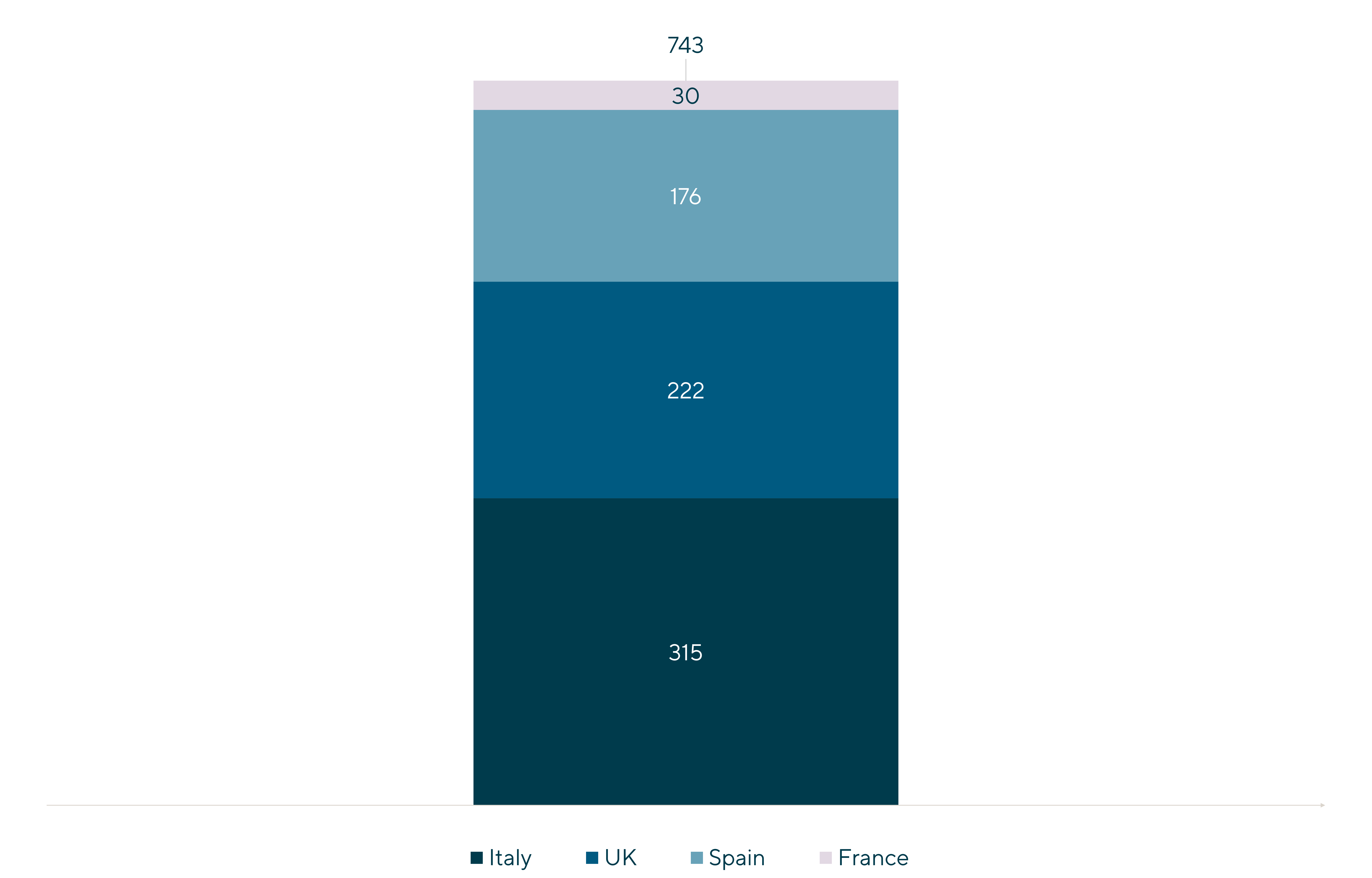
Grid connection queues for wind and solar in select countries (gigawatts)
Source: Neuroelectric, BNEF In the UK, nearly 220 gigawatts of solar and wind projects are in the connection queue, with developers facing average delays of 5.5 years. Similarly, a nearly 900 megawatts offshore wind farm in Germany completed in early 2025 will remain offline until 2026 due to ongoing grid connection works. These delays defer cash flows, introduce macroeconomic exposure (e.g., interest-rate risk, power price volatility) and reduce the attractiveness of merchant-risk profiles. The impact on valuation is twofold: first, project internal rate of returns (IRRs) are compressed due to increased holding periods and higher interest costs; second, delayed assets lose relevance in rapidly changing price environments, especially when forward price curves shift unpredictably. These factors also complicate debt structuring, increase reliance on sponsor equity and push sponsors toward higher-risk project profiles. |
|
1.2 |
Negative pricing and generation curtailment
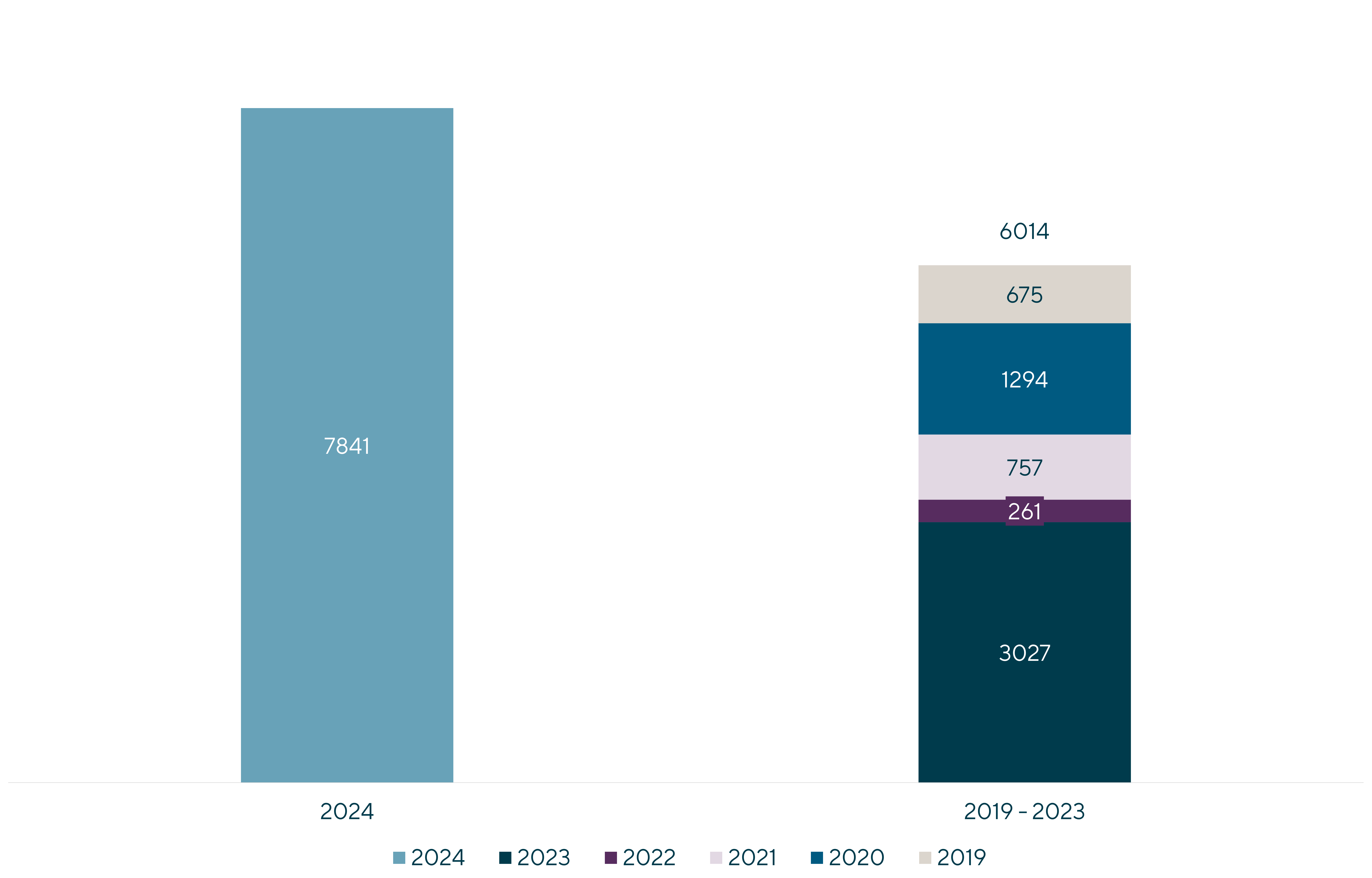
Periods of overgeneration from intermittent renewables often lead to negative electricity prices, especially in areas with limited interconnection. From January to August 2024, Europe experienced over 7,800 hours of negative pricing, exceeding the combined total from 2019 to 2023. The Iberian Peninsula, with just 3% cross-border interconnection2 versus the EU’s 15% target, was notably impacted. Negative pricing and curtailment challenge project economics, particularly for investors exposed to wholesale market dynamics. In the absence of hedging mechanisms such as floor-priced power purchase agreements (PPA) or capacity remuneration, returns can be eroded. As a result, some markets may require revised policy support or innovative structuring to sustain investment appetite. More broadly, negative pricing underscores the mismatch between rapid generation deployment and slower infrastructure adaptation. Investors must assess the curtailment risk of any given project, quantify the impact of seasonal volatility and structure returns accordingly. Merchant models3, while offering upside, need to be backed by sophisticated forecasting and monetization strategies, including flexibility-enhancing co-located storage. Number of negative price hours in Europe, Jan-Aug
Source: Ember Energy |
2. Strategic Responses to Grid Bottlenecks
|
2.1 |
Repowering of existing wind farms
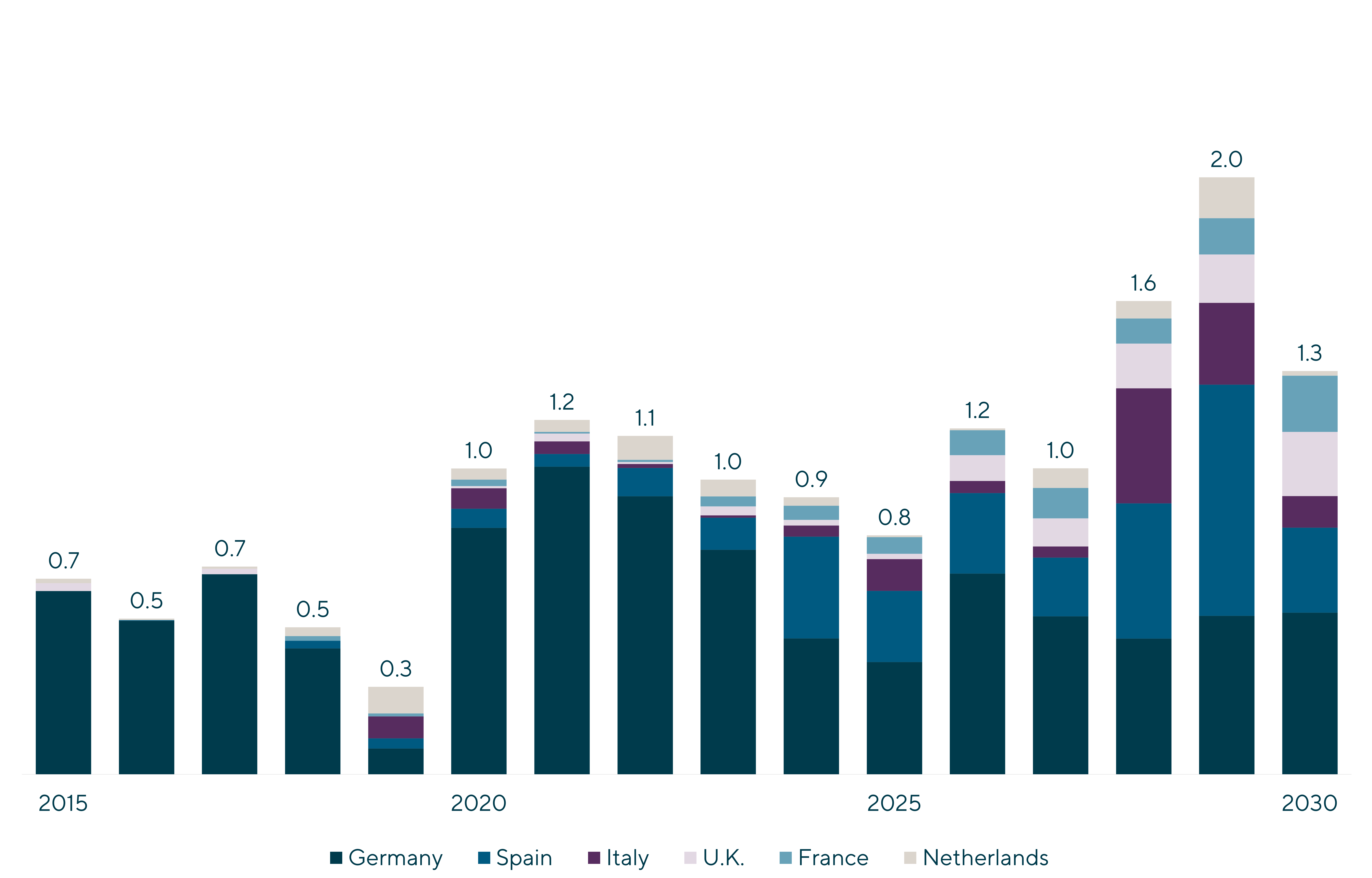
Repowering4 enables investors to capture enhanced yields and extend asset life by replacing aging turbines with larger, more efficient models. Leveraging existing infrastructure such as substations and grid connections reduces both capex and permitting timelines. The EU has reduced permitting requirements, and BNEF forecasts 8 gigawatts of repowering in Europe by 2030—equating to over €7 billion in capital needs and €4–5 billion in potential project finance volume. Germany leads this trend, with investor-backed vehicles actively acquiring portfolios for repowering. One major fund has committed €1.2 billion to a focused buy-and-repower strategy, having completed several deals since 2024. Beyond the cost and timeline efficiencies, repowering offers more predictable returns. With long-standing yield histories and known site conditions, lenders are more comfortable underwriting leverage. Investors also benefit from more competitive PPAs, as repowered sites often secure improved pricing due to increased capacity and dispatchability. Moreover, repowering allows a natural entry point for long-term infrastructure investors looking to recycle capital into familiar geographies and technologies. Annual installation of repowered onshore wind capacity in Europe (GW)
|
|
2.2 |
Hybridization with battery storage and wind-solar projects
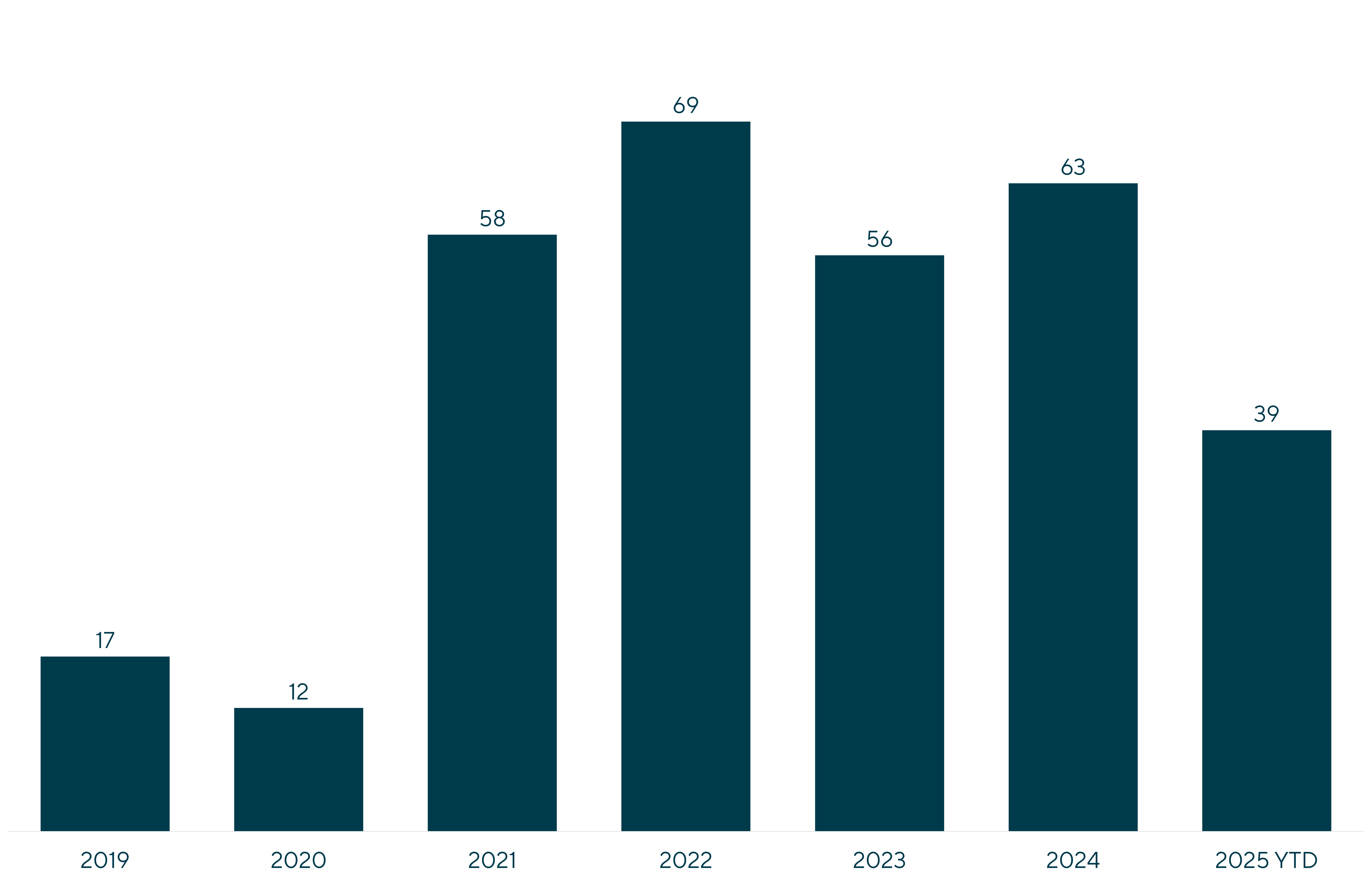
Pairing wind or solar assets with battery energy storage systems (BESS) is becoming an increasingly bankable strategy. Storage enhances revenue stability by enabling arbitrage across price periods and mitigating curtailment. The UK’s latest T-4 auction5 awarded 1.8 gigawatts of 15-year contracts to BESS assets, and Italy will initiate MACSE auctions6 in 2025 targeting 50 gigawatts of capacity by 2030. Wind-solar hybrid projects also allow co-location and shared grid use, optimizing land, capital expenditure and yield. EDP Renewables has delivered over 300 megawatts of hybrid projects across Iberia and Poland, showcasing the viability of this model at scale. Financial investors are increasingly targeting platform investments that combine generation with flexible capacity, especially as PPAs evolve to reward dispatchability. BESS also opens the door to multiple revenue streams—from capacity markets and frequency response services to day-ahead trading and imbalance mitigation. These diversified earnings are increasingly critical in underwriting long-dated debt and sustaining equity valuations. Number of European M&A transactions in Battery Storage
Source: Infralogic |
|
2.3 |
Behind-the-meter generation for data centers
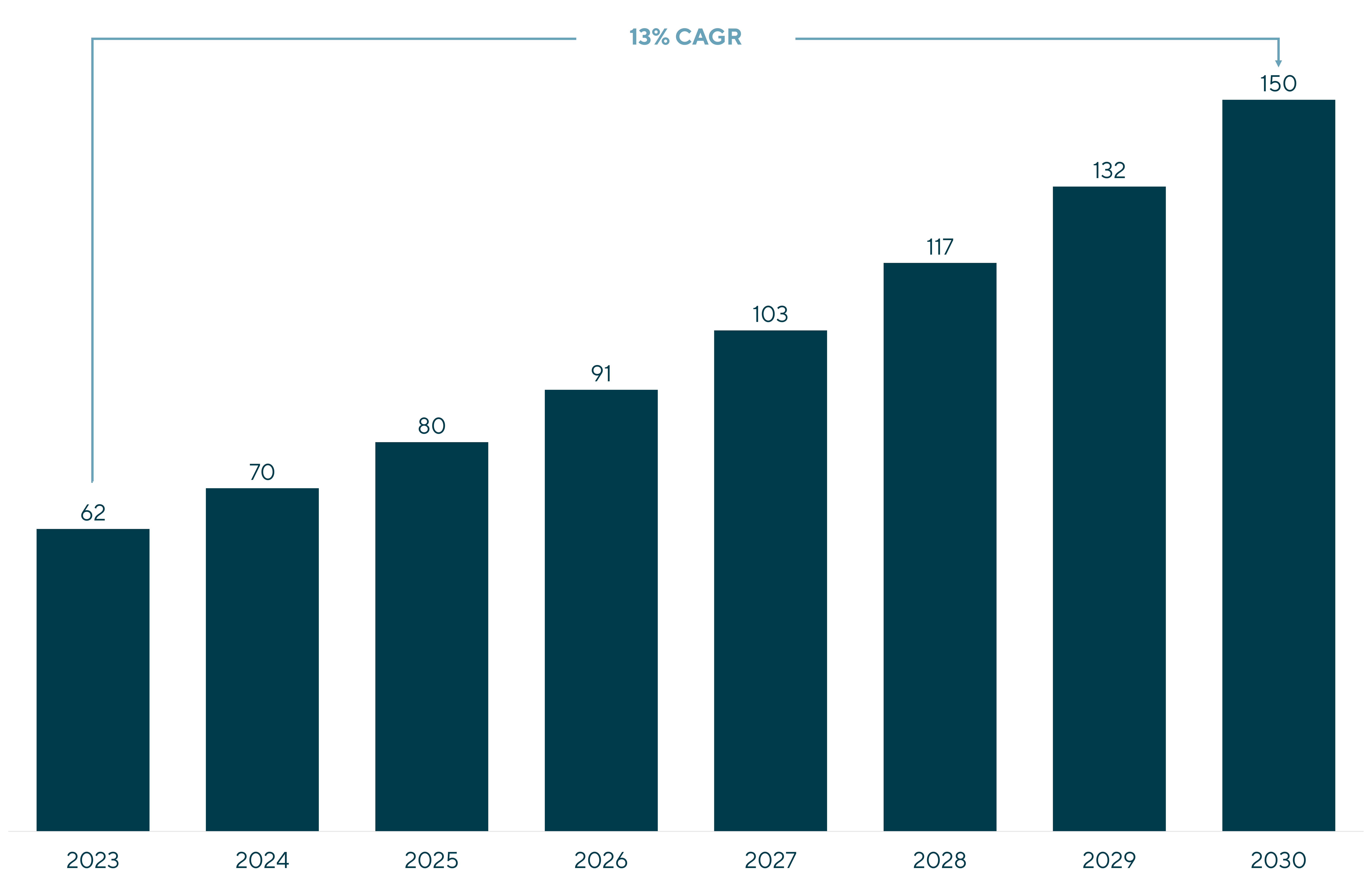
Behind-the-meter renewable generation7 for data centers presents an emerging investment class with contracted, inflation-linked revenues. With AI projected to drive data-center power demand from 62 TWh in 2023 , operators are seeking resilient energy supply models. On-site renewables and microgrids eliminate exposure to grid delays and create long-term offtake certainty. This model has gained traction in the U.S., with 19% of operators deploying on-site power as of 2024. In Europe, large energy firms are forming strategic partnerships; for example, Vattenfall and Cloud&Heat Technologies linked a biomass plant to a Stockholm data center. These models offer investors stable returns in mission-critical infrastructure backed by strong demand fundamentals. For financial investors, this space represents a growing intersection of energy and digital infrastructure. The increasing power intensity of AI workloads and edge computing has created a structural need for energy independence, which renewables are uniquely positioned to serve. Paired with long-term offtake agreements and index-linked pricing, behind-the-meter assets can anchor infrastructure portfolios with resilient, low-volatility returns. Data center energy consumption in Europe (TWh) Data center energy consumption expected to increase from 62TWh in 2023 to 150TWh in 2030
Source: McKinsey |
3. Emerging Themes: Policy, M&A, and Structuring Implications
|
3.1 |
Policy alignment and risk allocation
The European Commission’s upcoming Grids Package (Q1 2026) is expected to introduce permitting streamlining, standardized tender frameworks and incentives for co-located storage. Investors should monitor national-level implementation closely, as grid-priority schemes and capacity payments can significantly enhance project bankability. Governments are also increasingly aware of the role institutional capital must play in infrastructure build-out. New de-risking mechanisms—such as Contracts for Difference (CfD) expansions, availability-based support for storage or guarantees for merchant tail revenues—are being piloted by private capital. |
|
3.2 |
M&A and platform consolidation
In response to these dynamics, platform-level M&A is accelerating. Investors are actively aggregating repowering-eligible portfolios, acquiring hybrid-ready sites and partnering with corporate offtakes. Valuations continue to favor buyers who bring integration or development capabilities. Mid-cap developers with grid-ready land banks, permitting expertise or operational BESS assets are increasingly sought after. Consolidation in this space is expected to continue, particularly as private equity funds seek exit options via trade sales or IPOs once equity capital markets re-open to this segment. |
|
3.3 |
Financing Structures and Value Creation
As project risk profiles evolve, so must financing structures. Hybrid projects and storage-backed PPAs often require more bespoke debt packages, blending merchant exposure with contracted revenue floors. Structured equity, holding company financing and tailored mezzanine tranches are becoming essential tools for sponsors aiming to optimize capital stacks. Investors who can underwrite both technology and regulatory risk are best positioned to capture premium returns in the current environment. |
Turning Constraints into Investable Themes
Europe’s energy transition is not only a climate imperative but also an asset-class evolution. While grid constraints pose real challenges, they are catalyzing differentiated investment strategies that combine regulatory support with scalable deployment models. Repowering, hybridization and behind-the-meter generation all present routes to de-risked, value-accretive returns.
Lincoln International’s Energy Transition, Power and Infrastructure Group has advised on over 60 transactions in the past three years, including 21 in 2024. We are currently working with investors across Europe to identify and execute on these very opportunities. With deep sector expertise and a global footprint, Lincoln is uniquely positioned to help financial investors capitalize on the next wave of energy infrastructure deployment.
1 Incorporating energy generated from renewable sources into existing electricity grids.
2 Linking separate electricity grids, typically across national borders, using high-voltage cables.
3 Selling electricity into the wholesale market at market price instead of relying on long-term, fixed-price contracts.
4 Replacing or upgrading major components such as solar modules and wind turbines to improve the lifespan, efficiency, and capacity of a power plant.
5 Capacity Market auctions in the UK are held four years in advance of the delivery year. Successful bidders receive capacity payments in return for committing to supply electricity during periods of peak demand or system stress.
6 The Capacity Market auction in Italy.
7 Building a renewable energy asset directly alongside the data center in order to supply electricity directly to the data center without the national grid.
Contributor

Related Perspectives
in Energy Transition, Power & Infrastructure
Recent Transactions in Energy, Power & Infrastructure









Power in Transition: Strategies for Renewable Asset Investors
Turning Grid Challenges into a Catalyst for Europe’s Renewable Future Europe’s renewable energy sector stands at a pivotal juncture. After years of rapid expansion, clean energy’s momentum is being tested… Read More

Court Square has sold RailPros to Littlejohn & Co.
RailPros RailPros is a leading provider of outsourced safety management, design & engineering, inspection, site & program management, utility observation and training solutions to rail operators, utilities, state DOTs and… Read More

Six Key Themes from Infrastructure Investor Global Summit 2025
Lincoln International’s Energy Transition, Power & Infrastructure Group recently attended the 2025 Infrastructure Investor Global Summit, one of the industry’s largest events that brought together 3,000 of the world’s top… Read More

Oaktree’s Power Opportunities Group has sold Richards Manufacturing for approximately $2.3 billion
Richards Manufacturing Richards Manufacturing Co. (Richards) is a best-in-class provider of utility grid products and a leader in underground distribution equipment, with differentiated positions in both medium voltage cold-shrink cable… Read More

Francisco Partners has acquired Quorum Software from Thoma Bravo
Quorum Software Quorum Software is a leading provider of energy software worldwide, serving more than 1,500 customers across the entire energy value chain in 50 countries. Quorum’s solutions power growth… Read More

Tessco Technologies, majority owned by Lee Equity Partners and Twin Point Capital, has sold Ventev, a division of Tessco Technologies, to Hubbell Incorporated
Ventev Located in Timonium, Maryland, Ventev is a leading manufacturer and provider of a complete ecosystem of solutions to power, protect and connect wireless networks. Ventev serves enterprise, industrial and… Read More

2025 Energy Transition Outlook: Digitalization, Decentralization and the Future of Power
The global energy transition is being shaped by two interconnected forces: digitalization and decentralization. These pillars are not only reshaping how energy is produced, managed and consumed but are also… Read More

PE Hub | GPs Skeptical of European IPO Revival; Private Capital “Crucial” in UK Nuclear Energy Development
Originally posted by PE Hub on February 10, 2025 Carlos Candil, Managing Director and head of Lincoln International’s European energy transition efforts, recently shared his perspective with PE Hub on… Read More
“Leader to Leader” Series
The Leader to Leader video series turns up the dial on rich conversations with prominent leaders – from business owners and entrepreneurs to investors and CEOs – highlighting their stories… Read More
2024 Global Results

Triton Partners has sold SEDIVER to Blackstone
SEDIVER SEDIVER is a leading manufacturer of toughened glass insulators, a mission-critical element for the electric transmission grid. The company supports the energy transition by enabling the reliable and sustainable… Read More

COL Giovanni Paolo, a portfolio company of Oaktree, has acquired IME SpA, with acquisition financing provided by BPER Banca and Generali
IME SpA IME, Industrie Meccaniche Elettriche S.p.A., headquartered in Urgnano (Bergamo), is a leading producer of switchgear for industrial applications and operates through two business units: IME Quadri Duestelle and… Read More

Sentinel Capital Partners has acquired NSI Industries from Odyssey Investment Partners
NSI Industries Founded in 1975, NSI Industries is a market-leading provider of branded products for the North American electrical and heating, ventilation and air conditioning (HVAC) markets. NSI is composed… Read More

Alexander Grimston
Alex provides mergers and acquisitions and debt advisory services within the Energy Transition, Power & Infrastructure Group based in the firm’s London office. He focuses on the power and utilities,… Read More

Family shareholders has sold DRIESCHER to IK Partners
DRIESCHER DRIESCHER is a leading German manufacturer of high-tech medium and low voltage switches and switchgears. Established over 85 years ago, DRIESCHER plays an important role in advancing the energy… Read More

Global Energy Transition
Closing the gap on global emissions to align with the 2050 NetZero targets outlined in the Paris Climate Accord will be a challenge. Fortunately, such challenges often lead to opportunities,… Read More
Lincoln’s Latest
Lincoln’s Latest video series features experts from across industries, services and geographies, sharing perspectives on current trends, recent observations and future outlooks.

Mill Point Capital has acquired Pioneer CEP and Jefferson Electric to form Voltaris
Client: Mill Point Capital Client Location: United States Target: Pioneer CEP, Jefferson Electric Target Location: United States Acquirer: Mill Point Capital Acquirer Location: United States Target Descriptions: Voltaris Power LLC (“Voltaris”), a leading… Read More

Bloomberg | Lincoln International CEO on Private vs. Public Markets
Originally aired on Bloomberg TV on October 22, 2024. Rob Brown, CEO of Lincoln International, discusses improving mergers and acquisitions activity and compares public and private markets.

Brown Brothers Harriman has sold Utility Pipeline to iCON Infrastructure
Utility Pipeline Ltd. Headquartered in Canton, Ohio, Utility Pipeline Ltd. (UPL) is a provider of natural gas distribution and related services. The company services residential, commercial, industrial and government customers… Read More

Juan Carlos Montoya
Juan Carlos provides mergers and acquisitions advisory services to corporate and private equity clients across Europe, North America and Asia, with a focus on energy transition. Backed by 15+ years… Read More

Real Deals | Roundtable: Green Shoots for the UK Mid-market
Originally posted by Real Deals on September 18, 2024. The UK and wider market are filled with cautious optimism as macroeconomic challenges cool, providing hope that higher levels of transaction… Read More

Blackstone has acquired Trystar and Salient
Client: Blackstone, Blackstone Energy Transition Partners Client Location: United States Target: Trystar, Salient Target Location: United States Acquirer: Blackstone, Blackstone Energy Transition Partners Acquirer Location: United States Target Description: Trystar is a leading… Read More

Founders and investors have sold Sulzer Schmid to RES
Sulzer Schmid Sulzer Schmid, based in Switzerland, is a pioneer in autonomous drone inspections for the renewable energy sector. Their AI-powered 3DX™ Blade Platform revolutionizes blade inspections and repairs, offering… Read More

Align Capital Partners has sold SEAM Group to ABB
SEAM Group Headquartered in Beachwood, Ohio, SEAM Group provides safety, reliability and maintenance solutions that optimize energized asset performance for some of the world’s largest companies. The company partners with… Read More