
UK Master Trusts: Scale, Regulation and Consolidation
- Master trusts are the fastest-growing segment in the UK occupational defined contribution (DC) market, growing more than 20% in 2025, driven by auto-enrolment, member contributions, employer governance simplification and ongoing consolidation of single-employer trusts1
- Policy is accelerating the push to scale. Proposed minimum scale requirements, a mandatory Value for Money (VfM) framework, default decumulation solutions and targeted support will raise the bar on investment, service quality and data / technology
- Sub-scale schemes and providers face four strategic paths: merge / sell, partner, acquire books (GPP or trust) or differentiate via a niche proposition (e.g., sector focus, engagement, decumulation)
- Mergers and acquisitions (M&A) have been motivated by scale, technology and distribution access; scarcity of sizeable targets will likely increase the role of partnerships and alternative deal structures
- We believe winning platforms will combine scale, operational resilience (e.g., admin / cyber / data), a defensible investment proposition and strong employer and member journeys
Summary
- Lincoln International’s experts share insights into the UK master trust landscape and the key trends to watch in coming quarters.
- Sign up to receive Lincoln's perspectives



Market Landscape
Master trusts (MTs) are multi-employer occupational pension schemes where an employer appoints a trustee board to oversee a single trust used by multiple participating employers. MTs have become a mainstream destination for auto-enrolment Defined Contribution (DC), alongside contract-based group personal pensions (GPPs).
While the market remains dominated by contract-based schemes, representing over 50% of total assets, MTs are the fastest-growing segment within the sector.2
This growth has been driven by the implementation of auto-enrolment, rising member contributions, favourable investment performance and the consolidation of single-employer trusts into MT structures. Employers are increasingly transitioning to MTs to achieve improved member outcomes while reducing operational complexity and governance burdens.
There are over 20 MTs currently operating in the UK market. These include government-sponsored schemes, such as NEST and The People’s Pension; provider-led MTs offered by firms, such as Aviva and Legal & General; consultant-led MTs from firms, such as Mercer, WTW and Aon; industry-specific schemes (e.g. for the FCA and railway pensions); and a few independent players, including Smart Pension.
UK DC Master Trust Market Landscape Map, AuM in £b as of YE25
Source: Go Pensions. Smart Pension figures include Mercer Smart Pension and Options Master Trust. Now Pensions has been acquired by Mercer. Cushon has been acquired by WTW. Aegon UK workplace (including master trust) has been acquired by Standard Life For providers below the £25bn threshold a transition pathway is available, provided they have £10bn AuM by 2030 with a credible plan to reach £25bn by 2035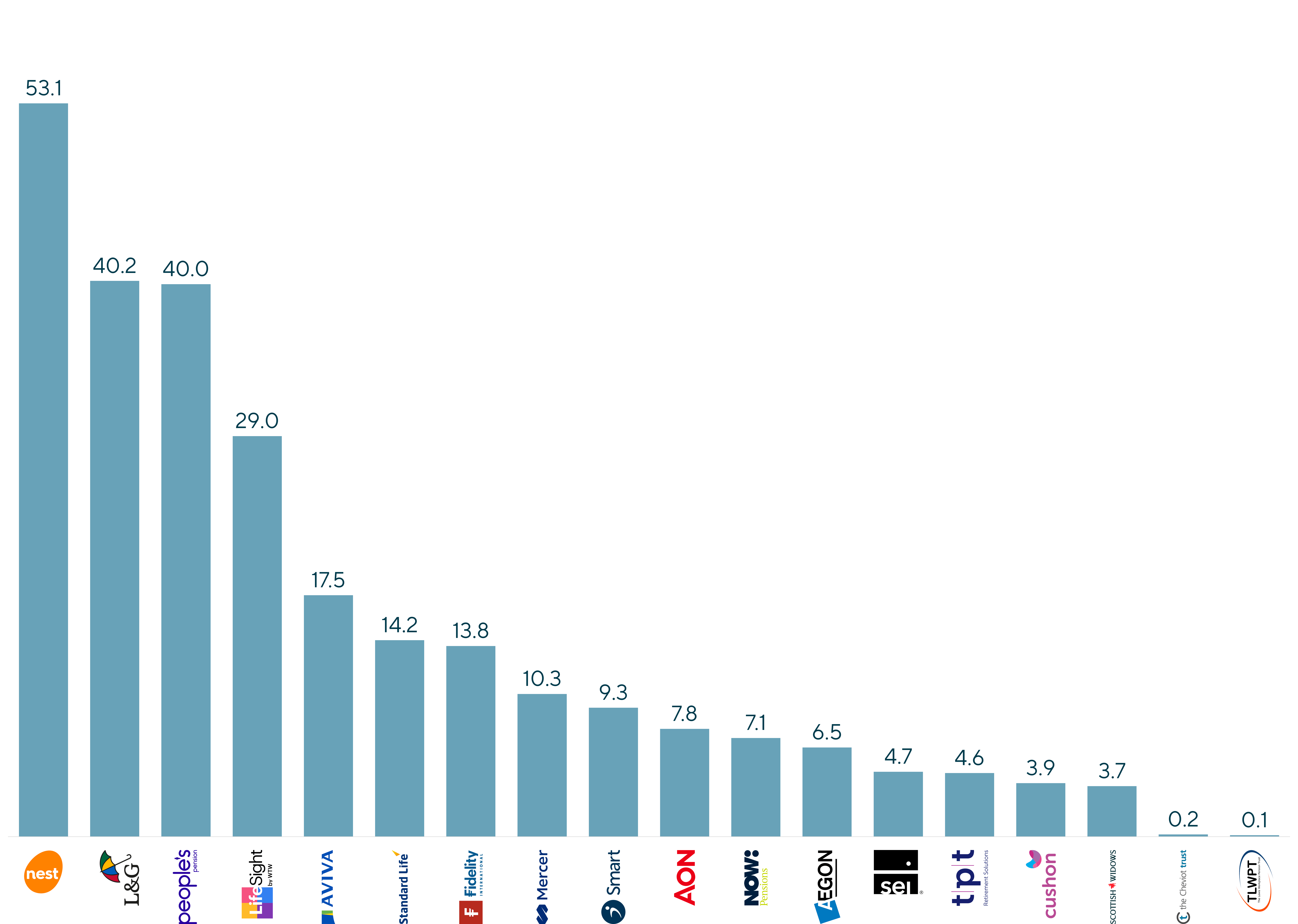
Key Trends Shaping UK MTs
1.Regulation and policy are raising the minimum bar
Government and regulatory initiatives are driving structural change across the sector, with the Pension Schemes Act 2026 representing a key watershed moment.
With overarching objectives to reduce scheme fragmentation, enhance member protection and engagement and increase investment into UK productive assets, the government has proposed several measures:
- Main scale default arrangement (megafunds): All multi-employer MTs and Group Personal Pension (GPP) providers used for auto-enrolment will be required to operate at scale, with at least £25 billion in assets in a main default investment arrangement by 2030 subject to final regulations / consultation (with a 5-year extension period for schemes that cannot reach £25 billion by 2030 but have at least £10 billion in their default arrangement).
- Value for Money (VfM) framework: DC schemes will be required to assess and disclose value across three core dimensions: investment performance, costs and charges and service quality. Schemes that fail to meet the necessary VfM rating could be forced by The Pensions Regulator to wind up and consolidate.
- Default decumulation solutions: Trustees will need to provide default retirement income options for members.
- Contractual override: Contract-based providers will be permitted to transfer members out of legacy or underperforming arrangements without individual consent when it is in members’ best interests.
- Enhanced member engagement: Measures such as targeted support and Pension Dashboards aim to improve decision-making and retirement outcomes.
Collectively, these reforms will accelerate the need for scale, drive reassessment of investment strategies and increase reliance on technology, both for customer engagement and core operational functions, such as administration, compliance and communications.
2.The scale conundrum
At first glance, the proposed scale requirements suggest that many MTs may struggle to meet the threshold by 2030. However, commentators have suggested that firms offering both MT and GPP products may be assessed on a combined basis, based on the default arrangements. This would likely allow large provider-backed MTs to meet the requirements, given the scale of their GPP assets.
For other players, the following primary inorganic avenues for achieving scale are emerging:
Strategic Response Options
| Route | Description | Why it matters | Key watchouts |
|---|---|---|---|
| M&A (merge / sell) | Mid-tier MTs / platforms combine | Fastest route to scale and lower unit costs | Target scarcity; integration complexity |
| Acquire contract-based books (GPP) | Buy legacy / non-core GPP books; migrate into MT where feasible | Adds AUM / members; strengthens distribution footprint | GPP concentration; migration feasibility & outcomes |
| Consolidate single-employer trusts | Convert remaining single-employer DC trusts into MTs | Large, still-available pool of assets | Win on VfM, service, and transition execution |
| Partnerships / alternatives | White-label, delegated admin, investment partnership or referral deals | Capability / distribution uplift without full M&A | Less control; alignment and economics risk |
3.M&A activity: Scale, technology and distribution are the recurring drivers
Recent DC platform transactions illustrate that acquirers are prioritising (i) scalable operating models, (ii) modern administration and engagement technology and (iii) distribution access (e.g., employers, advisors, employee benefit consultants).
Recent Transactions
| Acquirer | Target | Date | Strategic rationale | Implications |
|---|---|---|---|---|
| WTW | Cushon (NatWest) | 2026 | Expand middle market access; bolster technology; leverage NatWest referral distribution | Signals appetite for tech-enabled workplace platforms; reinforces value of distribution partnerships |
| Standard Life* | Aegon UK workplace / retail | 2026 | Complement advisor and corporate distribution; add tech-enabled admin and servicing | Highlights strategic value of combined distribution + admin / tech capability |
*Standard Life has agreed to acquire Aegon UK; completion expected around year-end 2026, subject to regulatory approvals
Key challenges to M&A execution:
- A shrinking pool of available targets increases the importance of timing and execution
- MT offerings are often part of broader product suites and may not be core strategic priorities
- Providers with in-house investment management capabilities may be reluctant to relinquish associated revenue streams
These dynamics may necessitate more flexible approaches, including partnerships or alternative deal structures, rather than traditional acquisitions.
Looking Ahead with Lincoln: 15-20 DC “Megafunds” by 2035
The MT sector is entering a period of accelerated consolidation, with the government targeting a market structure comprising 15-20 DC “megafunds” by 2035.3
Firms that combine scale, vertically integrated capabilities, advanced technology infrastructure and compelling investment propositions are likely to emerge as long-term winners and potential consolidators in the market.
Sources
Contributors


My clients come to me to gain clarity on transformative decisions. I cultivate that by listening to their concerns, simplifying complex issues and finding creative solutions to the challenges we navigate together. This empowers them to move forward with conviction.
Mark Karasik
Managing Director
New York
Recent Transactions in Financial Services

Related Perspectives
Meet Professionals with Complementary Expertise in Financial Services
My clients come to me to gain clarity on transformative decisions. I cultivate that by listening to their concerns, simplifying complex issues and finding creative solutions to the challenges we navigate together. This empowers them to move forward with conviction.
Mark Karasik
Managing Director
New York